What are the hardest recent ATPL 032 Performance questions and how do you solve them?
The hardest recent questions in 032 Performance are chart readings and short calculations where one missed step gives a plausible wrong answer. Four of them are solved below, each with the slip it hides.
A student's question, answered from the rotatestudy 032 practice questions.
Four of the ten, solved step by step
- One-engine-out climb gradient. A four-engine aeroplane of 315 000 kg, thrust 245 000 N per engine, drag 435 000 N, g = 10 m/s². Thrust with one engine out: 3 × 245 000 = 735 000 N. Weight: 315 000 kg × 10 m/s² = 3 150 000 N. Gradient = (thrust − drag) / weight = (735 000 − 435 000) / 3 150 000 = 0.0952, so 9.5%. The trap: 17.3% uses all four engines, (980 000 − 435 000) / 3 150 000: that is the all-engines gradient.
- Height over a forced-landing area. A single-engined piston aeroplane, a safe forced-landing area 10 NM away, terrain at 0 ft, gross glide gradient 10.2%, TAS 130 kt, headwind 10 kt. Single-engined en-route glide: gross gradient + 0.5%, so 10.2 + 0.5 = 10.7%. GS = 130 − 10 = 120 kt, so still-air distance = 10 × 130 / 120 = 10.83 NM (rounded to two decimals). In feet: 10.83 × 6080 = 65 846 ft. Height = 65 846 × 0.107 = 7045.6 ft, rounded to 7046 ft above the 0 ft terrain (without rounding, 10.833 NM gives 7048 ft, still closest to 7046 ft). The trap: 6506 ft ignores the headwind and uses 10 NM as the still-air distance.
- Distance to 1500 ft with a cloud base. Performance class B, from the end of the TODR to 1500 ft above reference zero. Cloud base 300 ft, TAS 101 kt with no wind. Rate of climb at take-off power: 1830 ft/min on all engines, 400 ft/min on one. Up to the cloud base, use the all-engines rate factored by 0.77: 1830 × 0.77 = 1409 ft/min. From the 50 ft screen at the end of the TODR to 300 ft is 250 ft: 250 / 1409 = 0.177 min and 0.177 × 101 / 60 = 0.30 NM. In cloud, assume the engine fails: 1500 − 300 = 1200 ft at 400 ft/min means 3 min and 3 × 101 / 60 = 5.05 NM. Total: 0.30 + 5.05 = 5.35 NM. The trap: 5.05 NM counts the single-engine climb but leaves out the first 0.30 NM below the cloud base.
- ASDA and TODA. Runway 09: TORA 2300 m, stopway 280 m, clearway 480 m. Find the ASDA. ASDA = TORA + stopway = 2300 + 280 = 2580 m. The 480 m clearway is an obstacle-free area for the climb, not a surface to stop on, so it stays out of the ASDA. The trap: 2780 m is the TODA: it adds the clearway, which serves the climb-out, not the stop.
Sources: the rotatestudy 032 free sample, questions 6, 7, 8 and 10 of the ten, with their explanations as written. The other six use charts: regulated take-off mass tables, engine-failure drift-down, en-route ceilings, landing distance factors and rate of climb.
The ten questions below are the whole sample, with the step-by-step explanation of each. You can also open them on the 032 Performance page.
The 10 hardest questions in Performance
Picked from the question bank: the ones that need a calculation, a chart or hide a trap.
No account needed.
Pick an answer and the explanation opens.
The notes come with 1 month of all 584 questions and the mock exams.
1Refer to the figure.
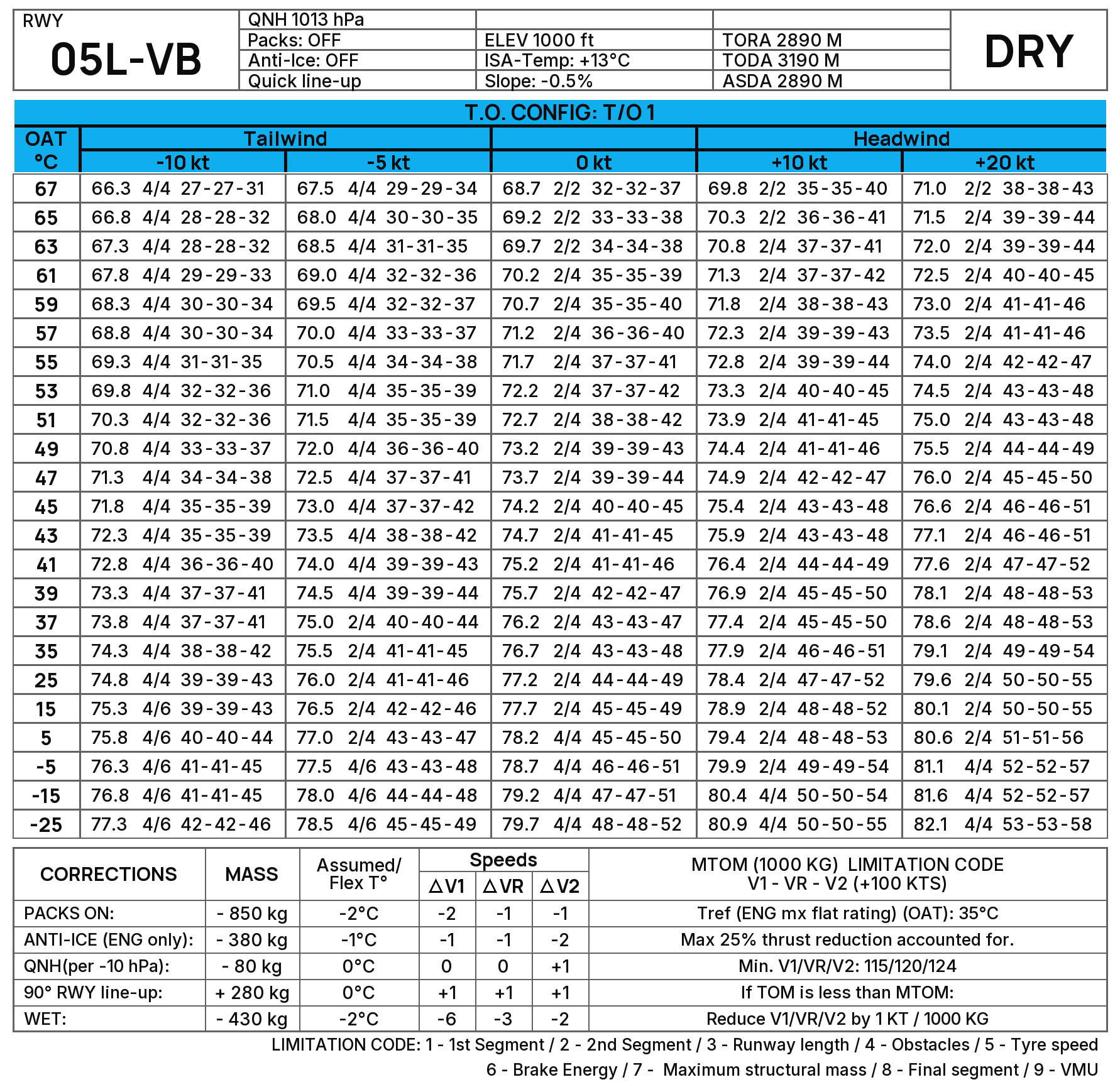
The annex shows a Regulated Take-Off Weight (RTOW) table for runway 05L from intersection VB. Using the data below, determine the appropriate assumed/FLEX temperature and V speeds. For this question do NOT interpolate; always choose the most conservative figures.
W/V: 050°/16 kt
OAT: +12°C
QNH: 1008 hPa
Runway: DRY
Anti-ice (ENG only): OFF
Packs: OFF
Line-up: Quick
Take-off mass: 71 480 kg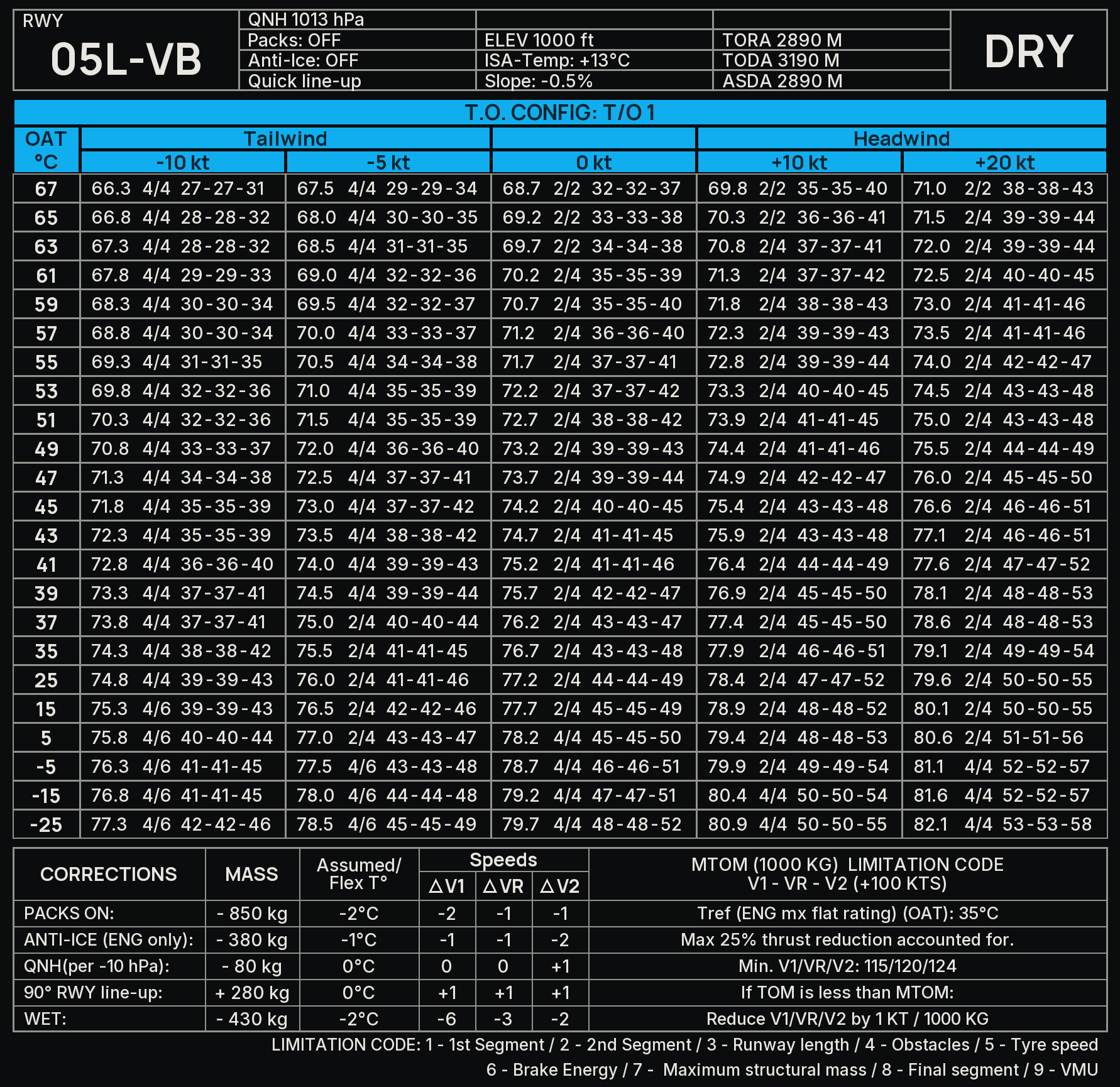
Show the answer
The answer
Answer C. 59° with 138 / 138 / 144 is right: 59°C is the warmest row whose mass, once corrected, is at least 71 480 kg, and the low QNH adds 1 kt to V2.
Step by step
- Wind 050°/16 kt on runway 05L is a 16 kt headwind; without interpolation take the lower column, +10 kt.
- QNH 1008 hPa is 5 hPa below 1013: count a full 10 hPa step, so take 80 kg off the limiting mass and add 1 kt to V2.
- In the +10 kt column, 61°C allows 71 300 − 80 = 71 220 kg, short of 71 480 kg; 59°C allows 71 800 − 80 = 71 720 kg, which is enough.
- The 59°C box reads 38-38-43, so 138 / 138 / 143 kt, and V2 becomes 144 kt with the QNH correction (the 240 kg margin is too small for the 1 kt per 1000 kg speed reduction).
Where to read it
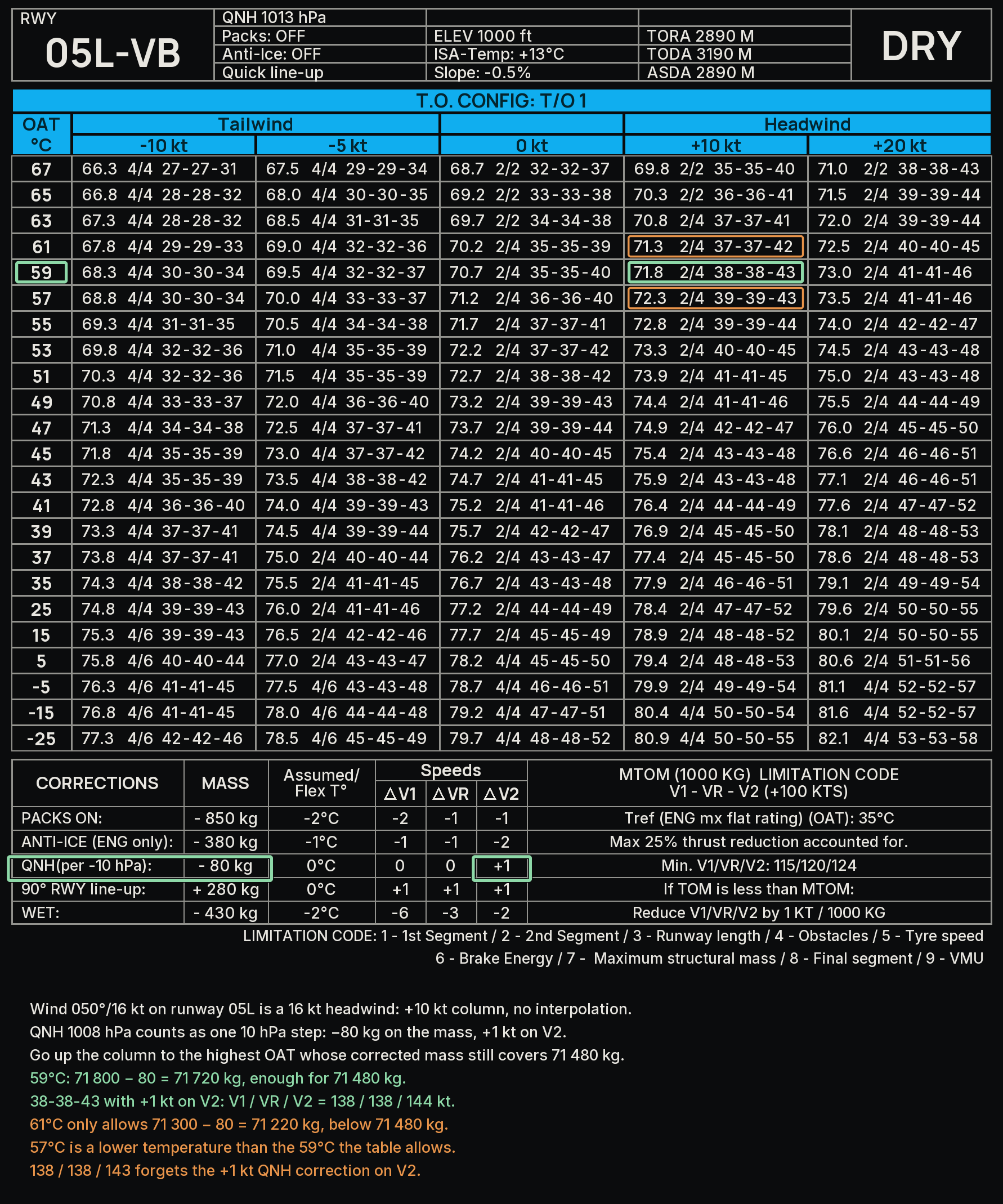
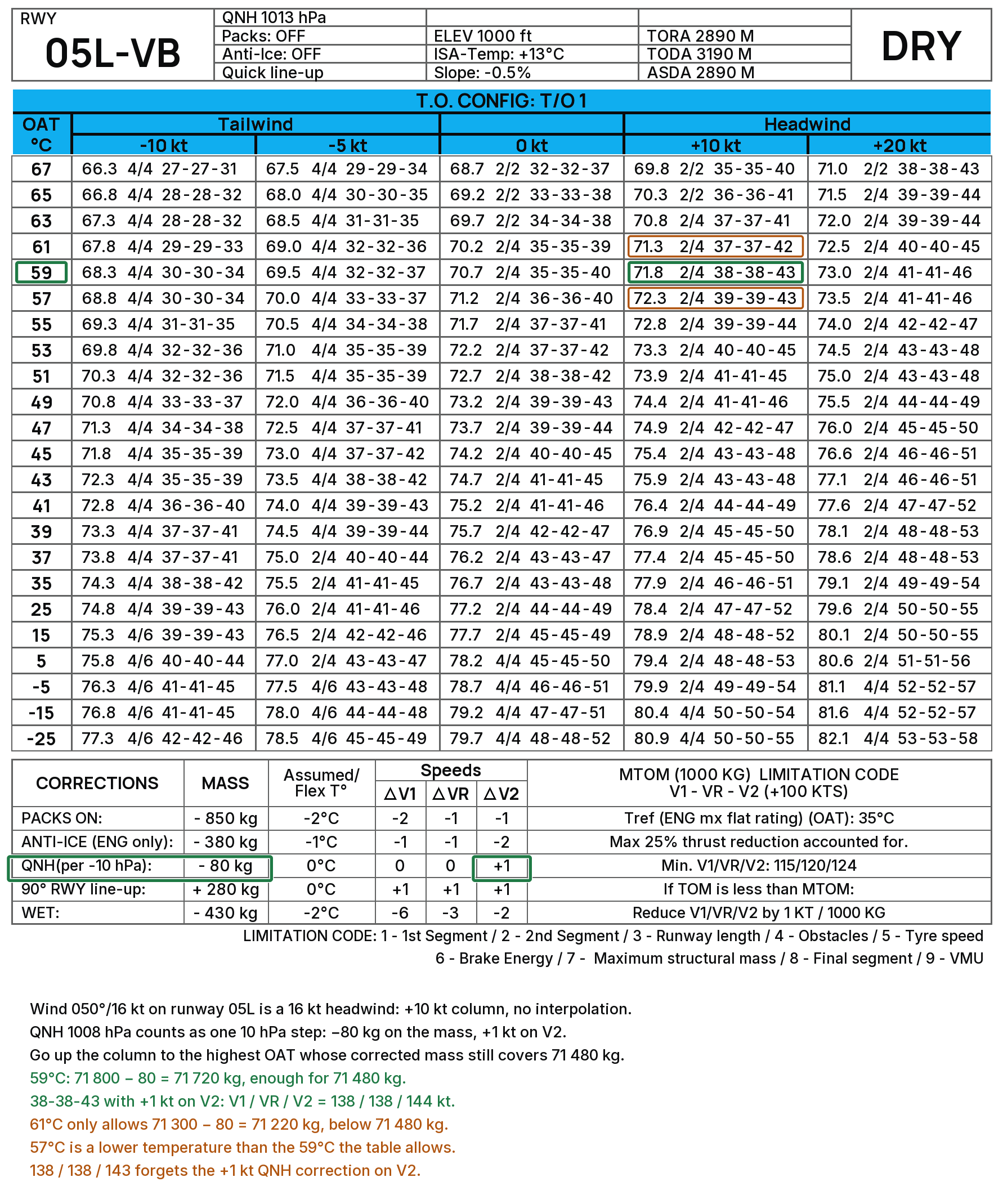
The trap. 59° with 138 / 138 / 143 forgets the +1 kt on V2 for the low QNH.
Remember it
Without interpolation, round every entry against yourself: headwind down to the lower column, a QNH deficit up to a full step. Then take the warmest row whose corrected mass still covers the take-off mass.
2Refer to the figure.
An aircraft suffers an engine failure at 36 000 ft with an all-up weight of 34 000 lb at the moment of failure. Find the time taken (I), the fuel used (II) and the distance travelled (III) to reach the stabilising height.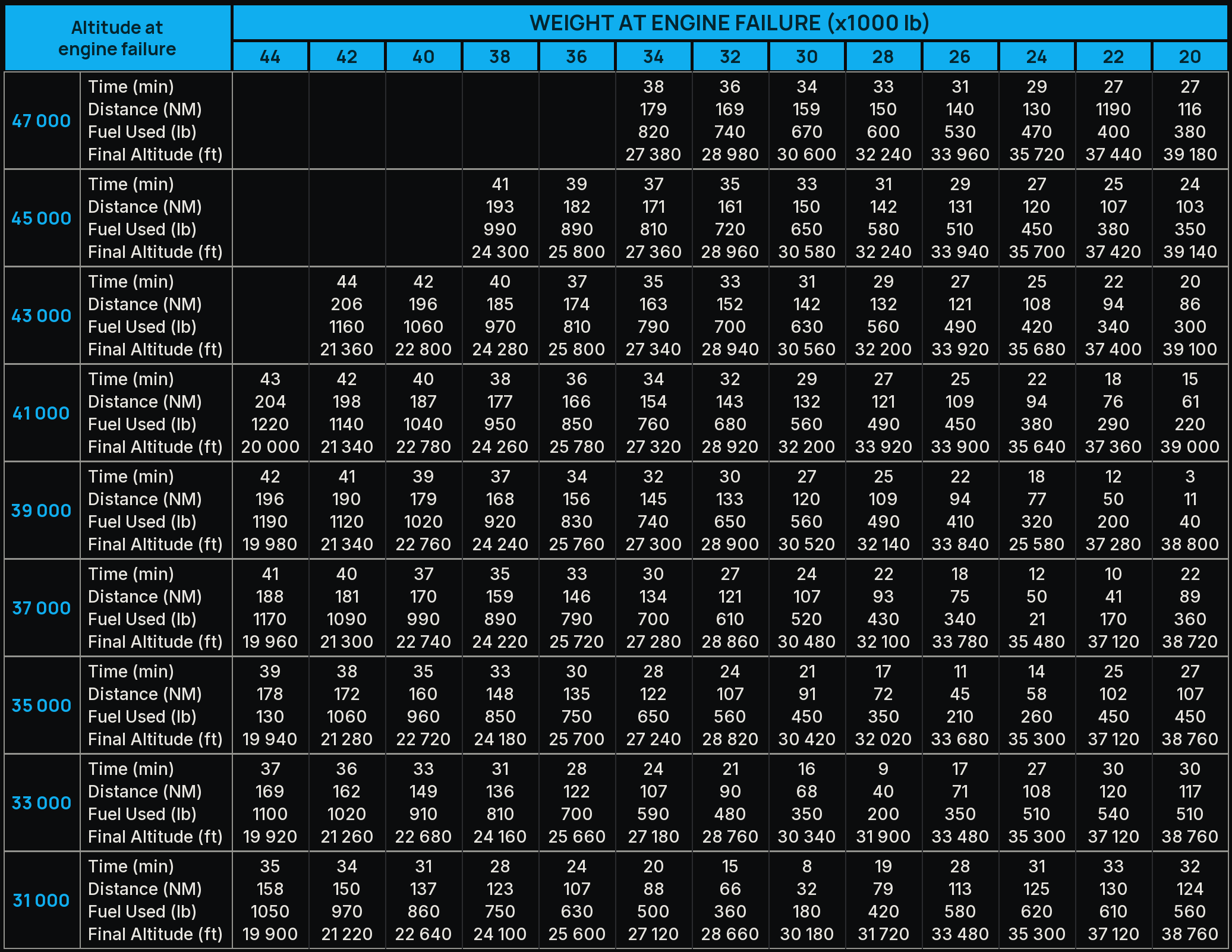
Show the answer
The answer
Answer A. 29 minutes, 675 lb and 128 NM are right: 36 000 ft lies halfway between the 35 000 ft and 37 000 ft rows, so each value is their average.
Step by step
- Use the 34 (×1000 lb) column; 36 000 ft has no row of its own, so take the 35 000 ft and 37 000 ft rows.
- 37 000 ft row: 30 min, 134 NM, 700 lb. 35 000 ft row: 28 min, 122 NM, 650 lb.
- Average each pair: (28 + 30) / 2 = 29 min, (650 + 700) / 2 = 675 lb, (122 + 134) / 2 = 128 NM.
Where to read it
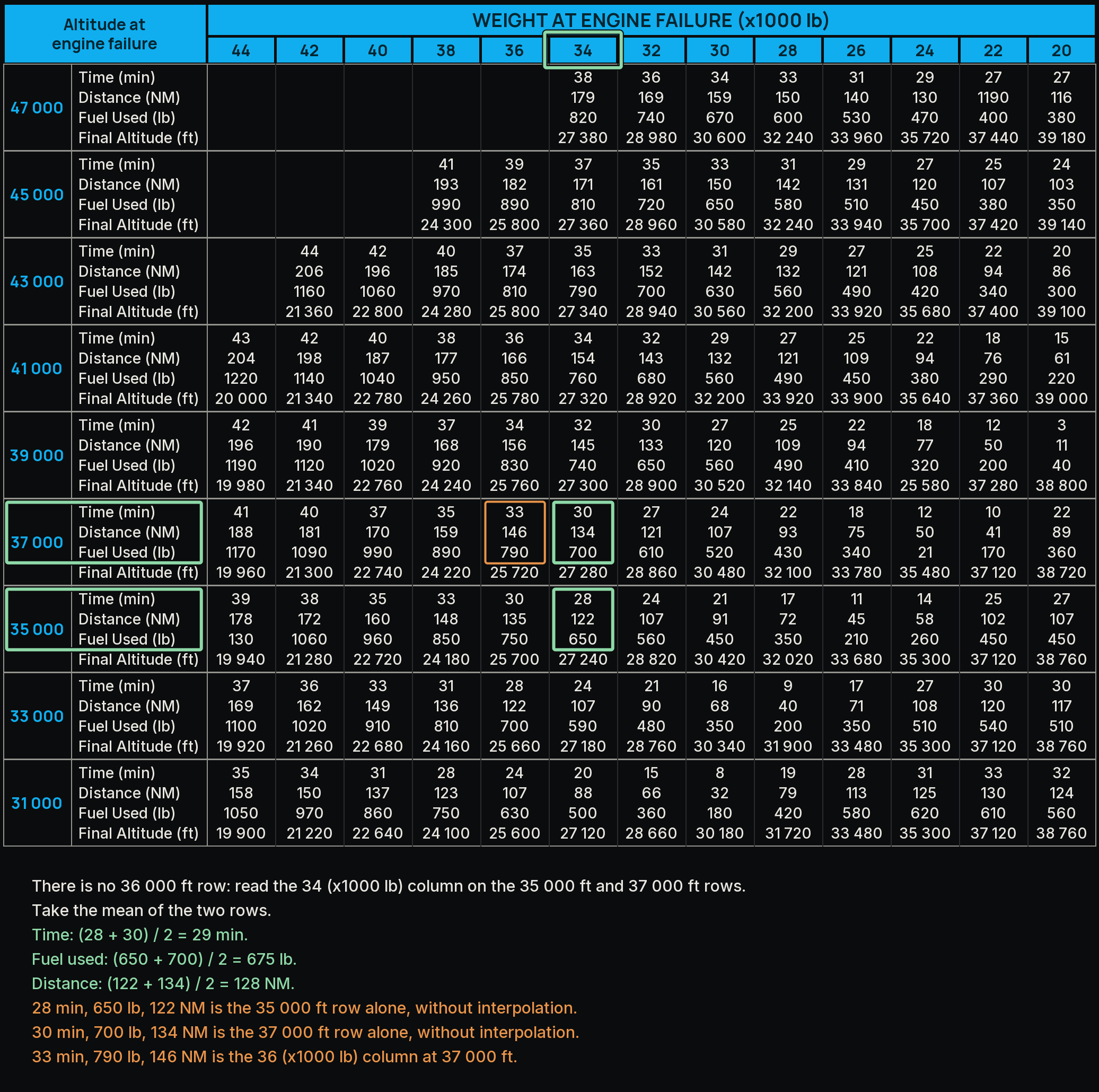
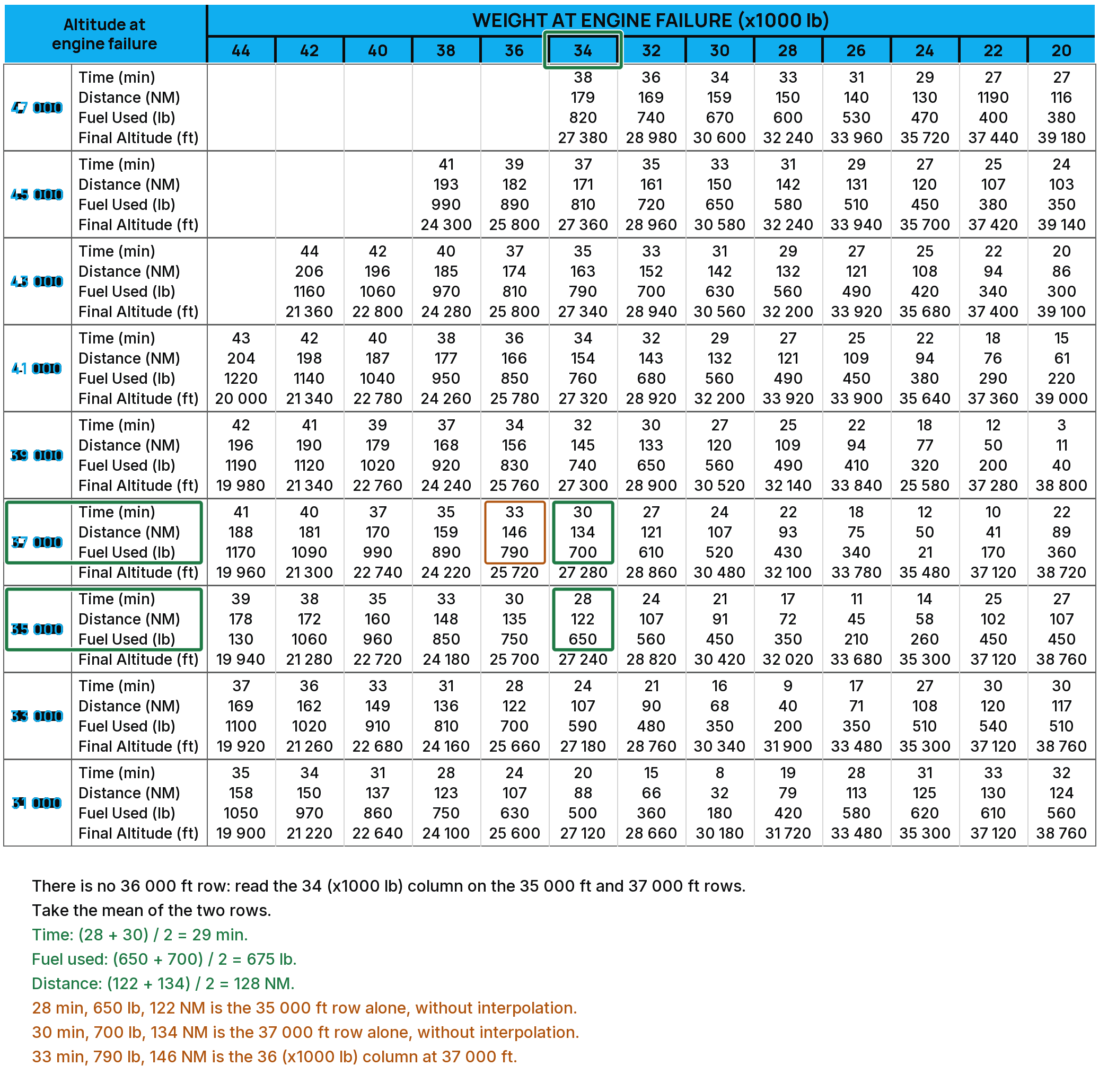
The trap. 28 minutes, 650 lb and 122 NM is the 35 000 ft row read without interpolation.
Remember it
A level exactly halfway between two rows needs no proportion: average the two rows. A right answer sits between them, never on one of them.
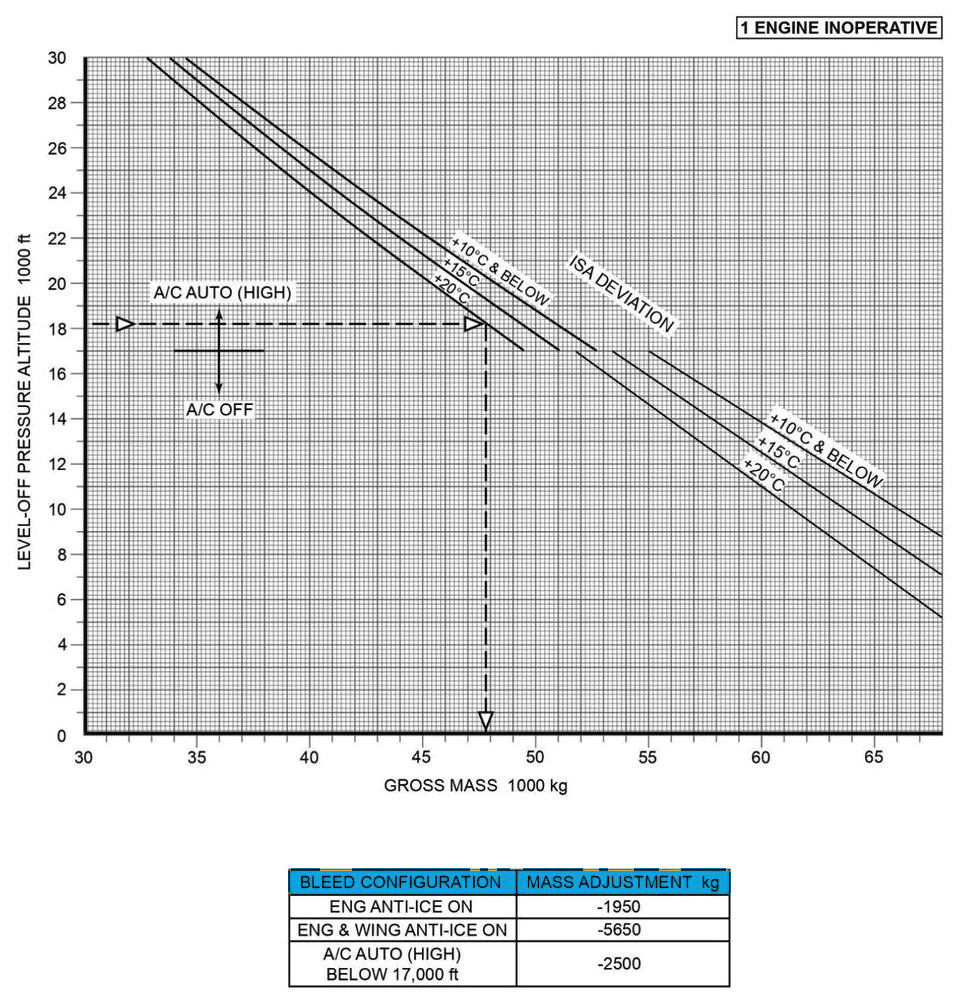
3Refer to the figure or CAP 698 file 4.23. The Medium Range Jet Transport aeroplane is planned to fly from Antalya to central Europe. The highest en-route MSA is 12 100 ft. With the conditions below and assuming net performance, what is the highest aircraft mass that can maintain the MSA after an engine failure?
OAT: ISA +14°C
Engine anti-ice: OFF
Wing anti-ice: OFF
A/C: AUTO (HIGH)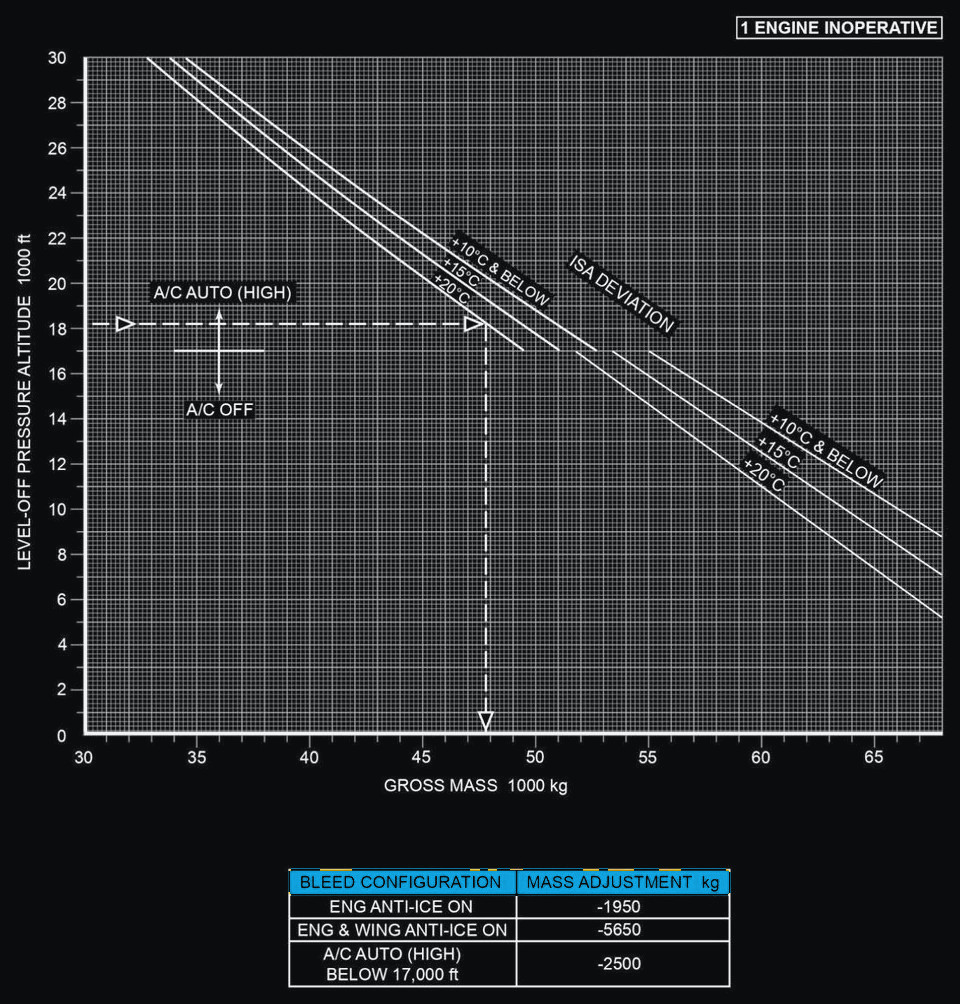
Show the answer
The answer
Answer A. 58 400 kg is right: the chart gives about 61 000 kg at 12 100 ft and ISA +14°C, and A/C on AUTO (HIGH) under 17 000 ft costs 2500 kg, which leaves about 58 500 kg.
Step by step
- 12 100 ft is under the 17 000 ft split, so read the bottom set of temperature lines.
- Across from 12 100 ft: the +15°C line meets about 60 600 kg and the +10°C & BELOW line about 62 700 kg.
- ISA +14°C sits one fifth of the way from the +15°C line to the +10°C line: 60 600 + 0.2 × 2100 = 61 020, about 61 000 kg.
- The bleed table charges 2500 kg for A/C on AUTO (HIGH) under 17 000 ft: 61 000 − 2500 = 58 500 kg; the nearest option is 58 400 kg.
Where to read it
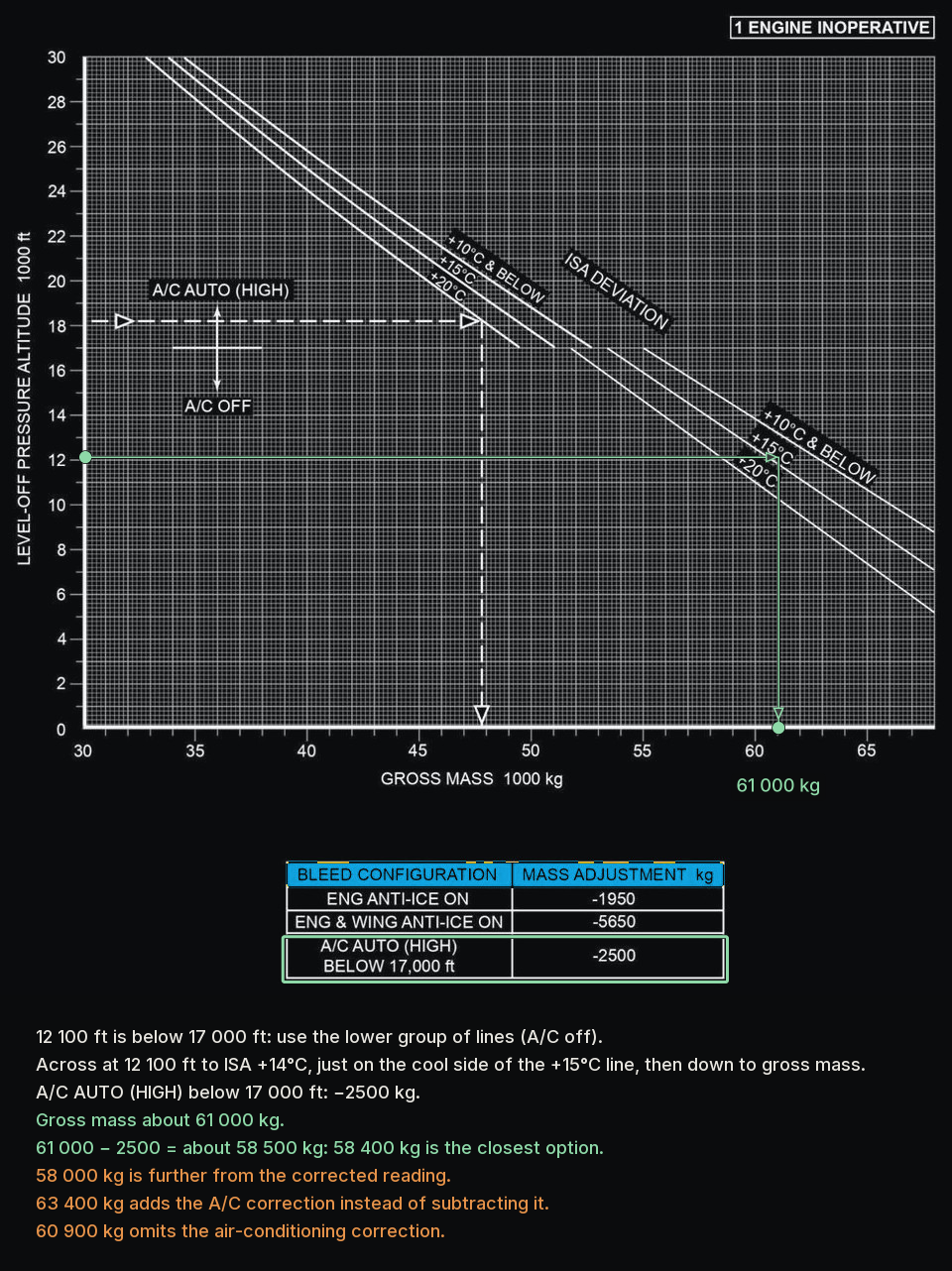
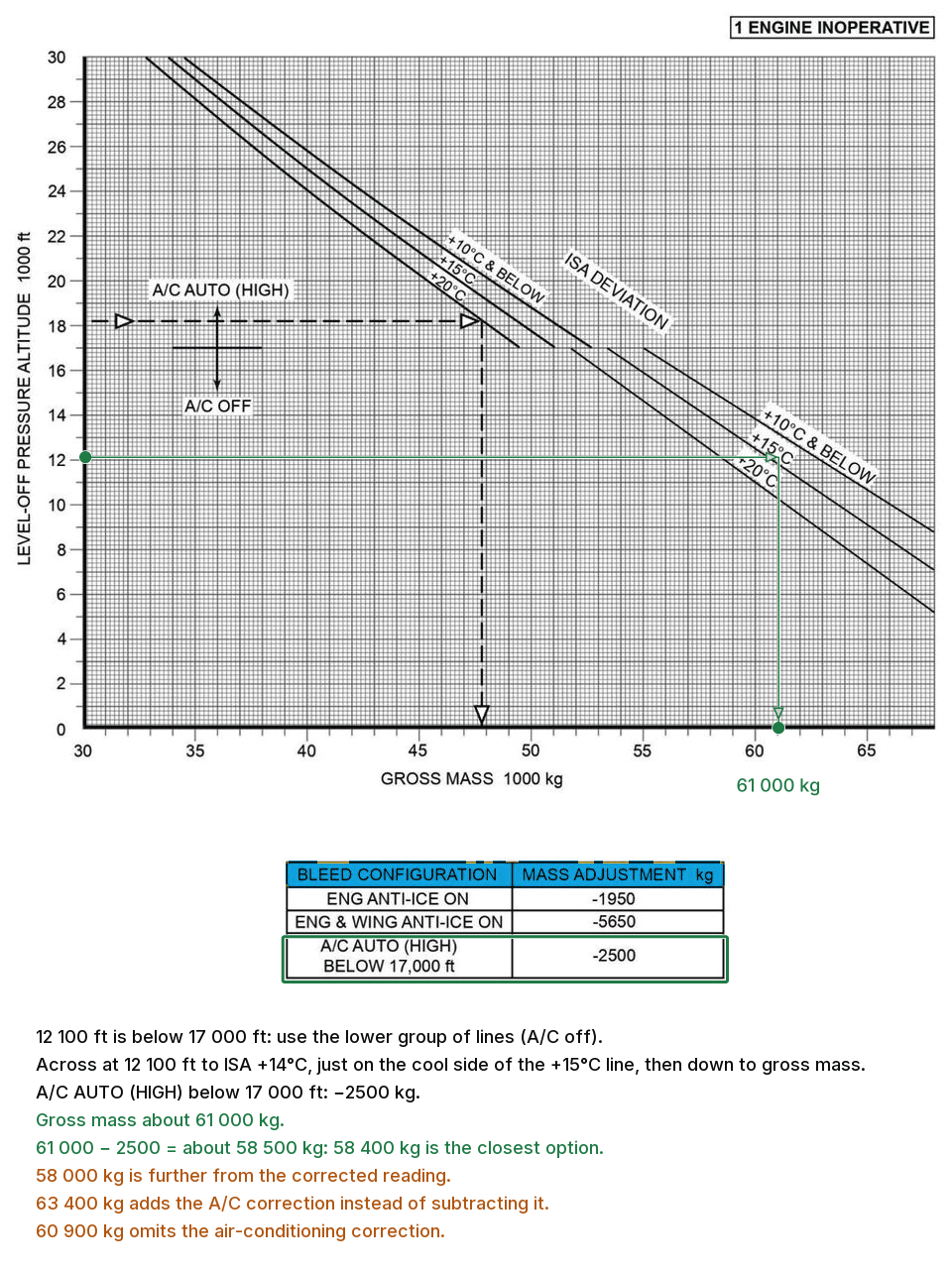
The trap. 60 900 kg leaves out the 2500 kg air-conditioning penalty, and 63 400 kg adds the 2500 kg rather than taking it off.
Remember it
Every bleed (A/C, anti-ice) costs thrust, so its correction always lowers the mass that can hold the altitude.
4Refer to the figure.
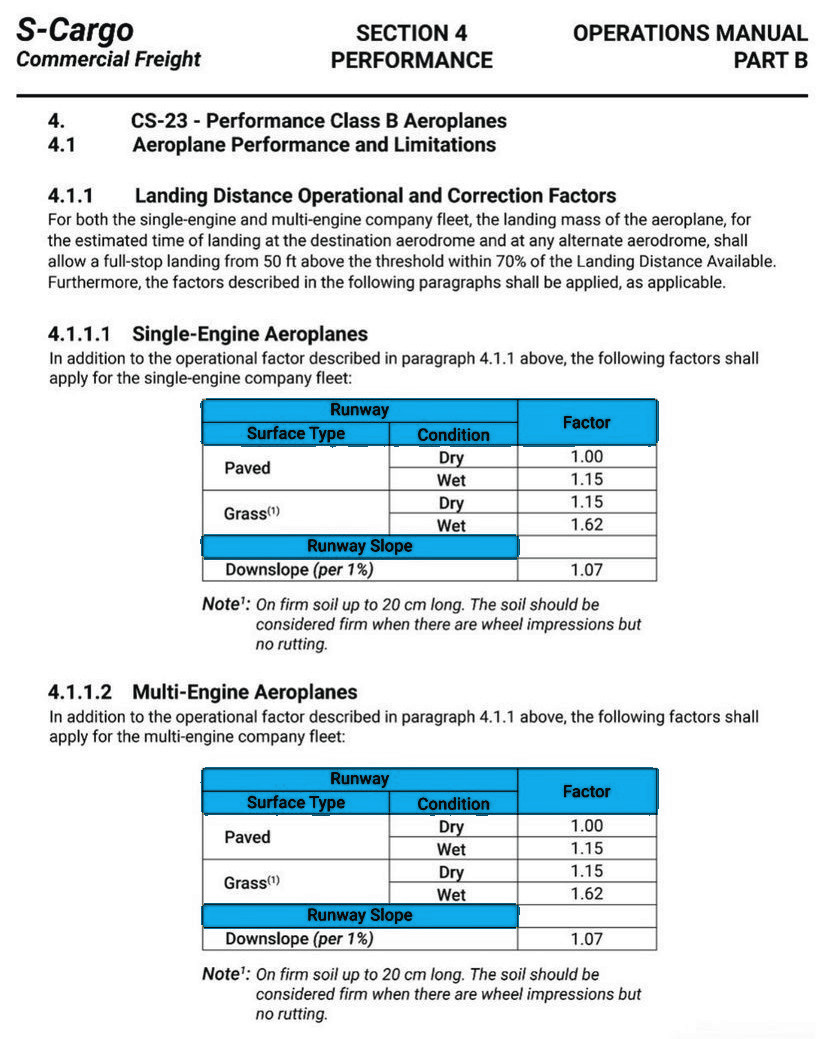
A pilot of the S-Cargo Airlines multi-engine fleet is working out landing performance. With the data below, which distance should be used to enter the landing distance graph to find the maximum permissible landing mass?
Landing distance available: 4230 ft
Runway surface: grass
Runway condition: dry
Runway slope: 1.5% upslope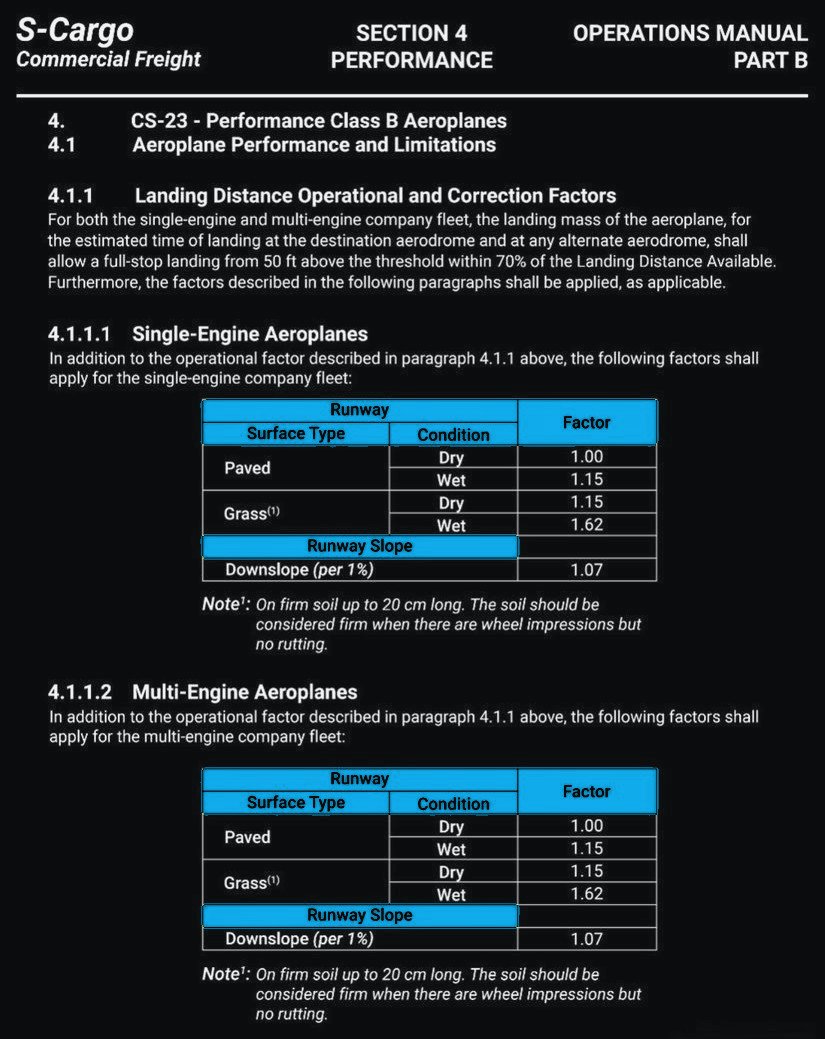
Show the answer
The answer
Answer C. 2575 ft is right: the landing must fit in 70% of the 4230 ft available, and dry grass adds a factor of 1.15.
Step by step
- Paragraph 4.1.1: a full stop within 70% of the LDA, so 4230 × 0.7 = 2961 ft.
- Table 4.1.1.2, multi-engine, grass, dry: factor 1.15, so 2961 / 1.15 = 2574.8 ft, rounded to 2575 ft.
- The table has a factor for downslope only, so the 1.5% upslope changes nothing: enter the graph with 2575 ft.
Where to read it
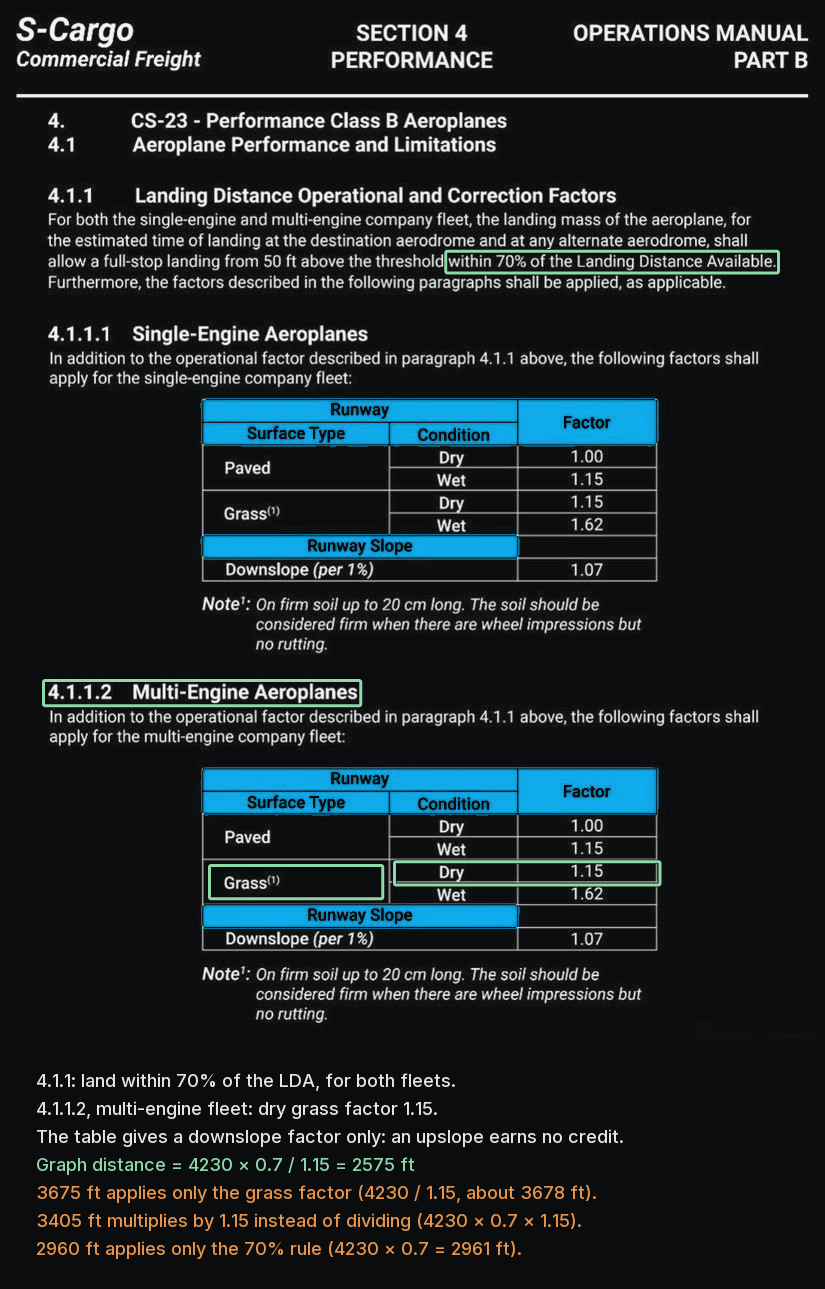
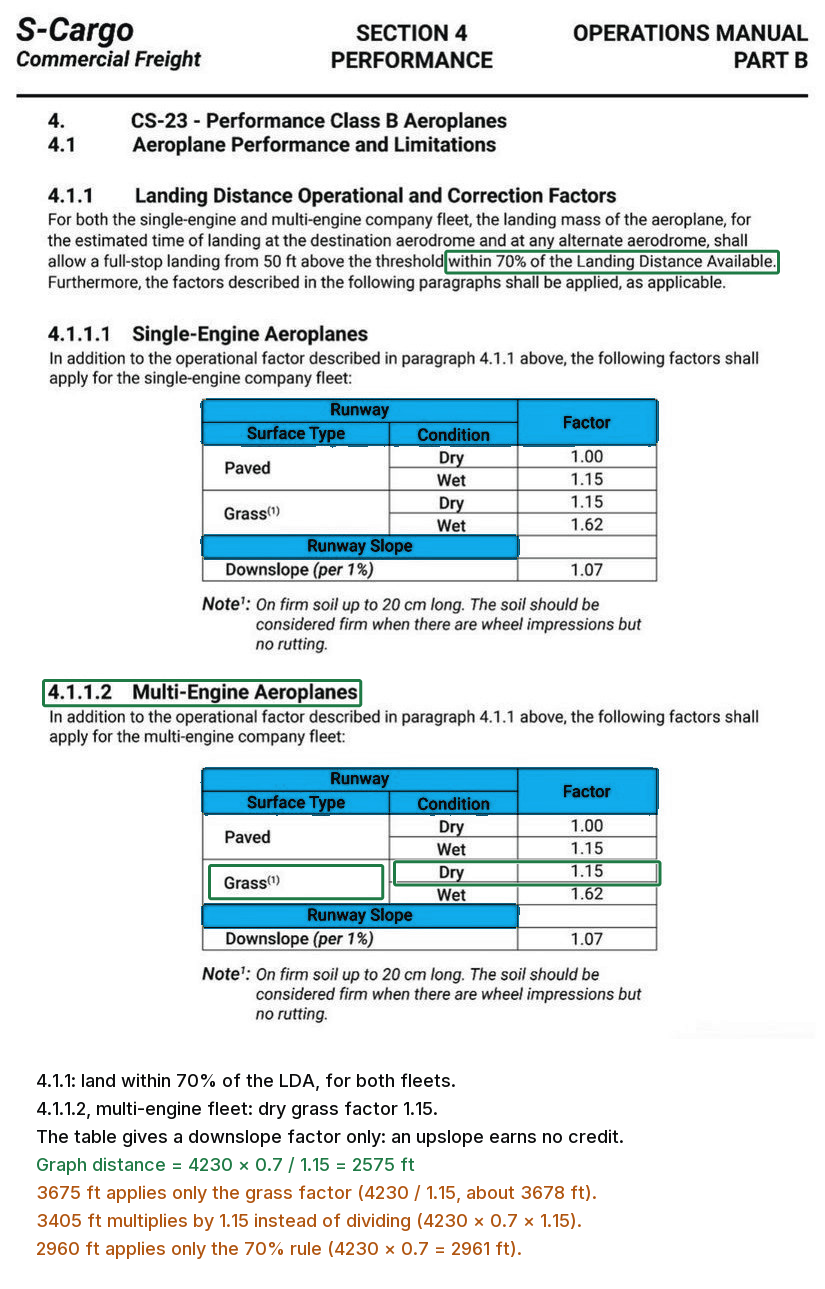
The trap. 2960 ft is 70% of 4230 ft (2961 ft) without the 1.15 factor for dry grass.
Remember it
From runway to graph, divide by each factor (the 70% rule is × 0.7); from graph to runway, multiply. Upslope shortens a landing, so only a downslope carries a factor.
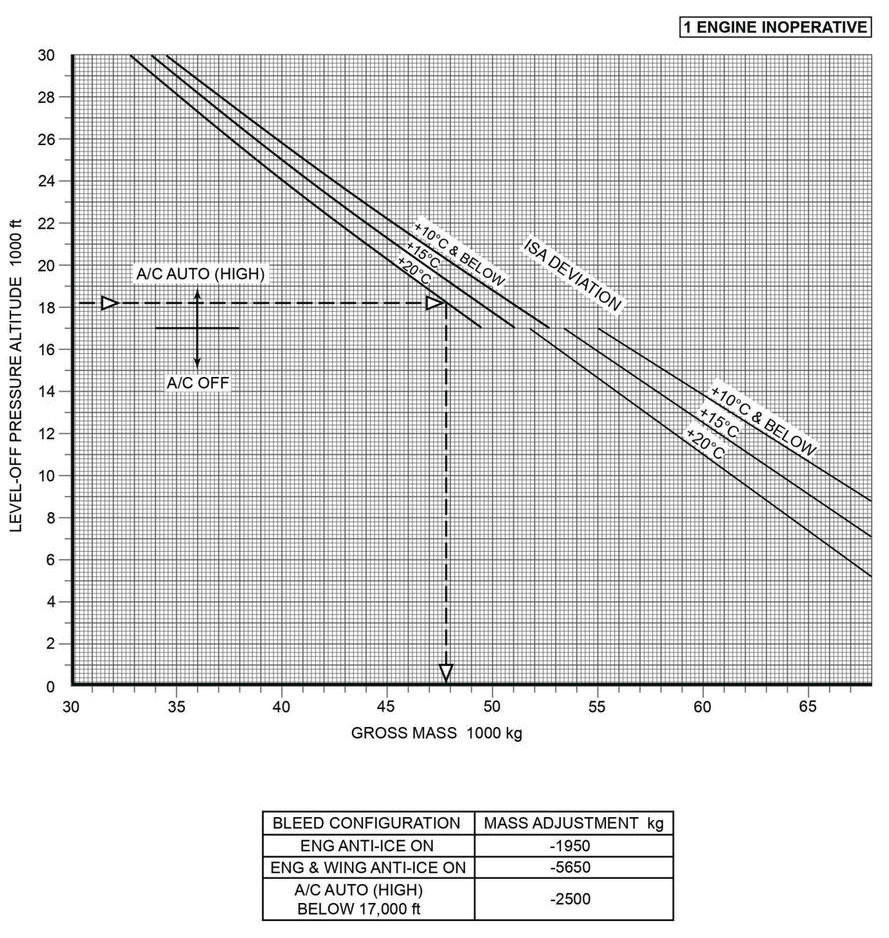
5Refer to the figure or CAP 698 file 4.23. With the information below, the pilot of a jet aeroplane must decide which en-route alternates are the most suitable diversion airports if an engine fails during the cruise.
Temperature: ISA +10°C or below
ANTI-ICE: ENG ANTI-ICE ON
Aircraft cruise mass: 43 000 kg
Required airport clearance:
Airport 1: 21 000 ft
Airport 2: 23 000 ft
Airport 3: 24 500 ft
Airport 4: 19 500 ft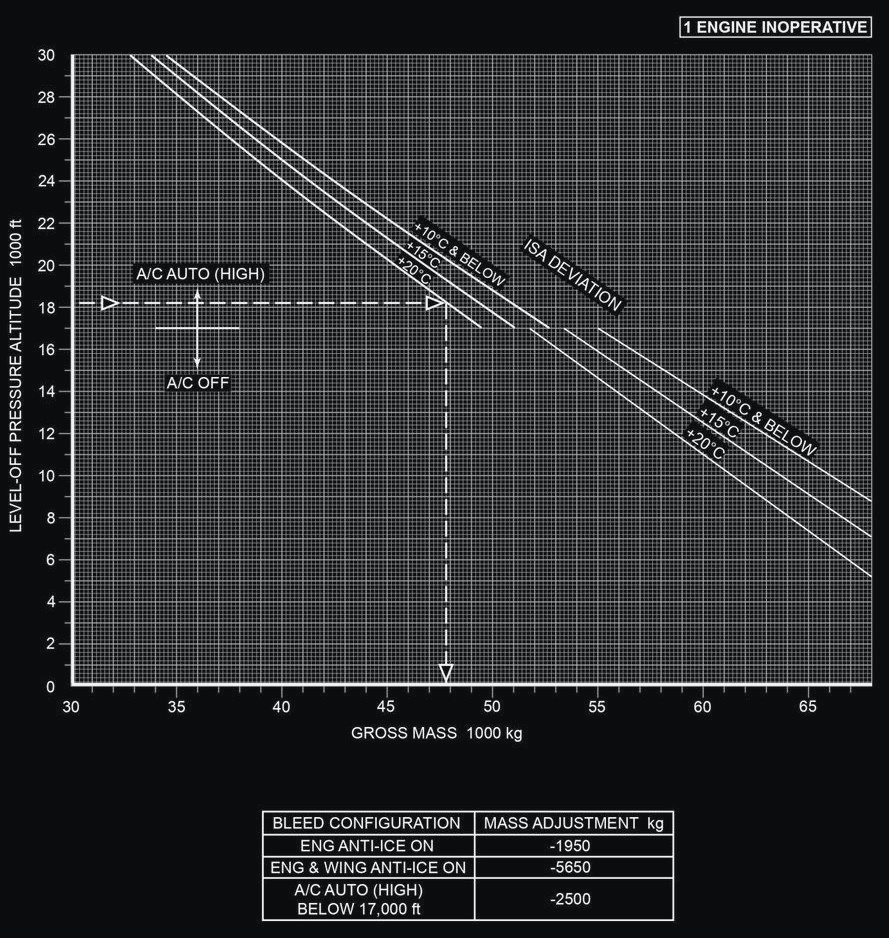
Show the answer
The answer
Answer B. Airports 1 and 4 are right: with engine anti-ice on, the aeroplane levels off at about 22 200 ft, above 21 000 ft and 19 500 ft but below 23 000 ft.
Step by step
- The table corrects a mass read from the chart; going the other way, from mass to altitude, reverse the sign: 43 000 + 1950 = 44 950 kg.
- Above 17 000 ft use the upper group, on the +10°C & BELOW line for ISA +10°C or below.
- Up from 44 950 kg to that line, then across to the altitude scale: about 22 200 ft.
- Airport 1 (21 000 ft) and Airport 4 (19 500 ft) lie below it; Airports 2 (23 000 ft) and 3 (24 500 ft) lie above.
Where to read it
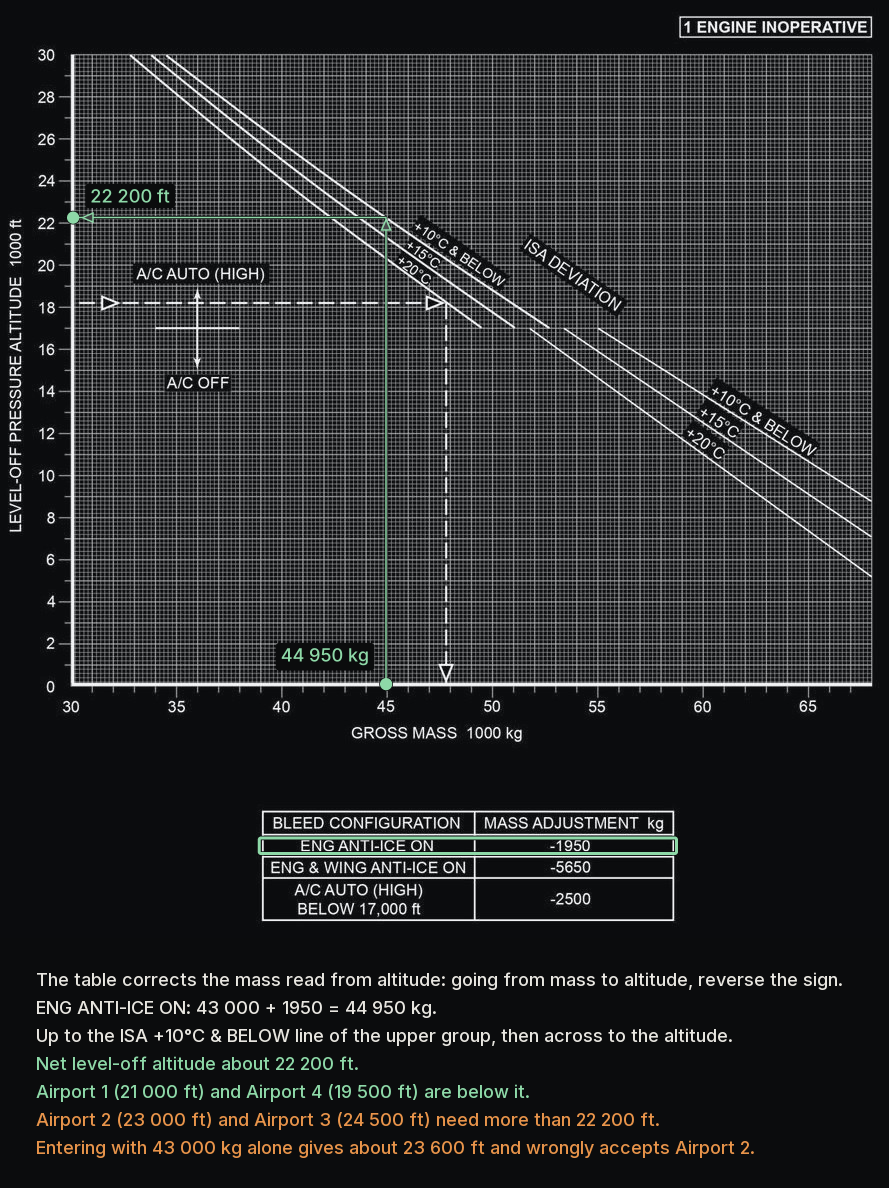
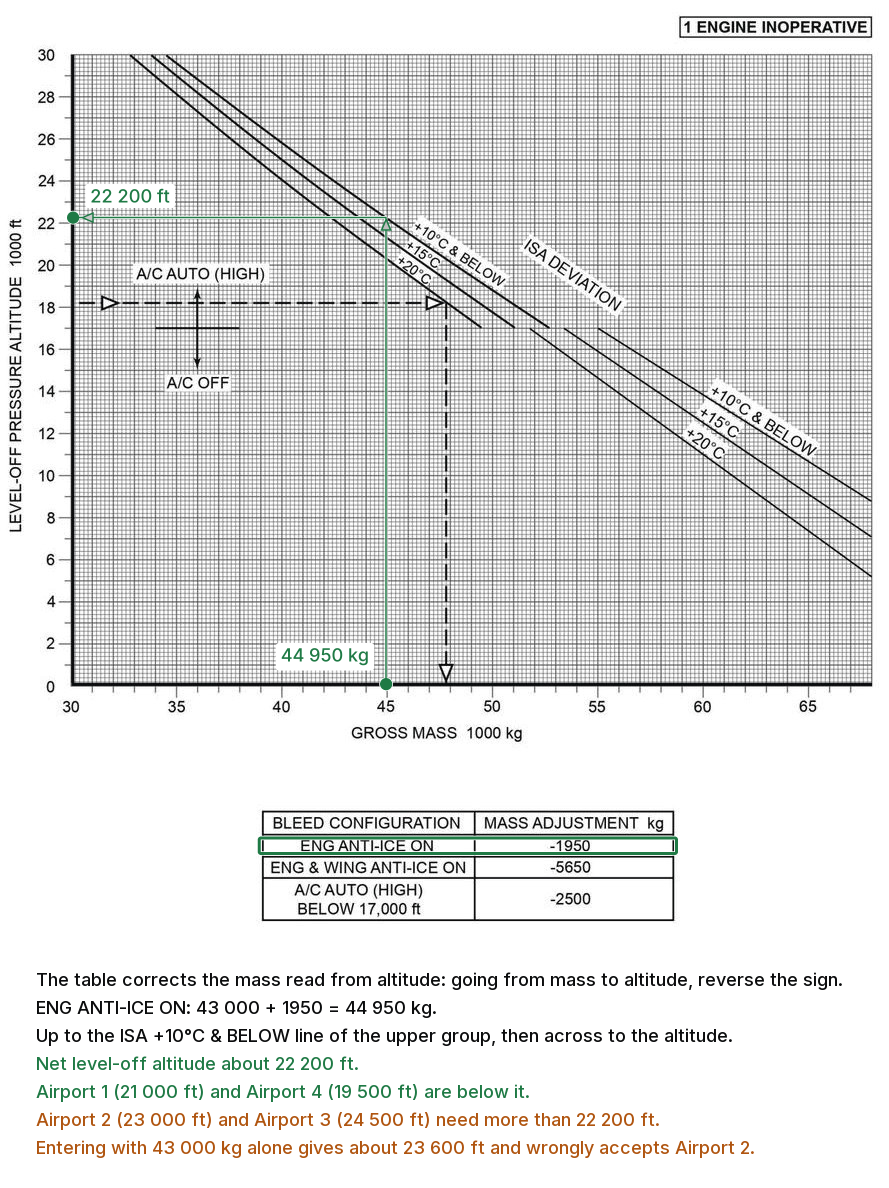
The trap. 1 and 2 comes from entering with 43 000 kg, without the anti-ice correction: about 23 600 ft, which wrongly keeps Airport 2.
Remember it
Anti-ice always costs: entering with the actual mass, make the aeroplane heavier by the correction, so the level-off altitude comes out lower.
6Determine the one-engine-out climb gradient of a four-engine aeroplane, given:
Aeroplane mass: 315 000 kg
Thrust per engine: 245 000 N
Drag: 435 000 N
(Assume the acceleration due to gravity is 10 m/s².)Show the answer
The answer
Answer A. 9.5% is right: with one engine out, the thrust of three engines minus the drag, divided by the weight, gives 0.095.
Step by step
- Thrust with one engine out: 3 × 245 000 = 735 000 N.
- Weight: 315 000 kg × 10 m/s² = 3 150 000 N.
- Gradient = (thrust − drag) / weight = (735 000 − 435 000) / 3 150 000 = 0.0952, so 9.5%.
The trap. 17.3% uses all four engines, (980 000 − 435 000) / 3 150 000: that is the all-engines gradient.
Remember it
Climb gradient = (thrust − drag) / weight: remove the dead engine's thrust, keep the drag, and turn kg into newtons (× g) before dividing.
7A Commercial Air Transport flight is planned in a single-engined piston aeroplane. At the most critical point of the route, a safe forced-landing area lies 10 NM away. Using the data below, what is the minimum altitude at which the aeroplane should cross this critical point?
Terrain elevation: 0 ft
Gross glide gradient: 10.2%
TAS: 130 kt
Expected headwind component: 10 kt
1 NM = 6080 ft
Ground distance = Still Air Distance x (GS / TAS)Show the answer
The answer
Answer D. 7046 ft is right: the 10.7% glide gradient applies to the still-air distance, which the 10 kt headwind stretches to 10.83 NM.
Step by step
- Single-engined en-route glide: gross gradient + 0.5%, so 10.2 + 0.5 = 10.7%.
- GS = 130 − 10 = 120 kt, so still-air distance = 10 × 130 / 120 = 10.83 NM (rounded to two decimals).
- In feet: 10.83 × 6080 = 65 846 ft.
- Height = 65 846 × 0.107 = 7045.6 ft, rounded to 7046 ft above the 0 ft terrain (without rounding, 10.833 NM gives 7048 ft, still closest to 7046 ft).
The trap. 6506 ft ignores the headwind and uses 10 NM as the still-air distance.
Remember it
A headwind stretches the glide through the air: still-air distance = ground distance × TAS / GS. Height = still-air distance in feet × the net gradient (gross + 0.5%).
8Using the data below, what is the distance from the end of the TODR to the point 1500 ft above reference zero, for the obstacle clearance of a performance class B aeroplane?
Cloud base: 300 ft above reference zero
TAS: 101 kt, no wind
All-engines rate of climb at take-off power: 1830 ft/min
Single-engine rate of climb at take-off power: 400 ft/minShow the answer
The answer
Answer C. 5.35 NM is right: a short all-engines climb to the 300 ft cloud base, then a single-engine climb to 1500 ft, both at 101 kt.
Step by step
- Up to the cloud base, use the all-engines rate factored by 0.77: 1830 × 0.77 = 1409 ft/min.
- From the 50 ft screen at the end of the TODR to 300 ft is 250 ft: 250 / 1409 = 0.177 min, and 0.177 × 101 / 60 = 0.30 NM.
- In cloud, assume the engine fails: 1500 − 300 = 1200 ft at 400 ft/min means 3 min, and 3 × 101 / 60 = 5.05 NM.
- Total: 0.30 + 5.05 = 5.35 NM.
The trap. 5.05 NM counts the single-engine climb but leaves out the first 0.30 NM below the cloud base.
Remember it
Split the climb at the cloud base: all engines below it (rate × 0.77), one engine above it. Distance in NM = minutes × TAS / 60.
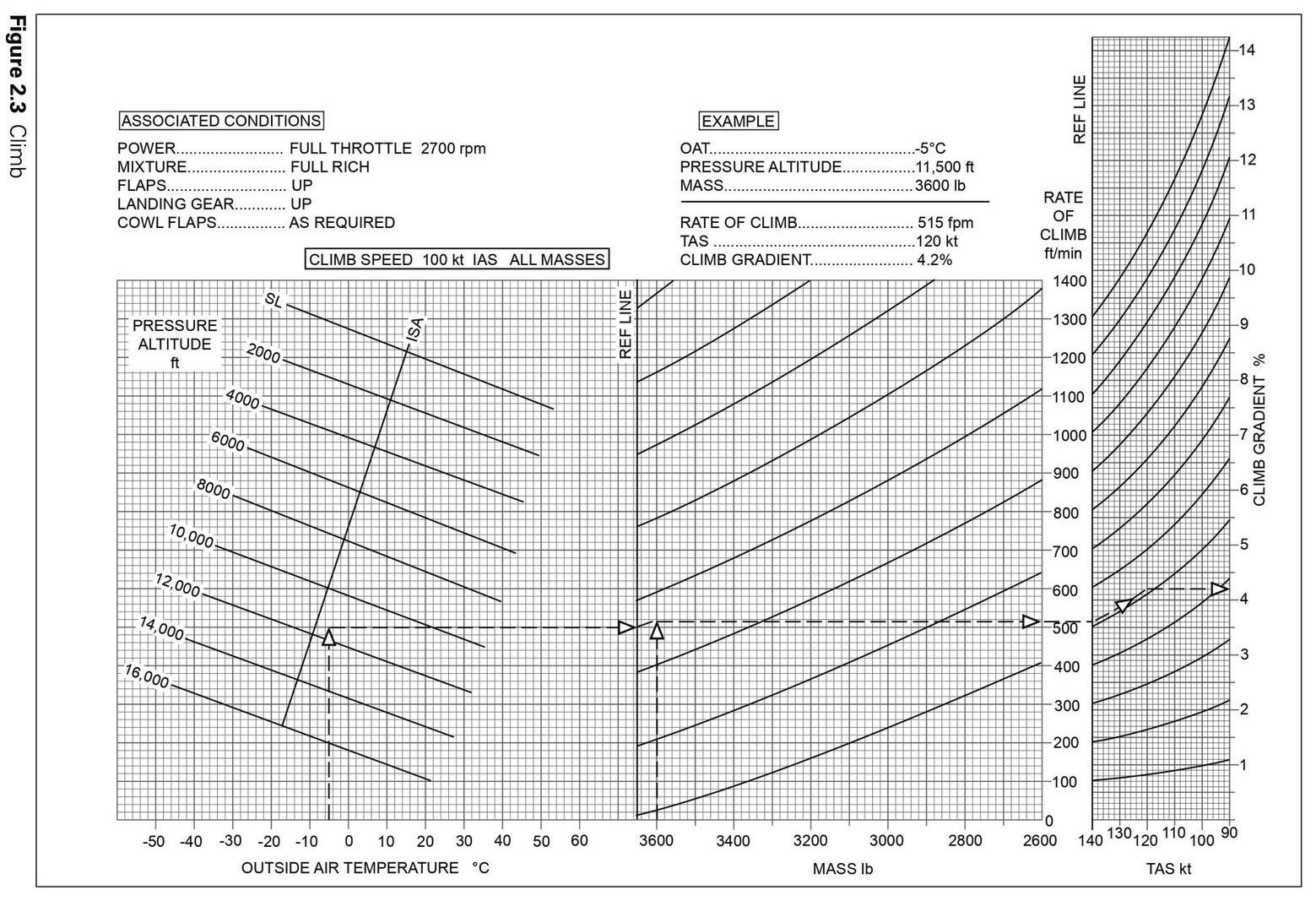
9Refer to the figure (CAP file 2.3). Using the data below, what is the rate of climb?
OAT: -10°C
PA: 6000 ft
TOM: 3200 lb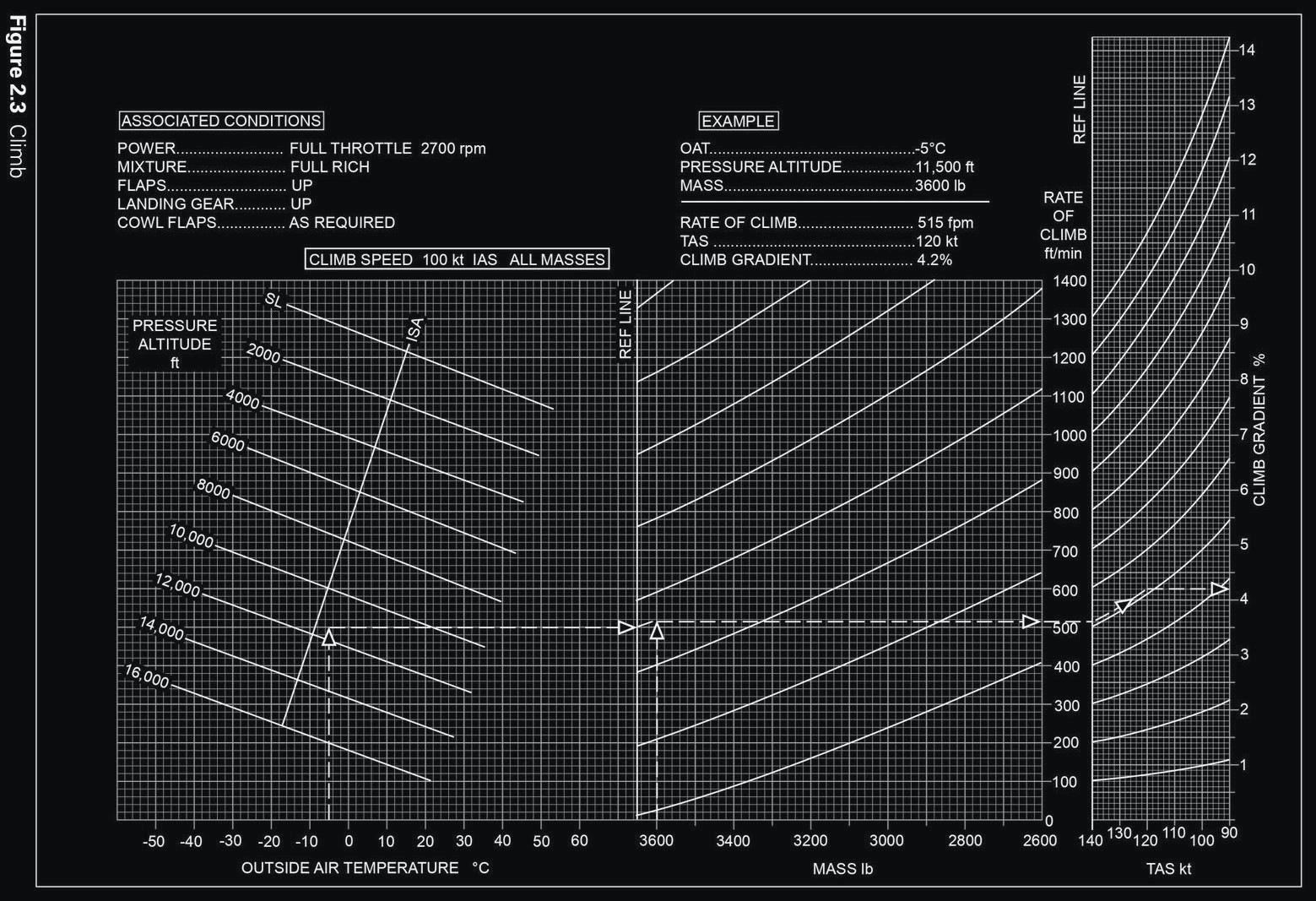
Show the answer
The answer
Answer A. 1140 ft/min is right: the chart gives about 900 ft/min at the reference mass, and the lighter 3200 lb aeroplane climbs faster.
Step by step
- Go up from −10°C to the 6000 ft pressure altitude line.
- Go across to the REF LINE: about 900 ft/min.
- Follow the guide lines from the REF LINE to 3200 lb on the mass scale.
- Read it off on the right-hand scale: about 1140 ft/min.
Where to read it
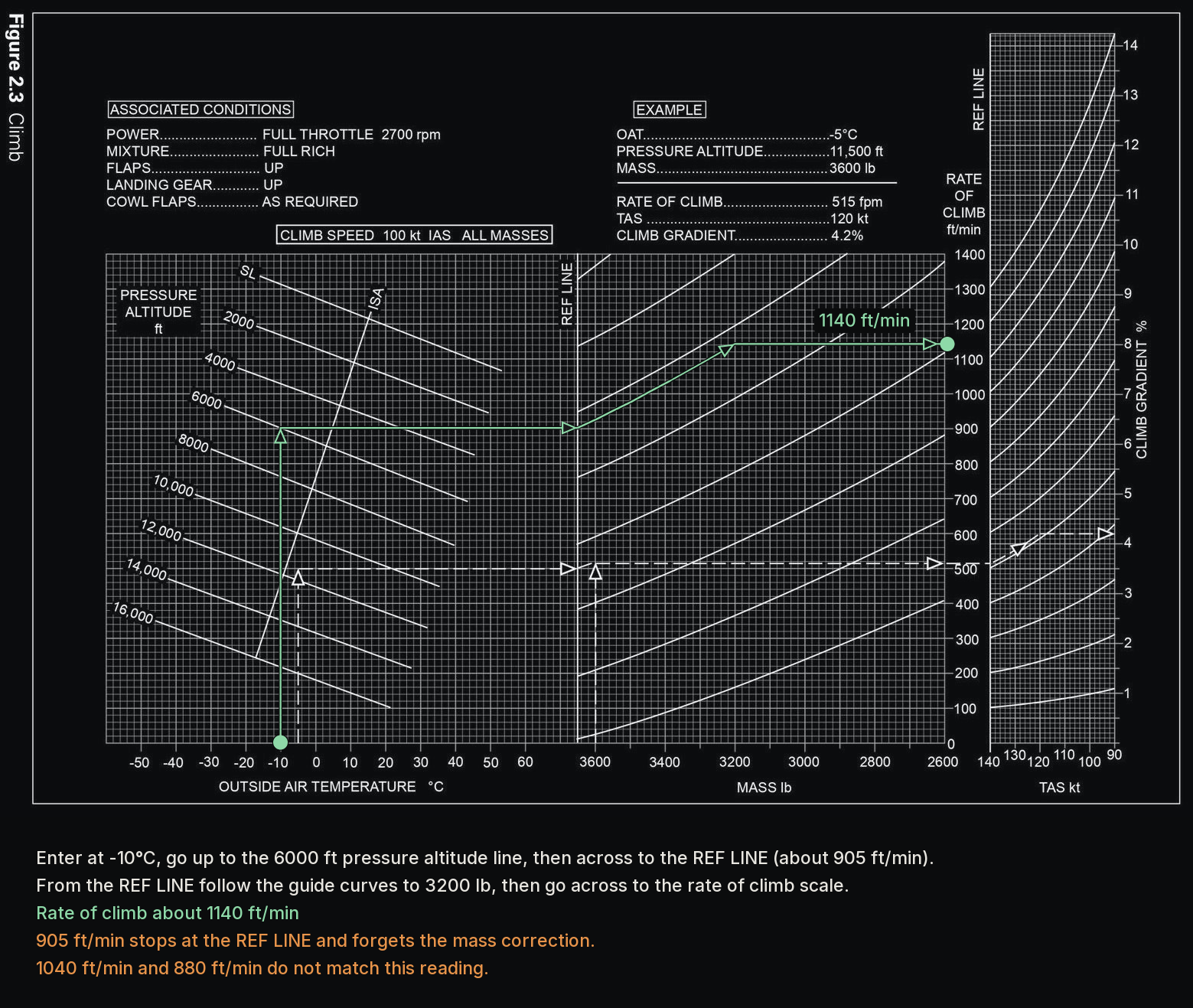
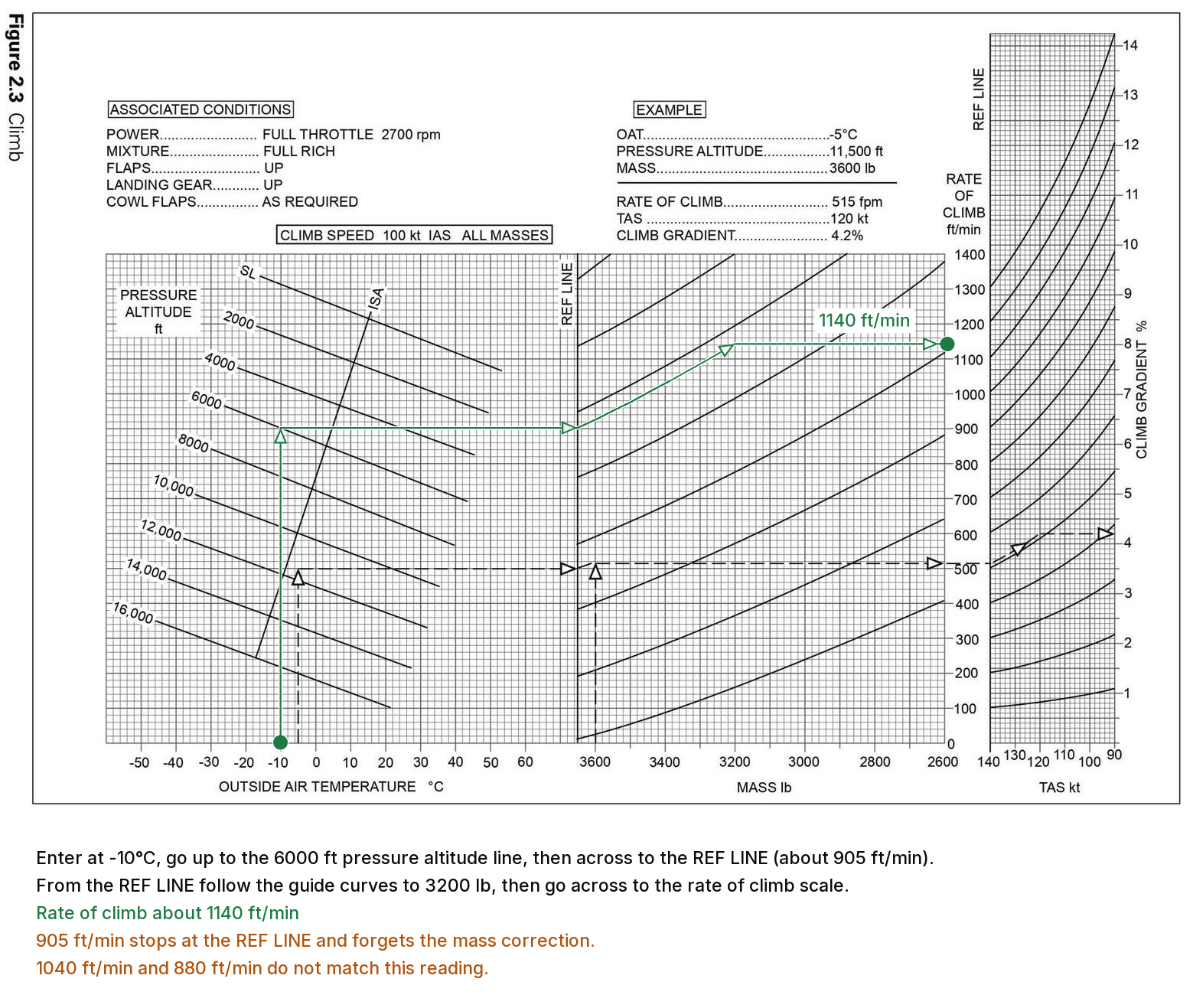
The trap. 905 ft/min stops at the REF LINE and leaves out the mass correction.
Remember it
Never stop at the REF LINE: follow the guide lines to the mass. A lighter aeroplane climbs better, so the rate must end above the REF LINE value.
10Determine the ASDA for runway 09, given:
TORA: 2300 m
Stopway: 280 m
Clearway: 480 mShow the answer
The answer
Answer D. 2580 m is right: the ASDA is the TORA plus the stopway, and a clearway does not count.
Step by step
- ASDA = TORA + stopway = 2300 + 280 = 2580 m.
- The 480 m clearway is an obstacle-free area for the climb, not a surface to stop on, so it stays out of the ASDA.
The trap. 2780 m is the TODA: it adds the clearway, which serves the climb-out, not the stop.
Remember it
Stopway for Stopping, Clearway for Climbing: ASDA = TORA + stopway, TODA = TORA + clearway.
You got 0 / 10 on the hardest questions.
The bank has 574 more questions in Performance, each with its explanation.
The 032 notes come with 1 month of its 584 questions.
The pack: the notes of all thirteen subjects, with 2 months of all 6,762 questions.
Revise it with the notes
Pay once, no subscription.
032 Performance
€7.90 once
+ 1 month of its questions
PDF and screen edition, yours for life.
Updates included for 1 year.All 13 subjects
€79 once
+ 2 months of all questions
The notes of every ATPL subject, PDF and screen edition, yours for life.
Updated