ATPL(A) 021 Airframe, Systems, PowerplantRevision notes and practice questions
The broadest subject in the syllabus.
It is not understood system by system, but through the question asked of each one: what happens when it fails?
- 50 pages
- 551 questions
- €19.90 once
What the 021 notes cover
Written on the EASA Learning Objectives.
Checked against the primary texts.
An A4 PDF and a screen edition.
- Part 1021 01
Design, loads and maintenance
System design · Loads and stresses · Fatigue · Maintenance
- Part 2021 02
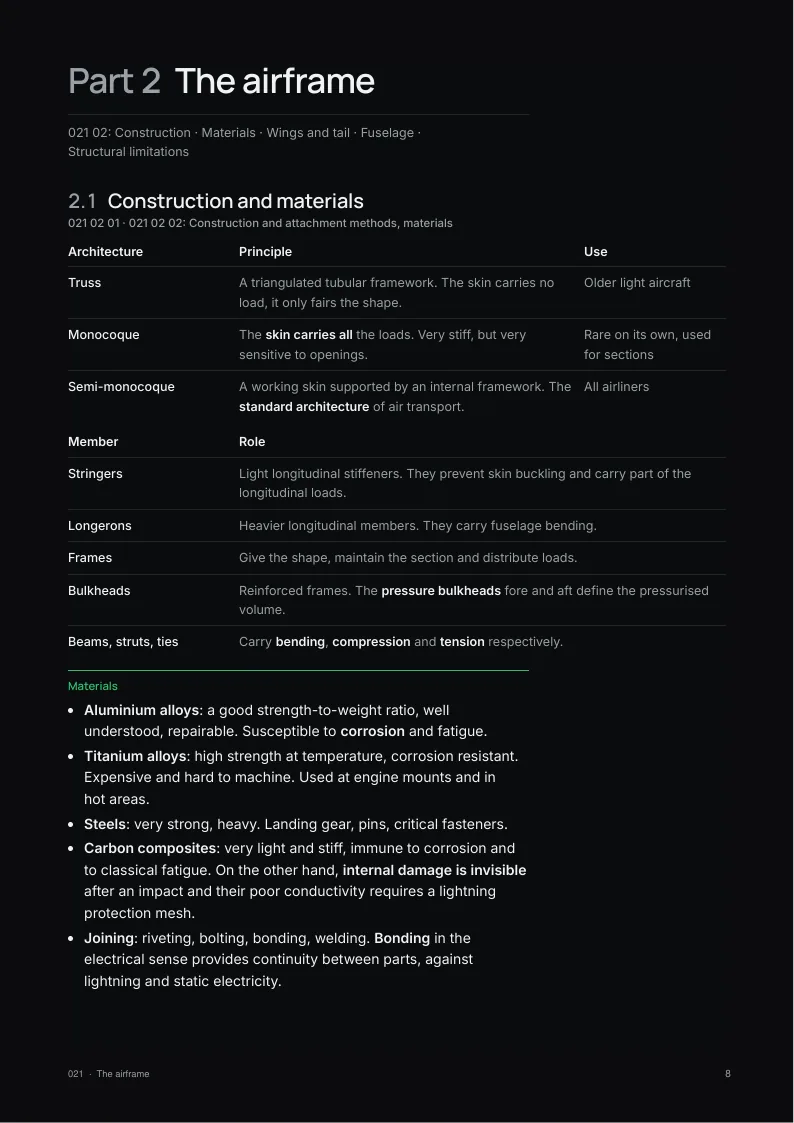
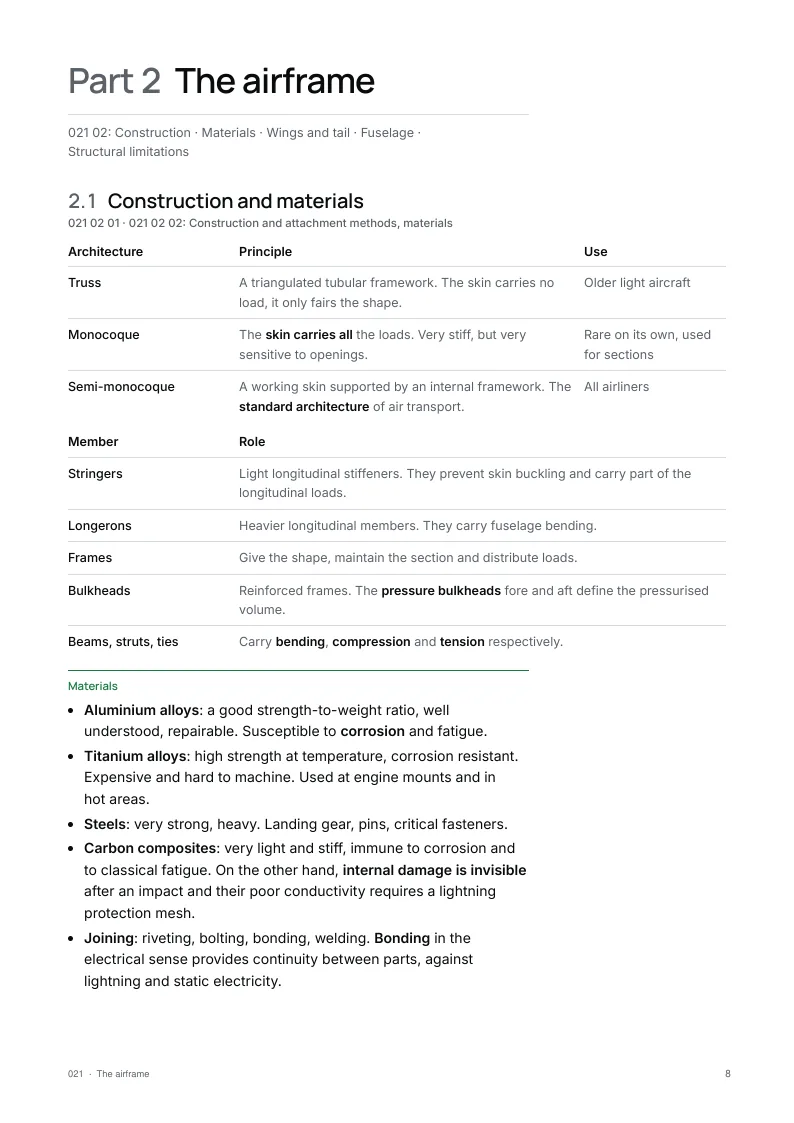
The airframe
Construction · Materials · Wings and tail · Fuselage · Structural limitations
- Part 3021 03 · 021 04
Hydraulics, landing gear and brakes
Hydraulic principles · Systems · Landing gear · Brakes · Wheels and tyres
- Part 4021 05
Flight controls
Primary controls · Trim · Secondary controls · Fly-by-wire
- Part 5021 06
Air, conditioning and pressurisation
Bleed air supply · Air conditioning · Pressurisation
- Part 6021 07 · 021 12 03
Ice and rain protection
Anti-icing and de-icing · Detection · Rain protection
- Part 7021 08
The fuel system
Tanks · Pumps · Distribution · Refuelling · Jettisoning
- Part 8021 09
Electrics
Fundamentals, batteries, DC and AC generation, distribution, protection and electrical motors.
- Part 9021 10
Piston engines and propellers
Cycle and construction · Fuel and ignition · Lubrication · Supercharging · Propellers
- Part 10021 11
Gas turbines
Principles · Compressors · Combustion and turbines · Ancillaries · Operation · APU
- Part 11021 12 · 021 13
Protection, detection and oxygen
Smoke and fire detection, extinguishing, rain protection and oxygen systems. Followed by the appendices.
Exam traps in 021 Airframe, Systems, Powerplant
A sample from Appendix B.
The full list is in the notes.
Exam trap
- Believing VA increases as mass decreases: it is the reverse.
- Confusing limit load and ultimate load: the first permits no permanent deformation, the second does.
- Getting the direction of the trim tab wrong: it moves opposite to the control surface.
- Forgetting that buckling occurs well below the material's compressive strength.
- Forgetting that ground spoilers determine braking effectiveness.
- Believing a PTU transfers fluid: it transfers only energy.
The EASA 021 paper: 80 questions in 2 h. The exam rules →
Ten free 021 Airframe, Systems, Powerplant questions
No account needed.
Pick an answer and the explanation opens.
The notes come with 1 month of all 551 questions and the mock exams.
1A turbofan has an inlet mass flow of 400 kg/s and an HP compressor mass flow of 80 kg/s. What is its bypass ratio?
Show the answer
Answer A. The bypass ratio is the bypass mass flow divided by the core mass flow. All the air entering the HP compressor goes through the core: 80 kg/s. Bypass flow = 400 − 80 = 320 kg/s, so the ratio is 320 / 80 = 4. Dividing the total inlet flow by the core flow (400 / 80 = 5) is the common trap.
2A jet operator's home base is close to the sea coast. The operator has issued a directive to wash the undercarriage and fit engine covers after every flight back to base, although the aircraft maintenance manual (AMM) contains no such procedure. Which statement is correct?
Show the answer
Answer A. Salt-laden sea air leaves chloride deposits on the airframe, and the landing gear and engine intakes are among the most exposed areas. Washing the gear after each flight and fitting covers limits the build-up of salt and moisture, so the operator is simply adding preventive measures suited to its environment. The AMM sets a minimum standard: the absence of a procedure in the manual does not forbid an operator from doing more.
3Light aircraft and helicopters may be fitted with a "blowdown" emergency gear extension system for use after a hydraulic failure. Which gases are used, and how do they reach the actuators?
Show the answer
Answer C. A blowdown system stores nitrogen or compressed air in a bottle. When the pilot releases it, the gas passes through a shuttle valve that moves across, isolating the failed normal hydraulic line and sending the emergency pressure into the same gear actuators. No separate parallel actuators are needed, and helium or CO2 are not used for this purpose.
4On which of the following principles do aircraft ice detectors operate?
1. Vibration
2. Sound detection
3. Pressure
4. TactileShow the answer
Answer A. The common ice detectors use vibration or pressure. The vibrating-probe type senses the drop in resonant frequency caused by the mass of ice on its rod, while the differential-pressure type compares pressures from small holes that become blocked by ice. Neither sound detection nor a tactile principle is used for ice detection.
5Under CS-25 for aeroplanes and CS-29 for helicopters, what does the term unusable fuel mean?
Show the answer
Answer A. Unusable fuel is the quantity that cannot be delivered to the engines under the most adverse feeding conditions, because the pump inlets are not at the very lowest point of the tank. It is a fixed amount set by the design and included in the basic empty mass. It is not shown as usable on the gauges, since indicating it would mislead the crew about the fuel actually available.
6Which of the following statements about DC electric motors are correct?
1. If a motor seizes, the applied EMF is equal to the back EMF
2. If a motor seizes, the applied EMF is equal to the net EMF
3. If a motor runs away, the applied EMF is equal to the back EMF
4. If a motor runs away, the back EMF is equal to the net EMFShow the answer
Answer A. The armature sees a net EMF equal to the applied EMF minus the back EMF, and the back EMF is proportional to rotor speed. When the rotor seizes, speed and back EMF fall to zero, so the whole applied EMF becomes net EMF and the current surges (2). In a runaway the speed rises until the back EMF approaches the applied EMF, leaving almost no net EMF (3).
7The engine lubrication system is slowly losing oil. Which indications can be expected as a result?
Show the answer
Answer A. With less oil in circulation the pump can no longer maintain a steady supply, so the pressure drops and fluctuates as air is drawn in. The smaller quantity of oil also removes less heat from the engine, so the oil temperature rises. The tempting option with low pressure and low temperature gets the temperature trend wrong.
8On a FADEC-controlled gas turbine engine, what happens if a single input data item fails?
Show the answer
Answer B. FADEC inputs are duplicated: each critical parameter is measured by dual sensors and cross-checked between the two channels. If one input fails, the system uses the valid source from the other sensor or channel and the engine keeps running normally, usually with only a maintenance message. Fail-safe or default-value modes are only used when no valid source remains, not after a single failure.
9During the test sequence of the fire detection system, the "TEST" light does not illuminate and the pilot has no other visual confirmation. Assuming the indicator light itself is serviceable, which statement is correct?
Show the answer
Answer A. The test switch simulates a fire and checks the continuity of the detection circuit, so a serviceable system must show its light during the test. If the lamp is known to be good and it stays off, the circuit is not being completed, typically because of a broken wire between detectors. A missing test indication is never normal, and an aural warning alone does not prove the whole loop is intact.
10What are the basic functions of a smoke hood?
Show the answer
Answer B. A smoke hood (protective breathing equipment) is pulled over the whole head. It supplies breathable oxygen from its own chemical source and shields the eyes and airways from smoke and toxic gases while a crew member fights a fire. It is not a fire blanket, does not protect the body, and gives no protection against flames.
Keep practising.
The 021 notes come with 1 month of its 551 questions.
The pack: the notes of all thirteen subjects, with 2 months of all 6,295 questions.
Get 021 Airframe, Systems, Powerplant
Pay once, no subscription.
Practise longer with its question bank.
The notes
€19.90 once
+ 1 month of its questions
PDF and screen edition, yours for life.
Updates included for 1 year.3 months of 021 questions
€39 once
€13.00 / month
All 551 questions with explanations and the mock exams, for this subject only. Questions only: the notes are not included.
The other subjects
- 010Air Law28 pages547 questions€7.90
- 022Instrumentation29 pages568 questions€11.90
- 031Mass & Balance30 pages328 questions€11.90
- 032Performance25 pages461 questions€7.90
- 033Flight Planning & Monitoring31 pages311 questions€11.90
- 040Human Performance46 pages578 questions€19.90
- 050Meteorology43 pages447 questions€19.90
- 061General Navigation49 pages417 questions€19.90
- 062Radio Navigation29 pages512 questions€11.90
- 070Operational Procedures40 pages531 questions€15.90
- 081Principles of Flight39 pages516 questions€15.90
- 090Communications27 pages528 questions€7.90