ATPL(A) 050 MeteorologyRevision notes and practice questions
The broadest subject in the syllabus.
It falls into three movements: understand the atmosphere, understand what it produces and know how to read what is said about it.
- 43 pages
- 447 questions
- €19.90 once
What the 050 notes cover
Written on the EASA Learning Objectives.
Checked against the primary texts.
An A4 PDF and a screen edition.
- Part 1050 01
The atmosphere
Composition, vertical structure, temperature, pressure, density, the standard atmosphere and altimetry. The foundation of the whole subject.
- Part 2050 02
Wind
The forces involved, geostrophic and surface wind, general circulation, local winds, mountain waves, turbulence and jet streams.
- Part 3050 03
Thermodynamics
Humidity, changes of state, adiabatic processes and stability. This is where everything that will form in the sky is decided.
- Part 4050 04 · 050 05
Clouds, fog and precipitation
Cloud formation · Fog and visibility · Precipitation
- Part 5050 06 · 050 07
Air masses, fronts and depressions
Air masses · Fronts · Pressure systems · Tropical revolving storms
- Part 6050 08
Climatology
Climatic zones · Tropical climatology · Typical situations
- Part 7050 09
Flight hazards
Icing · Wind shear · Thunderstorms · Inversions · Mountains · Visibility
- Part 8050 10
Meteorological information
METAR, TAF, SIGMET, upper wind and significant weather charts, VOLMET and ATIS.
Exam traps in 050 Meteorology
A sample from Appendix B.
The full list is in the notes.
Exam trap
- Believing the tropopause is higher at the poles: it is the reverse, higher and colder at the equator.
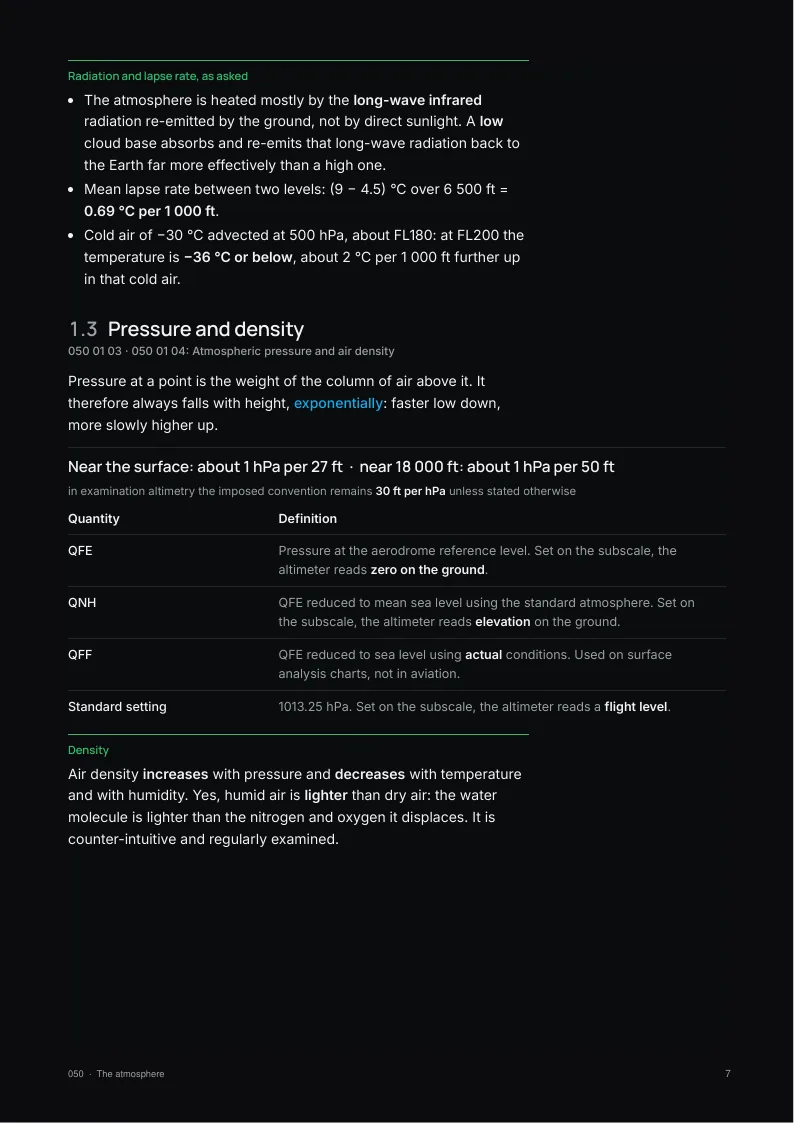
- Forgetting that humid air is less dense than dry air.
- Getting the sense of altimetry error wrong: from warm to cold, you actually descend.
- Confusing QNH, QFE and QFF. QFF is not used in aviation.
- Believing Coriolis creates wind or changes its speed: it only deflects.
- Forgetting that the gradient wind is stronger around an anticyclone than around a depression, for the same gradient.
The EASA 050 paper: 84 questions in 2 h. The exam rules →
A student asked: What is the difference between QNH, QFE and 1013?
Ten free 050 Meteorology questions
No account needed.
Pick an answer and the explanation opens.
The notes come with 1 month of all 447 questions and the mock exams.
1Which of the following processes can cause the air temperature to decrease?
1. Adiabatic cooling
2. Expansion of air
3. Radiation cooling
4. Greenhouse effect
5. Conduction coolingShow the answer
Answer A. Rising air expands as the surrounding pressure falls and cools adiabatically, so statements 1 and 2 describe the same cooling mechanism. At night the ground loses heat by long-wave radiation, and the air in contact with it then cools by conduction, which covers 3 and 5. The greenhouse effect is the odd one out: water vapour and CO2 absorb outgoing infrared and slow the cooling, so it warms rather than cools.
2In the Northern Hemisphere, a pilot flying at 1000 ft AGL straight towards the centre of a LOW pressure area will most likely find the wind blowing from...
Show the answer
Answer B. Around a low in the northern hemisphere the air turns anticlockwise, and friction at 1000 ft adds a component across the isobars towards the centre. Flying straight at the centre, the circulation puts the wind on the aircraft's left, and the inflow towards the centre gives it a component from behind. Buys Ballot's law says the same thing: with your back to the wind, low pressure is on your left.
3If a parcel of humid air is forced to rise from the ground in summer, (1) ___ may occur and unstable conditions for (2) ___ are created.
Show the answer
Answer D. Humid air forced to rise cools, reaches its dew point and the vapour condenses into cloud. Condensation releases latent heat, which warms the parcel relative to its surroundings and makes it more buoyant. That is how a moist summer air mass becomes unstable and builds convective cloud; sublimation plays no part in this.
4Which option lists only main cloud genera that indicate an unstable atmosphere?
Show the answer
Answer A. Instability shows itself in heaped, convective cloud at whatever level it occurs: cumulus low down, altocumulus in the middle, cirrocumulus high up. The layered forms (stratus, altostratus, cirrostratus, nimbostratus) are the signature of stable air spreading out instead of rising, so any list containing one of them is wrong.
5A trough is an area of (1) ______ causing widespread (2) ______, with (3) ______ along the line of the trough.
Show the answer
Answer A. In a trough the isobars bend out from a low, and the surface flow converges along its axis. Air that converges at low level has to go up, so the trough is a line of lifting, often marked by cumuliform cloud, showers or squalls. Divergence and descent are the features of a ridge or high, which gives clear skies and light winds.
6Which statement about an aircraft being struck by lightning is true?
Show the answer
Answer C. The flash of a nearby strike, especially at night, can dazzle the pilots for several seconds, making the instruments hard to read, so the crew may briefly struggle to determine the aircraft's attitude. That is why cockpit lights are turned fully up near thunderstorms. A metal airframe acts as a Faraday cage and protects the occupants better than a non-conductive one, not worse, and a charged aircraft can itself trigger a discharge.
7Can TREND and TAF reports be found in scheduled HF VOLMETs and continuous VHF VOLMETs?
Show the answer
Answer B. VOLMET broadcasts carry the METARs or SPECIs of a group of aerodromes, each followed by its TREND forecast when one is issued, on both the scheduled HF and continuous VHF services. TAFs and SIGMETs may be added to HF VOLMET only when regional air navigation agreements provide for it, so they are not a standard content of both. Nothing prohibits trend forecasts in either broadcast.
8In the standard atmosphere, what is the temperature lapse rate in the troposphere?
Show the answer
Answer A. ISA temperature falls by 6.5 °C per km, which is 1.98 °C per 1000 ft, rounded to 2 °C per 1000 ft, from +15 °C at mean sea level up to the tropopause at 36 090 ft. The tempting -0.65 °C is the same lapse rate expressed per 100 m, not per 1000 ft.
9At FL370 the OAT is -45°C. What is the ISA deviation?
Show the answer
Answer D. The ISA tropopause is at 36 090 ft, so FL370 is already in the lower stratosphere where the standard temperature is constant at -56.5 °C. The deviation is -45 - (-56.5) = +11.5 °C. Extrapolating the 2 °C per 1000 ft lapse rate to FL370 gives -59 °C and the +14 trap.
10In which of the following changes of state is latent heat absorbed?
1. Evaporation
2. Condensation
3. Sublimation
4. Deposition
5. Freezing
6. MeltingShow the answer
Answer A. Evaporation, sublimation and melting all move water to a more energetic state, so they absorb latent heat and cool their surroundings. Condensation, deposition and freezing are the reverse changes and release that heat. Any option containing 2, 4 or 5 therefore mixes in a heat-releasing process.
Keep practising.
The 050 notes come with 1 month of its 447 questions.
The pack: the notes of all thirteen subjects, with 2 months of all 6,295 questions.
Get 050 Meteorology
Pay once, no subscription.
Practise longer with its question bank.
The notes
€19.90 once
+ 1 month of its questions
PDF and screen edition, yours for life.
Updates included for 1 year.3 months of 050 questions
€39 once
€13.00 / month
All 447 questions with explanations and the mock exams, for this subject only. Questions only: the notes are not included.
The other subjects
- 010Air Law28 pages547 questions€7.90
- 021Airframe, Systems, Powerplant50 pages551 questions€19.90
- 022Instrumentation29 pages568 questions€11.90
- 031Mass & Balance30 pages328 questions€11.90
- 032Performance25 pages461 questions€7.90
- 033Flight Planning & Monitoring31 pages311 questions€11.90
- 040Human Performance46 pages578 questions€19.90
- 061General Navigation49 pages417 questions€19.90
- 062Radio Navigation29 pages512 questions€11.90
- 070Operational Procedures40 pages531 questions€15.90
- 081Principles of Flight39 pages516 questions€15.90
- 090Communications27 pages528 questions€7.90