ATPL(A) 070 Operational ProceduresRevision notes and practice questions
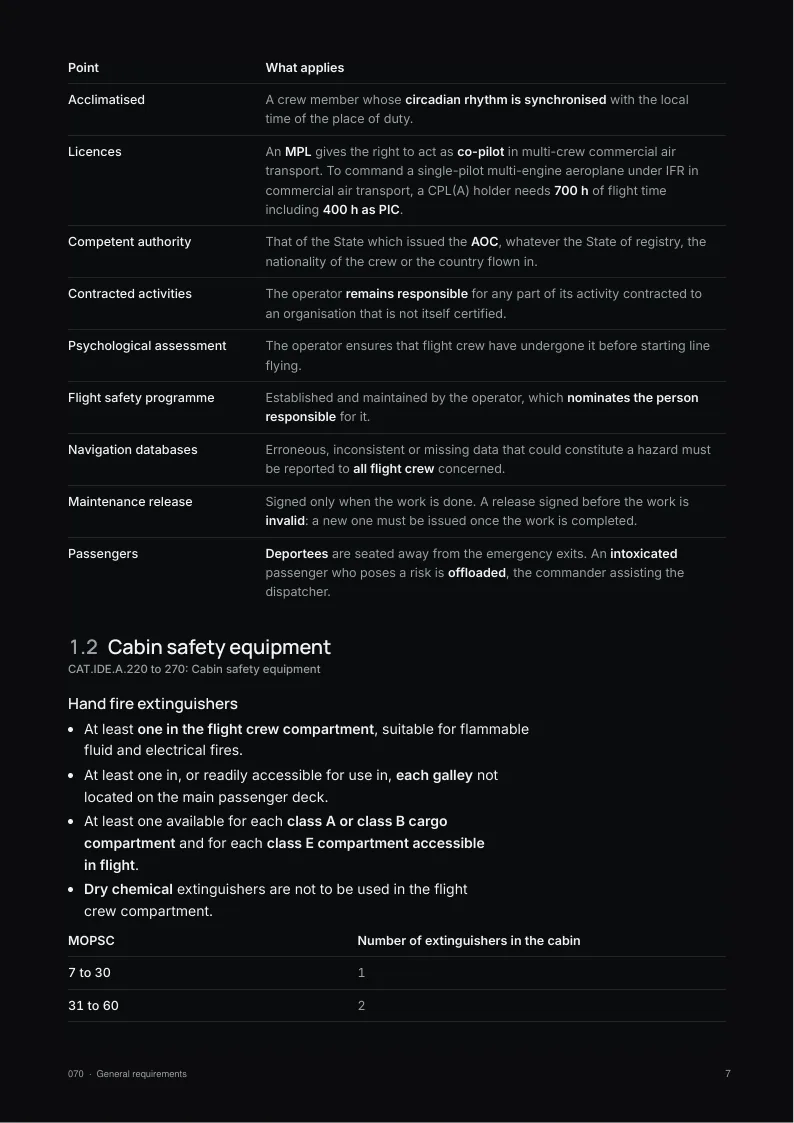
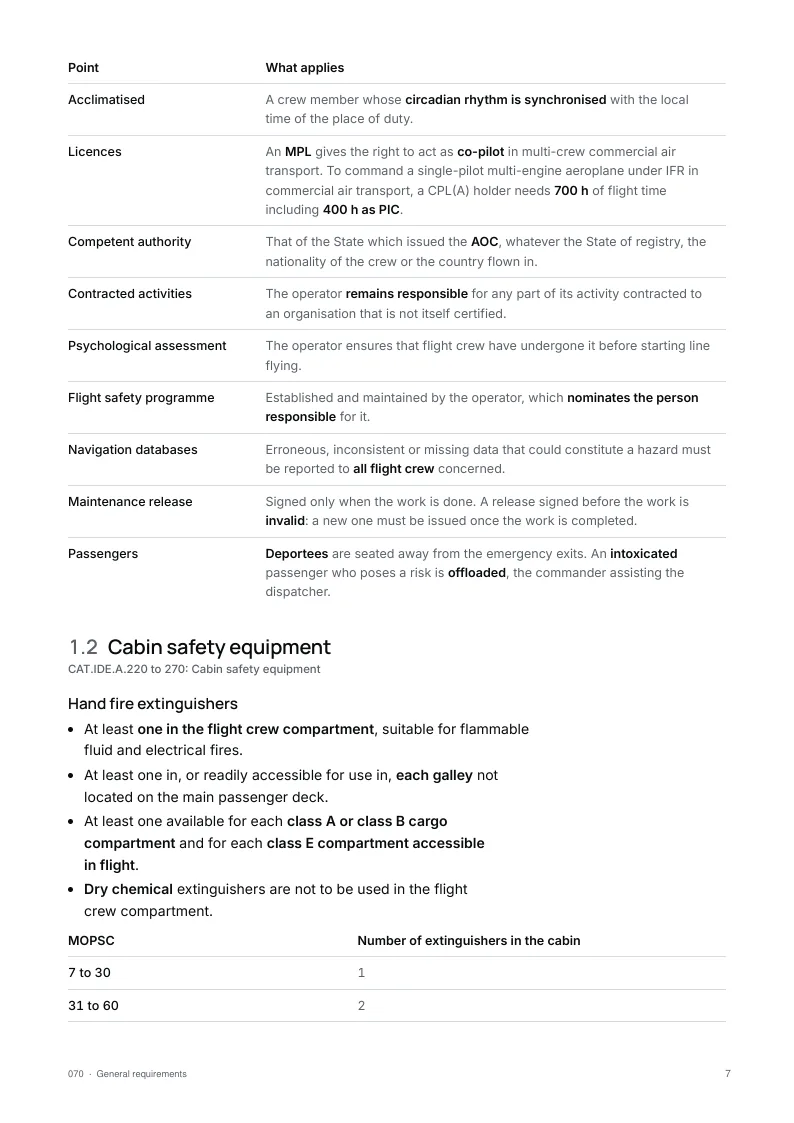
A subject of thresholds and regulatory figures.
You revise it by rereading the tables, not the paragraphs.
- 40 pages
- 531 questions
- €15.90 once
What the 070 notes cover
Written on the EASA Learning Objectives.
Checked against the primary texts.
An A4 PDF and a screen edition.
- Part 1071 01
General requirements
The ICAO and Part-CAT framework, the operations manual, safety and survival equipment, oxygen, mandatory avionics, long-range flights and NAT airspace.
- Part 2
Minima and planning
The 2022 reclassification of approaches, aerodrome minima, alternates, the approach ban, fuel and landing distances.
- Part 3071 02
Special procedures and hazards
Icing, contaminated runways, wind shear, wake turbulence, bird strike, fire and smoke, depressurisation, fuel jettisoning, security, dangerous goods.
Exam traps in 070 Operational Procedures
A sample from Appendix B.
The full list is in the notes.
Exam trap
- Mixing the seat thresholds: 9 for TAWS and the crash axe, 19 for ACAS, 30 for the medical kit, 60 for megaphones, 200 for the second axe.
- Forgetting that the emergency medical kit requires two cumulative conditions.
- Believing weather radar is required unconditionally on every pressurised aeroplane: it is required at night or in IMC in areas of expected thunderstorms.
- Forgetting the "or" between mass and seats: either criterion alone triggers the requirement.
- Reasoning in flight level instead of cabin altitude.
- On an unpressurised aeroplane, wrongly applying the 30-minute allowance to the flight crew: they have none above 10 000 ft.
The EASA 070 paper: 42 questions in 1 h 15. The exam rules →
Ten free 070 Operational Procedures questions
No account needed.
Pick an answer and the explanation opens.
The notes come with 1 month of all 531 questions and the mock exams.
1Under OPS regulations, when a cockpit voice recorder is required, it must start recording automatically...
Show the answer
Answer A. The CVR has to be running before the aeroplane first moves under its own power and must keep recording until the flight ends, when the aeroplane can no longer move under its own power. This way the taxi phase, where many ground incidents and runway incursions happen, is captured as well as the flight itself. Parking brake or engine start and shutdown are not the reference points, and starting only at full thrust would miss the whole taxi.
2In ground anti-icing procedures, what is the term for the estimated time during which the anti-icing fluid will prevent ice and frost from forming and snow from accumulating on the treated surfaces of the aircraft?
Show the answer
Answer A. Holdover time (HOT) is the estimated protection time given by the anti-icing fluid, read from tables for the fluid type, concentration, outside temperature and precipitation. It starts with the final (anti-icing) application and ends when the fluid can no longer absorb the precipitation. LOUT is a different notion, the Lowest Operational Use Temperature of a fluid, not a time.
3An operator has been contracted for aerial photography that requires a task specialist on board. Where are the task specialist's responsibilities found?
Show the answer
Answer D. Under Part-SPO the task specialist's duties are written into the standard operating procedures for the task, and those SOPs form part of the operator's Operations Manual. The AOC is only the certificate authorising the operator, the AFM covers the aircraft itself, and the training manual deals with how crews are trained.
4What minimum flight time on aeroplanes must a CPL(A) holder have to act as commander of a single-pilot multi-engine aeroplane under IFR in commercial air transport?
Show the answer
Answer D. To command a single-pilot multi-engine aeroplane under IFR in commercial air transport, a CPL(A) holder needs at least 700 hours of total flight time on aeroplanes, 400 of them as pilot-in-command. Those PIC hours must include 100 hours under IFR and 40 hours of multi-engine operation. The 700 h + 200 h PIC option is the trap: the total is right but the command experience is only half of what is required.
5After landing or a rejected take-off, the brakes are overheated. One correct action is to...
Show the answer
Answer A. After a high-energy stop the brakes may be hot enough to cause a wheel failure or a fire. The aircraft should be parked away from other aircraft, buildings and people, with the parking brake released so that heat is not concentrated, and the fire services informed. Water on hot brakes can cause thermal shock and steam, and the wheels must be approached from the front or rear, never from the side, where a bursting wheel or fuse plug sends its debris.
6An aeroplane carrying dangerous goods (DG) has to start an emergency descent to the nearest airport. Who should be informed about the DG?
Show the answer
Answer D. When an in-flight emergency occurs with dangerous goods on board, the commander tells the air traffic control unit about them, if the situation allows, so that the aerodrome emergency services can be ready on arrival. ATC passes the information on; the operator and the authority are informed afterwards through the normal reporting channels.
7In which case must an aircraft carry survival equipment?
Show the answer
Answer C. Survival equipment (signalling devices, life-saving equipment, food and water) is required when the aircraft flies over areas where search and rescue would be especially difficult: open sea, desert, jungle, polar or other remote regions. High terrain is not the criterion by itself; what matters is how long it would take to find and reach the survivors. Night flying and ordinary flights over populated areas do not trigger the requirement.
8In cruise, damage to the hull of a pressurised aircraft causes an explosive decompression. What will the occupants experience?
Show the answer
Answer D. In an explosive decompression the pressure around the body falls almost instantly. Gas in the middle ear, the sinuses, decayed teeth and the gut expands faster than it can escape, which can rupture ear drums, cause intense sinus and dental pain and, in extreme cases, distend the abdomen enough to injure internal organs. Every occupant feels it at once, because the whole cabin loses pressure together.
9You are flying a specialised operation with an analyst on board. During the flight the analyst believes an incident affecting safety has occurred. To whom should the analyst report it?
Show the answer
Answer B. An analyst on a specialised operation is a task specialist and works under the authority of the pilot-in-command. Anything that may affect the safety of the flight is reported directly to the PIC, who decides what action to take and whether ATC or the operator must be told. The safety department receives the report later, not during the flight.
10Which combination best describes the factors to be taken into account when calculating minimum time routes?
1. ATC restrictions
2. Wind and meteorological conditions
3. Straight-line distance between departure and destination points
4. Danger, restricted and prohibited areas and airspace restrictionsShow the answer
Answer D. A minimum time route is the track that gives the shortest flight time, not the shortest distance. It starts from the great circle and is then shaped by the winds and weather, by ATC route and level constraints, and by danger, restricted and prohibited areas. The straight-line distance is the trap: a longer track with a strong tailwind is often the quicker one.
Keep practising.
The 070 notes come with 1 month of its 531 questions.
The pack: the notes of all thirteen subjects, with 2 months of all 6,295 questions.
Get 070 Operational Procedures
Pay once, no subscription.
Practise longer with its question bank.
The notes
€15.90 once
+ 1 month of its questions
PDF and screen edition, yours for life.
Updates included for 1 year.3 months of 070 questions
€39 once
€13.00 / month
All 531 questions with explanations and the mock exams, for this subject only. Questions only: the notes are not included.
The other subjects
- 010Air Law28 pages547 questions€7.90
- 021Airframe, Systems, Powerplant50 pages551 questions€19.90
- 022Instrumentation29 pages568 questions€11.90
- 031Mass & Balance30 pages328 questions€11.90
- 032Performance25 pages461 questions€7.90
- 033Flight Planning & Monitoring31 pages311 questions€11.90
- 040Human Performance46 pages578 questions€19.90
- 050Meteorology43 pages447 questions€19.90
- 061General Navigation49 pages417 questions€19.90
- 062Radio Navigation29 pages512 questions€11.90
- 081Principles of Flight39 pages516 questions€15.90
- 090Communications27 pages528 questions€7.90