PPL(A) 010 Air LawRevision notes and practice questions
Air law is the paper that decides what a private pilot may do, where and in what weather.
The French DGAC paper has 20 questions; 75 %, that is 15 correct answers, is a pass.
Learn the figures in Appendix A by heart, then reread the traps in Appendix B the night before.
- 24 pages
- 80 questions
- €6.90 once
French DGAC exam: 20 questions, 75 % to pass (15 correct).
What the PPL 010 notes cover
Written on the EASA PPL(A) syllabus.
Checked against the primary texts.
An A4 PDF and a screen edition.
- Part 1
International law and the aircraft
Chicago Convention, ICAO, airworthiness and registration marks.
- Part 2
Licensing and medical
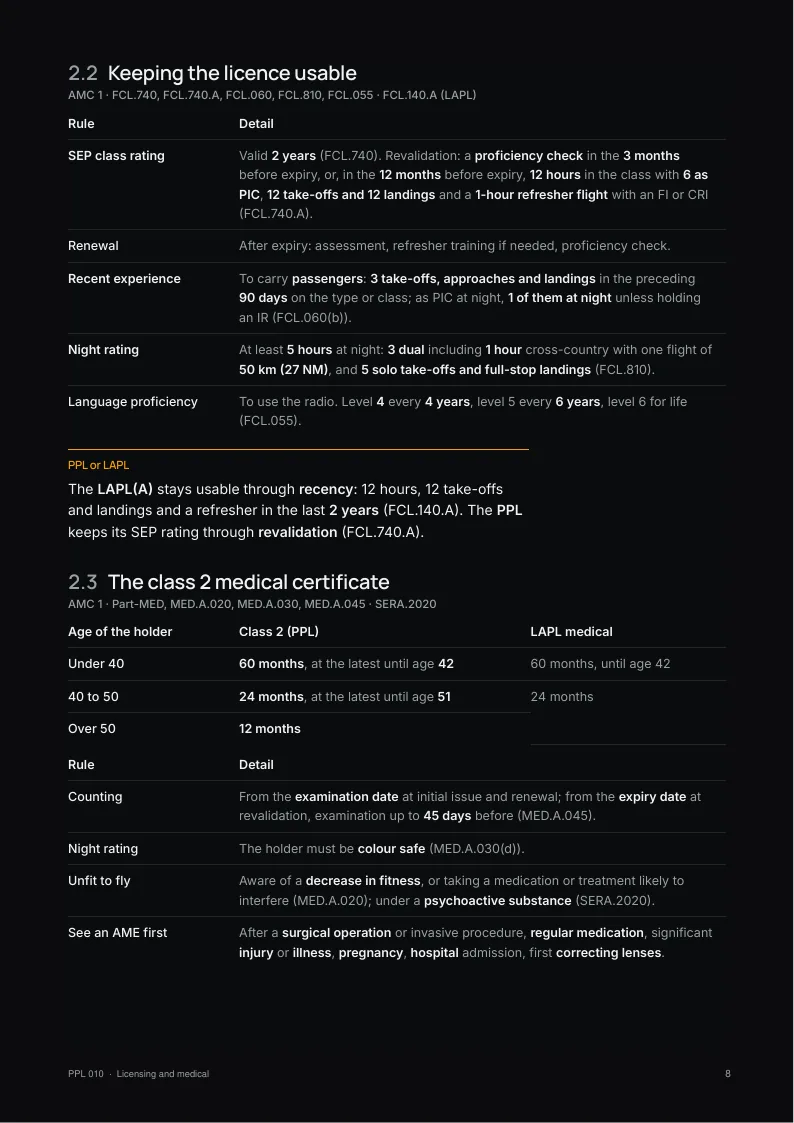
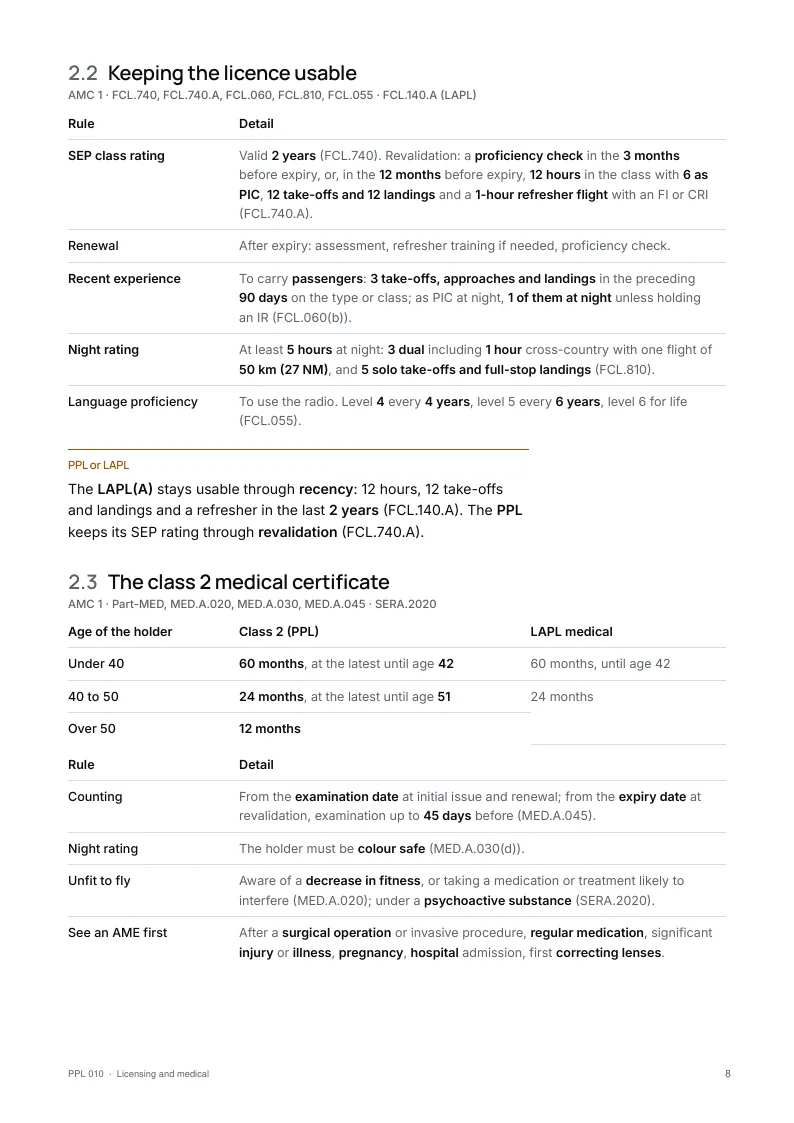
PPL(A) privileges and requirements, ratings, recency, class 2 medical.
- Part 3
Rules of the air
SERA general rules, right of way, VMC minima, night and special VFR, signals.
- Part 4
Altimetry, transponder and ATS
QNH and flight levels, squawk codes, airspace classes, services, emergencies.
- Part 5
Information and aerodromes
AIP, NOTAM, AIRAC, markings, signs, lights and obstacles.
- Part 6
SAR, security, investigation
Emergency phases, search and rescue signals, security, accidents and reporting.
- Part 7
EU rules and Part-NCO
The European framework and the rules a private pilot flies under.
Exam traps in PPL 010 Air Law
A sample from Appendix B.
The full list is in the notes.
Exam trap
- The Convention does not apply to State aircraft. Over the high seas the ICAO rules apply without exception.
- Wing marks: lower surface, left half. Certificate of airworthiness: State of Registry.
- The licence does not expire; the ratings and the medical do.
- Cost-sharing is allowed: all occupants share, pilot included, six at most.
- PPL: SEP revalidation (FCL.740.A); LAPL: recency (FCL.140.A).
- Priority by category grows from aeroplanes to airships, sailplanes, then balloons.
Ten free PPL 010 Air Law questions
No account needed.
Pick an answer and the explanation opens.
The notes come with 1 month of all 80 questions and the mock exams.
1A PPL(A) pilot flies a light aeroplane registered in France over the high seas, outside any State's territory. Which rules of the air apply?
Show the answer
Answer D. Article 12 of the Chicago Convention states that over the high seas the rules in force are those established under the Convention, that is Annex 2 (Rules of the Air). A State may notify differences for its own territory, but no difference applies over the high seas. The State of registry rules are the tempting answer: they apply to its aircraft wherever they are, except where the Convention rules take over.
2For how long is a standard certificate of airworthiness issued under Part-21 for a light aeroplane valid?
Show the answer
Answer A. Part-21 point 21.A.181 states that an airworthiness certificate is issued for an unlimited period of time. It remains valid while the aircraft complies with its type design and continuing airworthiness requirements and stays on the same register. The yearly renewal applies to the airworthiness review certificate (ARC), not to the certificate of airworthiness itself.
3Which statement correctly describes the privileges of the holder of a PPL(A), with no instructor or examiner certificate?
Show the answer
Answer B. FCL.205.A(a) gives the PPL(A) holder the privilege to act without remuneration as PIC or co-pilot of aeroplanes or TMGs engaged in non-commercial operations, and to exercise all LAPL(A) privileges. Remuneration is only allowed for holders with instructor or examiner privileges, for instruction, tests and checks (FCL.205.A(b)). The 2 000 kg and 3 passenger limits belong to the LAPL(A), not to the PPL(A).
4You are flying a single-engine piston aeroplane at 2,500 ft. A sailplane is converging from your left at approximately the same level, with a risk of collision. Who must give way?
Show the answer
Answer B. Under SERA.3210(c)(2), the aircraft that has the other on its right gives way, except that power-driven heavier-than-air aircraft give way to airships, sailplanes and balloons. The category rule overrides the right-hand rule, so you give way even though the sailplane is on your left. Avoid passing over, under or in front of it unless well clear. Turning right is the head-on rule, not the converging rule.
5Which of the following statements are correct?
1. With QNH set, the altimeter of an aircraft on the ground reads the aerodrome elevation.
2. With QFE set, the altimeter indicates altitude above mean sea level.
3. With 1013.25 hPa set, the altimeter indicates pressure altitude, used for flight levels.
4. Below the transition altitude, vertical position is expressed in flight levels.Show the answer
Answer A. QNH is the setting that makes the altimeter read the aerodrome elevation on the ground, so it gives altitude above mean sea level. QFE gives height above the aerodrome and reads zero on the ground. With 1013.25 hPa the altimeter shows pressure altitude, the basis of flight levels. SERA.8015(eb)(1) expresses vertical position as altitudes at or below the transition altitude and flight levels at or above the transition level.
6A VFR flight is operating in class D airspace. What does ATC provide to it with respect to other traffic?
Show the answer
Answer B. Under SERA.6001(a)(4), in class D only IFR flights are separated from each other; VFR flights receive traffic information in respect of all other flights and traffic avoidance advice on request. An ATC clearance and continuous two-way radio contact are still required. Separation of VFR from IFR is the class C rule, separation from everyone is class B, and flight information on request only is class G.
7In which part of the AIP does a pilot find the declared distances, the aerodrome charts and the local VFR procedures of a particular aerodrome?
Show the answer
Answer A. The AIP is made of three parts (ICAO Annex 15 and PANS-AIM, Doc 10066): GEN for general information such as national regulations, units and charges, ENR for airspace, routes, navigation aids and restricted areas, and AD for aerodromes. The data of each aerodrome, including declared distances and charts, are in AD 2. AIP Supplements carry only temporary changes, not the permanent aerodrome data.
8The magnetic bearing of a runway centreline, measured in the direction of approach, is 076°. Which designators are painted at its two ends?
Show the answer
Answer C. ICAO Annex 14 sets the designator as the whole number nearest to one tenth of the magnetic bearing seen from the direction of approach, preceded by a zero if it has a single digit. 076° gives 7.6, rounded to 08; the reciprocal 256° gives 25.6, rounded to 26. Truncating instead of rounding is the error that leads to 07 and 25.
9Survivors of a forced landing lay out the symbol X on the ground. According to the ground-to-air visual signal code of ICAO Annex 12, what does it mean?
Show the answer
Answer C. The survivors' code in Annex 12 is: V require assistance, X require medical assistance, N no or negative, Y yes or affirmative, and an arrow for proceeding in this direction. V and X are easily swapped, which is the usual trap. An aircraft acknowledges a ground signal it has understood by rocking its wings by day.
10During a private flight in turbulence, a passenger breaks an arm and is admitted to hospital for three days. The aeroplane is undamaged. How is this occurrence classified under ICAO Annex 13?
Show the answer
Answer A. Annex 13 defines an accident as an occurrence, from boarding with the intention of flight until disembarkation, in which a person is fatally or seriously injured, the aircraft sustains substantial damage, or the aircraft is missing. A fracture (other than a simple fracture of a finger, toe or nose) and a hospital stay of more than 48 hours within 7 days are both serious injuries. Damage to the aircraft is not needed, and the cause being turbulence does not change the classification; in the EU it must be notified without delay to the safety investigation authority (Regulation (EU) No 996/2010, Article 9).
Keep practising.
The PPL 010 notes come with 1 month of its 80 questions.
The PPL pack: the notes of all nine subjects, with 2 months of all 698 questions.
Get PPL 010 Air Law
Pay once, no subscription.
Practise longer with its question bank.
The notes
€6.90 once
+ 1 month of its questions
PDF and screen edition, yours for life.
Updates included for 1 year.3 months of PPL 010 questions
€19 once
€6.33 / month
All 80 questions with explanations and the mock exams, for this subject only. Questions only: the notes are not included.
The other PPL subjects
- 020Aircraft General Knowledge24 pages80 questions€6.90
- 030Flight Performance and Planning22 pages80 questions€6.90
- 040Human Performance20 pages80 questions€6.90
- 050Meteorology24 pages80 questions€6.90
- 060Navigation24 pages80 questions€6.90
- 070Operational Procedures19 pages79 questions€6.90
- 080Principles of Flight21 pages80 questions€6.90
- 090Communications22 pages59 questions€6.90