PPL(A) 020 Aircraft General KnowledgeRevision notes and practice questions
Aircraft general knowledge is the paper on the aeroplane itself: how it is built, how its engine and systems work, what each instrument shows and how it fails.
The French DGAC paper has 12 questions; 75 %, that is 9 correct answers, is a pass.
Learn each principle with its failure, then the figures in Appendix A, and reread the traps in Appendix B the night before.
- 24 pages
- 80 questions
- €6.90 once
French DGAC exam: 12 questions, 75 % to pass (9 correct).
What the PPL 020 notes cover
Written on the EASA PPL(A) syllabus.
Checked against the primary texts.
An A4 PDF and a screen edition.
- Part 1
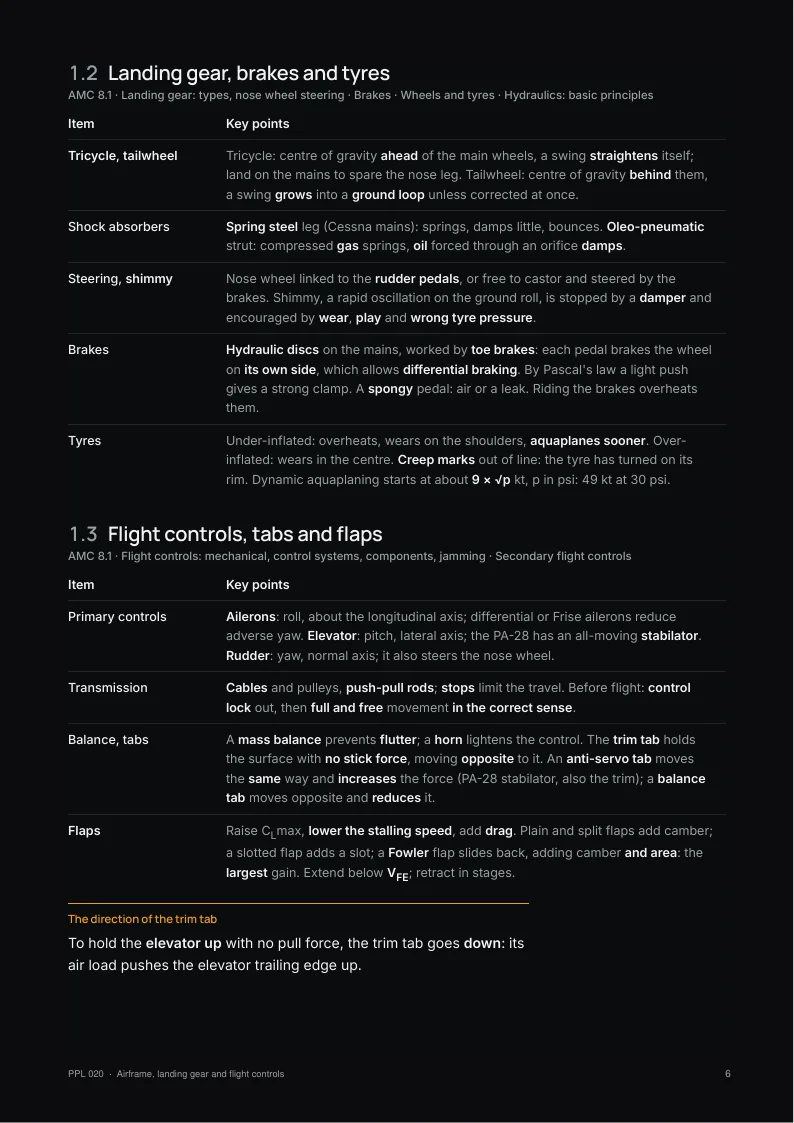
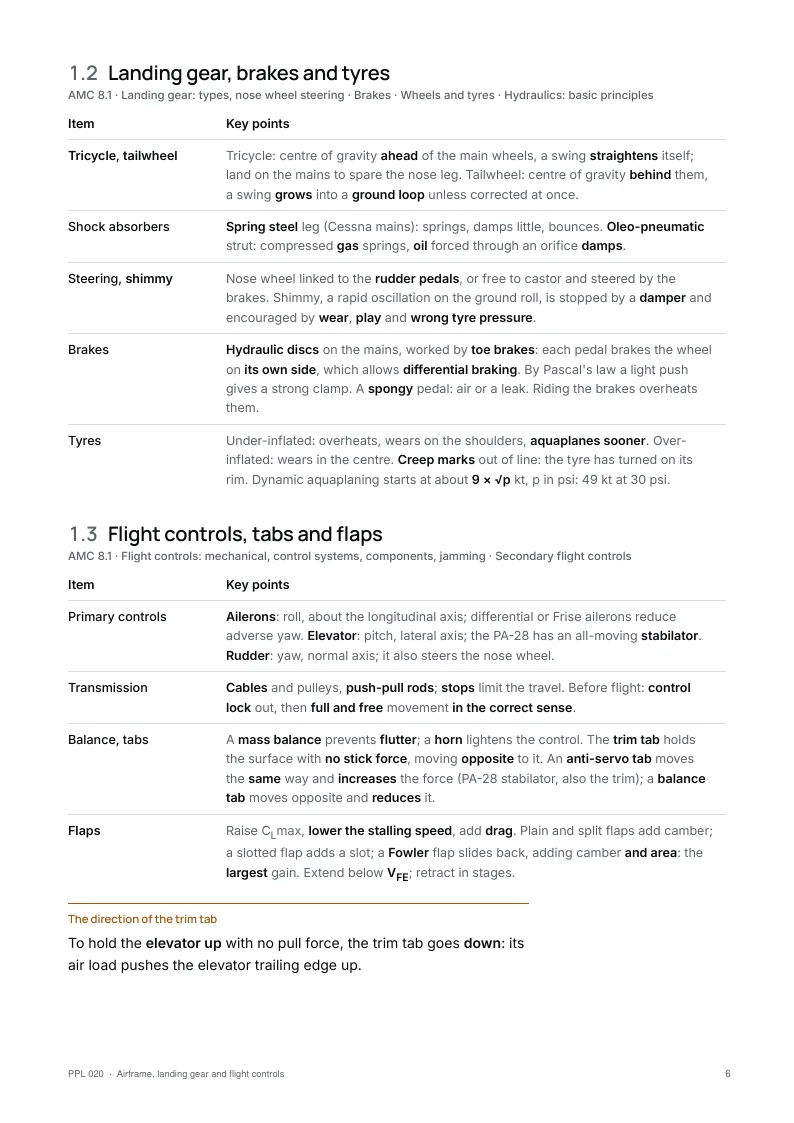
Airframe, landing gear and flight controls
Loads and limits, gear and brakes, controls, tabs and flaps.
- Part 2
Fuel, anti-icing and electrics
Fuel system and grades, pitot heat, battery, alternator and bus.
- Part 3
The piston engine
Four-stroke cycle, compression ratio, mixture, detonation.
- Part 4
Carburettor, ignition, cooling, lubrication and propeller
Carburettor icing, magnetos, oil, propellers and engine handling.
- Part 5
Engine and pitot-static instruments
Engine gauges, blockages, altimeter, VSI, airspeed and its arcs.
- Part 6
Compass and gyroscopic instruments
Deviation, ANDS and UNOS, gyros, vacuum failure, turn and ball.
- Part 7
Radio, warnings and electronic displays
VHF range and spacing, stall warning, PFD, ADC and AHRS.
Exam traps in PPL 020 Aircraft General Knowledge
A sample from Appendix B.
The full list is in the notes.
Exam trap
- Wing in flight: upper skin in compression. VA decreases with mass.
- Tailwheel: CG behind the mains. Under-inflated tyre: aquaplanes sooner.
- Trim tab opposite to the surface. Fowler flap: camber and area.
- Alternator failure: shed the load, keep the master on. Endurance from the remaining charge.
- Compression ratio: (swept + clearance) ÷ clearance, not swept ÷ clearance. Climbing unleaned: too rich.
- Detonation: enrich, nose down, less power. Carb heat on the run-up: a small drop is normal.
Ten free PPL 020 Aircraft General Knowledge questions
No account needed.
Pick an answer and the explanation opens.
The notes come with 1 month of all 80 questions and the mock exams.
1A low-wing cantilever monoplane is in steady level flight. Which loads mainly act on the upper and lower skins of the wing?
Show the answer
Answer C. Lift bends the wing upwards about its root, like a beam fixed at one end. The upper surface is therefore squeezed (compression) and the lower surface stretched (tension), while the spar webs carry shear and the wing also sees some torsion from its pitching moment. The inverted answer is the classic trap: it describes the loads with the wing hanging on the ground, not in flight.
2Why is a tailwheel aeroplane more prone to a ground loop than a tricycle-gear aeroplane?
Show the answer
Answer D. On a tailwheel aeroplane the centre of gravity lies behind the main wheels. Once a swing starts, the inertia of the CG acts behind the pivot point and pulls the tail further round, so the swing grows into a ground loop unless the pilot corrects it at once. On a tricycle aeroplane the CG is ahead of the main wheels and a swing tends to straighten itself, which is why the inverted answer is wrong.
3On a conventional elevator fitted with a trim tab, the pilot trims to relieve a steady pull force on the control column. How does the trim tab move?
Show the answer
Answer B. A trim tab always moves opposite to the control surface it trims. To hold the elevator up without a pull force, the tab moves down: the air load on the tab pushes the elevator trailing edge up and keeps it there. Thinking that the tab moves in the same direction as the surface is the classic exam trap. The PA-28 stabilator instead carries an anti-servo tab, which moves in the same direction as the stabilator to increase the control force and is trimmed by shifting its neutral position, which is why the question specifies a conventional elevator.
4During the pre-flight inspection, the pilot takes a fuel sample from a wing tank drain. A clear globule rests at the bottom of the blue fuel in the sampler. What is it and what should the pilot do?
Show the answer
Answer A. Water is heavier than AVGAS, so it sinks to the lowest points of the tanks, where the drains are fitted, and appears as a clear bead at the bottom of the sample. The pilot keeps draining until no more water appears, checking every drain, because water reaching the engine can stop it. A sample must never be poured back into the tank if it is contaminated.
5In cruise, the low-voltage warning light comes on and the ammeter shows a discharge. The alternator cannot be reset. What is the best course of action?
Show the answer
Answer C. With the alternator off line, the battery alone supplies the electrical system and will run down. Shedding non-essential loads extends the time during which the radio and other essential equipment remain available, and landing as soon as practicable avoids losing them. The engine keeps running because the magnetos are independent of the aircraft electrical system, so switching off the master switch to protect the engine is not needed.
6A four-cylinder, four-stroke piston engine runs at 2400 RPM. How many power strokes per minute does the engine produce in total?
Show the answer
Answer D. In a four-stroke engine, each cylinder completes one cycle (induction, compression, power, exhaust) every 2 crankshaft revolutions. Each cylinder therefore gives 2400 / 2 = 1200 power strokes per minute, and four cylinders give 4 x 1200 = 4800. The 9600 answer assumes one power stroke per revolution, which applies to a two-stroke engine.
7In cruise with a fixed-pitch propeller, OAT +12 °C and high humidity, the RPM slowly decreases at a constant throttle setting and the engine begins to run roughly. What is the most likely cause and the correct action?
Show the answer
Answer C. The cooling caused by fuel evaporation and the pressure drop in the venturi can produce carburettor ice at outside temperatures well above 0 °C, typically between about -5 and +30 °C in humid air. With a fixed-pitch propeller the first symptom is a gradual RPM drop, then rough running. Full heat is applied: the engine first runs more roughly as the melted ice passes through, then the RPM rises. Partial heat, without a carburettor air temperature gauge, can raise the air temperature into the range where icing is most severe.
8In cruise with a constant-speed propeller, the pilot advances the throttle without moving the propeller lever. What happens?
Show the answer
Answer C. The throttle sets manifold pressure and the propeller lever sets the RPM that the governor holds. When more power is applied, the flyweight governor coarsens the blades (larger blade angle) so that the extra power is absorbed without an RPM rise. A finer blade angle would let the RPM increase, which is the behaviour of a fixed-pitch propeller, not of a governed one.
9In cruise, the oil pressure gauge shows a steady fall while the oil temperature rises above the normal range. What is the most likely cause and the correct action?
Show the answer
Answer A. Low oil pressure together with high oil temperature confirms a real lubrication problem, typically a loss of oil, because two independent indications agree. The engine may seize, so power is reduced and the pilot lands as soon as possible with a field in mind. A gauge failure is only suspected when one indication changes alone while the other stays normal.
10Climbing in cloud at 0 °C with the pitot heat off, the pilot sees the indicated airspeed rise steadily although attitude and power are unchanged. The altimeter and the VSI behave normally. What is the most likely cause?
Show the answer
Answer B. With the pitot and its drain blocked, the pressure in the pitot line is trapped while static pressure keeps falling in the climb, so the ASI over-reads more and more: it behaves like an altimeter, and under-reads in the descent. A blocked static port is excluded, since it would freeze the altimeter and set the VSI to zero. A blocked pitot with an open drain lets the trapped pressure escape, so the IAS falls towards zero instead of rising.
Keep practising.
The PPL 020 notes come with 1 month of its 80 questions.
The PPL pack: the notes of all nine subjects, with 2 months of all 698 questions.
Get PPL 020 Aircraft General Knowledge
Pay once, no subscription.
Practise longer with its question bank.
The notes
€6.90 once
+ 1 month of its questions
PDF and screen edition, yours for life.
Updates included for 1 year.3 months of PPL 020 questions
€19 once
€6.33 / month
All 80 questions with explanations and the mock exams, for this subject only. Questions only: the notes are not included.
The other PPL subjects
- 010Air Law24 pages80 questions€6.90
- 030Flight Performance and Planning22 pages80 questions€6.90
- 040Human Performance20 pages80 questions€6.90
- 050Meteorology24 pages80 questions€6.90
- 060Navigation24 pages80 questions€6.90
- 070Operational Procedures19 pages79 questions€6.90
- 080Principles of Flight21 pages80 questions€6.90
- 090Communications22 pages59 questions€6.90