ATPL(A) 062 Radio NavigationRevision notes and practice questions
For every aid, ask the same four questions: which band, what range, what accuracy, which errors.
Exam questions rarely step outside that frame.
- 29 pages
- 512 questions
- €11.90 once
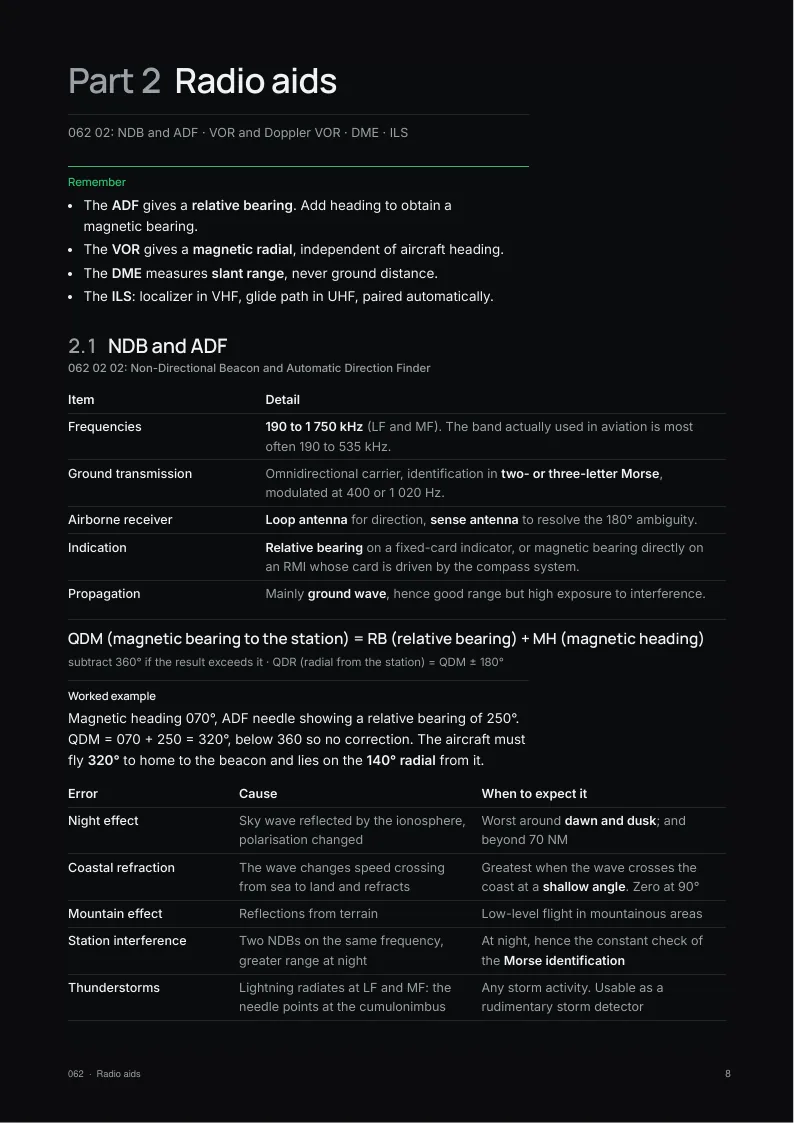
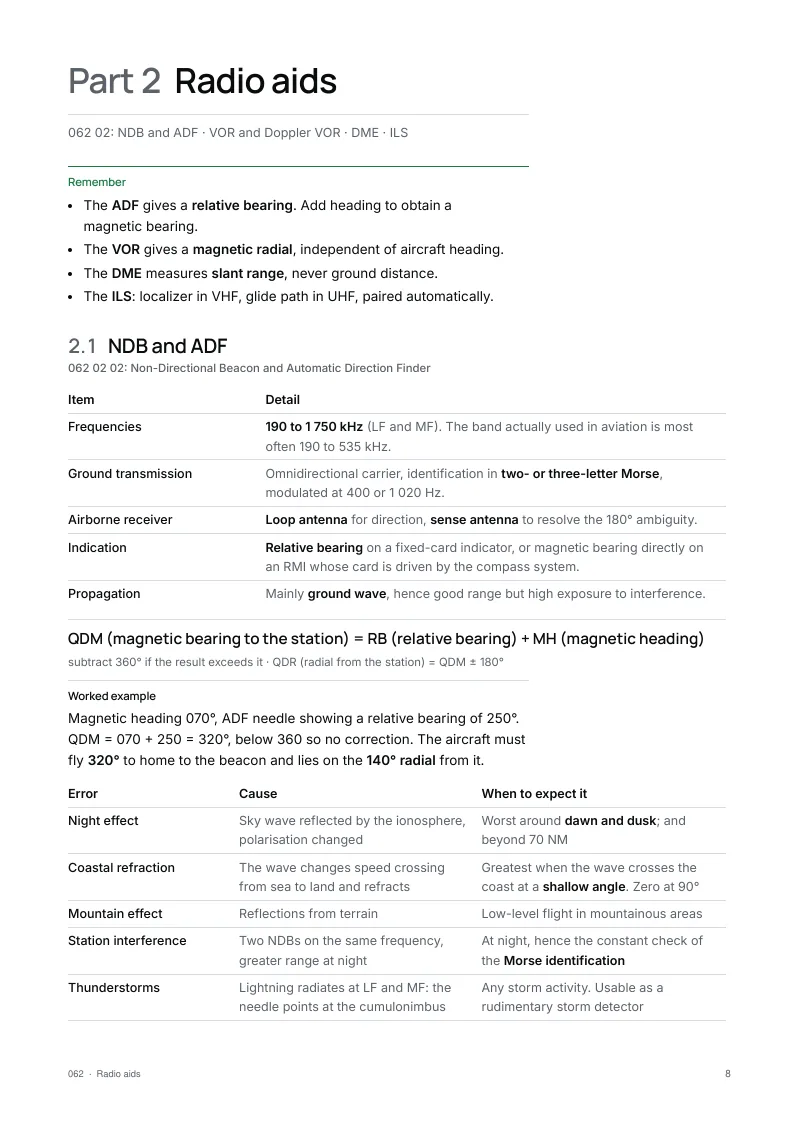
What the 062 notes cover
Written on the EASA Learning Objectives.
Checked against the primary texts.
An A4 PDF and a screen edition.
- Part 1062 01
Propagation
Frequency bands, polarisation, antennas and the three propagation paths that explain the range of every aid.
- Part 2062 02
Radio aids
NDB and ADF, VOR and Doppler VOR, DME, ILS. Principle, accuracy and the errors specific to each.
- Part 3062 03
Radar
Pulse techniques, ground radars, airborne weather radar, secondary surveillance radar and the transponder.
- Part 4062 05
RNAV and FMS
Area navigation, performance-based navigation, the flight management system and its sensors.
- Part 5062 06
GNSS
GPS, GLONASS, Galileo, the ranging principle, error sources and the ABAS, SBAS and GBAS augmentation systems.
Exam traps in 062 Radio Navigation
A sample from Appendix B.
The full list is in the notes.
Exam trap
- The ground wave travels further the lower the frequency and further over sea than over land.
- The D layer exists by day and absorbs. Its disappearance at night creates night effect.
- On HF, use higher frequencies by day and lower ones at night.
- Dead space lies between the ground wave limit and the first hop, not beyond it.
- The ADF depends on heading, the VOR does not. That is the structuring distinction.
- Coastal refraction is zero at 90° and greatest at shallow incidence.
The EASA 062 paper: 66 questions in 1 h 30. The exam rules →
Ten free 062 Radio Navigation questions
No account needed.
Pick an answer and the explanation opens.
The notes come with 1 month of all 512 questions and the mock exams.
1Electromagnetic waves in the VLF band cover which frequency range?
Show the answer
Answer A. The very low frequency band runs from 3 to 30 kHz, with wavelengths of 100 to 10 km. 30 to 300 kHz is LF, 300 to 3000 kHz is MF and 30 to 300 MHz is VHF: each band is ten times higher in frequency than the one below it.
2What distance will the DME display when the aircraft is at FL 360, 6 NM plan range from the DME station? For the calculation, assume: QNH is 1013 hPa; pressure altitude is true altitude.
Show the answer
Answer B. DME measures slant range, the straight line from the aircraft to the station. At FL360 the aircraft is 36000 ft high, which is 36000 / 6076 ≈ 5.9 NM. Slant range = √(6² + 5.9²) = √71.1 ≈ 8.4 NM, so the DME shows about 8 NM. 6 NM is the plan range the question gives, not what the DME reads.
3The airborne weather radar...
Show the answer
Answer A. Heavy rain attenuates the radar beam, and behind a strong shower too little energy may remain to produce returns from another cell. The screen then shows nothing where a thunderstorm may exist: this is the radar shadow. The radar has no second transmitter, does not use circular polarisation for this purpose, and cannot detect clear air turbulence, which contains no precipitation.
4Which statement about the NAVSTAR GPS transmission frequencies L1 and L2 and their codes is correct?
Show the answer
Answer A. The coarse acquisition (C/A) code is the code open to civil users, and on the legacy GPS signal it is transmitted on L1 only. The precision (P) code is modulated on both L1 and L2 and is encrypted as P(Y) for authorised, mainly military, users. The trap is the P code on L2 only: it is on both frequencies, which is what lets authorised receivers remove the ionospheric delay.
5Which statement is correct about the scope of the PBN concept?
Show the answer
Answer D. PBN applies to oceanic, en-route, terminal and approach operations. Outside the approach, lateral performance is linear: a fixed tolerance either side of the path. In the approach phase both kinds exist: linear, as in RNP APCH to LNAV minima, and angular, as in LPV, where the tolerance narrows towards the runway like an ILS. Angular guidance is therefore not used en route or in the terminal area.
6An aircraft has no automatic temperature correction. What happens to the glide path?
Show the answer
Answer C. A barometric vertical path assumes ISA temperatures. In air colder than ISA the true altitude is lower than indicated, and the error grows with height above the station, so the path actually flown is lower and flatter than published: the angle is reduced. Warm air does the opposite and steepens the path, which is why the uncompensated cold case is the dangerous one near terrain.
7The BFO switch on the ADF control panel must be selected "ON" to allow the pilot to:
Show the answer
Answer C. An NDB using NON A1A identifies itself by keying its plain carrier on and off, so there is no audio tone to hear. The beat frequency oscillator mixes a locally generated signal with the carrier to produce an audible tone, so the BFO must be on to hear the Morse ident. A2A beacons modulate their carrier with their own tone and need no BFO.
8During the descent it is important to set the AWR tilt to a higher setting. Why is this?
Show the answer
Answer A. As the aircraft descends, a beam that was pointing level or slightly down increasingly strikes the terrain ahead and fills the display with ground returns. Raising the tilt keeps the beam above the ground so that the weather ahead is displayed clearly. The radar remains essential in the descent, when the aircraft passes through the lower cloud layers.
9By using both GPS frequencies, L1 and L2, a receiver can almost eliminate the...
Show the answer
Answer D. The ionosphere delays a radio signal by an amount inversely proportional to the square of its frequency, so L1 and L2 arrive with different delays. Comparing the two lets the receiver compute the ionospheric delay and remove almost all of it. The troposphere delays both frequencies by the same amount, so dual-frequency reception cannot measure it: it has to be modelled.
10In PBN operations, for which phases of flight can RNAV 2 be used?
Show the answer
Answer C. RNAV 2 is intended for continental en-route routes and for arrivals and departures in the terminal area. Oceanic and remote airspace uses RNAV 10 or RNP 4, and approaches use RNP APCH or RNP AR APCH, so any option including an approach or oceanic segment is wrong.
Keep practising.
The 062 notes come with 1 month of its 512 questions.
The pack: the notes of all thirteen subjects, with 2 months of all 6,295 questions.
Get 062 Radio Navigation
Pay once, no subscription.
Practise longer with its question bank.
The notes
€11.90 once
+ 1 month of its questions
PDF and screen edition, yours for life.
Updates included for 1 year.3 months of 062 questions
€39 once
€13.00 / month
All 512 questions with explanations and the mock exams, for this subject only. Questions only: the notes are not included.
The other subjects
- 010Air Law28 pages547 questions€7.90
- 021Airframe, Systems, Powerplant50 pages551 questions€19.90
- 022Instrumentation29 pages568 questions€11.90
- 031Mass & Balance30 pages328 questions€11.90
- 032Performance25 pages461 questions€7.90
- 033Flight Planning & Monitoring31 pages311 questions€11.90
- 040Human Performance46 pages578 questions€19.90
- 050Meteorology43 pages447 questions€19.90
- 061General Navigation49 pages417 questions€19.90
- 070Operational Procedures40 pages531 questions€15.90
- 081Principles of Flight39 pages516 questions€15.90
- 090Communications27 pages528 questions€7.90