PPL(A) 040 Human PerformanceRevision notes and practice questions
Human performance is the paper about the pilot: the body at altitude, the senses that can deceive, health and fatigue, and the way a pilot thinks, errs and decides.
The French DGAC paper has 12 questions; 75 %, that is 9 correct answers, is a pass.
There is no calculation: learn the figures in Appendix A, then reread the traps in Appendix B the night before.
- 20 pages
- 80 questions
- €6.90 once
French DGAC exam: 12 questions, 75 % to pass (9 correct).
What the PPL 040 notes cover
Written on the EASA PPL(A) syllabus.
Checked against the primary texts.
An A4 PDF and a screen edition.
- Part 1
Human factors and the accident chain
The human share of accidents, the SHELL model, the error chain and the Swiss cheese.
- Part 2
The body in flight
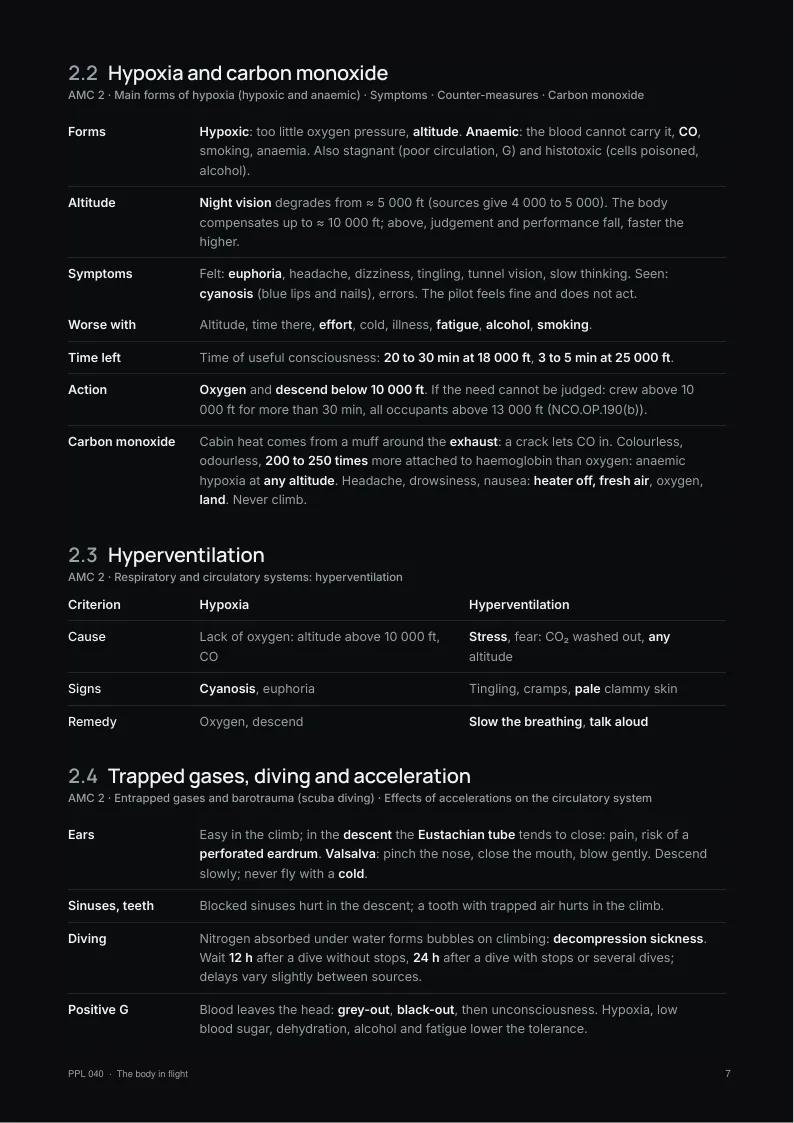
Atmosphere and gas laws, hypoxia, carbon monoxide, hyperventilation, trapped gases, diving, G.
- Part 3
The senses and disorientation
Night vision and look-out, landing illusions, hearing, the inner ear and spatial disorientation.
- Part 4
Health, fitness and fatigue
Fitness to fly, alcohol, medication, tobacco, minor ailments, sleep and the body clock.
- Part 5
Information processing, error and decision
Perception, attention, memory, slips and mistakes, DECIDE, I'M SAFE, biases and attitudes.
- Part 6
Stress, workload and TEM
The stress curve, priorities in flight, threat and error management, checklists, passengers.
Exam traps in PPL 040 Human Performance
A sample from Appendix B.
The full list is in the notes.
Exam trap
- The percentage of oxygen does not fall with altitude; its partial pressure does.
- Breathing is driven by CO₂, so hypoxia gives no warning. Its first symptom is often euphoria.
- Altitude gives hypoxic hypoxia; CO and smoking give anaemic hypoxia, at any altitude.
- Only hypoxia gives cyanosis. Hyperventilation: pale skin, any altitude, remedy = slow the breathing.
- CO: heater off, fresh air, land. Never climb.
- Ears hurt in the descent, teeth in the climb. Dive with stops: 24 h, not 12.
Ten free PPL 040 Human Performance questions
No account needed.
Pick an answer and the explanation opens.
The notes come with 1 month of all 80 questions and the mock exams.
1Studies of aviation accidents show that human factors play a part in roughly what proportion of them?
Show the answer
Answer C. Around 70 to 80 % of aviation accidents involve a human factors component. As engines and airframes became more reliable, technical causes fell and the human share became dominant. This does not mean the pilot alone is to blame: maintenance, air traffic control and the organisation are humans too.
2A pilot climbs from sea level to 18 000 ft, where the atmospheric pressure is about half its sea level value. Which statement about the oxygen in the air is correct?
Show the answer
Answer B. Dry air contains about 78 % nitrogen, 21 % oxygen and 1 % other gases, and this proportion stays the same at every altitude. By Dalton's law, the partial pressure of oxygen is the total pressure multiplied by 0.21, so it falls with the total pressure. At 18 000 ft the pressure is halved, so each breath delivers about half the oxygen pressure available at sea level.
3Which statement about vision at night is correct?
Show the answer
Answer B. Rods lie mainly at the periphery of the retina, work in low light and do not perceive colour; they need about 30 minutes to adapt fully to darkness. Cones are concentrated in the fovea, give colour and detail in daylight and adapt in about 7 minutes, but they are ineffective at night. The centre of the visual field therefore becomes a night blind spot, so a faint light is best seen by looking 5 to 10° to one side of it. A single bright light can destroy dark adaptation.
4A pilot has his last drink at 23:00, when his blood alcohol concentration is estimated at 1.6 g/L. Assume an elimination rate of 0.15 g/L per hour, a blood alcohol limit of 0.2 g/L and a minimum of 8 hours between the last drink and flight. What is the earliest time at which both conditions are met?
Show the answer
Answer C. The concentration must fall by 1.6 - 0.2 = 1.4 g/L, which takes 1.4 / 0.15 = 9.33 h, that is 9 h 20 min, so the limit is reached at 08:20. The 8-hour rule alone would give 07:00, but the later of the two times governs. 06:20 uses a 0.5 g/L limit and 09:40 is the time to reach zero. Nothing speeds up elimination, and a hangover can still impair performance after the alcohol has gone.
5In the simple model of human information processing, which sequence is correct?
Show the answer
Answer B. A stimulus first reaches the sense organs and is held very briefly, less than a second, in sensory memory. Perception then gives it a meaning using knowledge stored in long-term memory, a decision is made in working memory and the action follows. Attention filters the whole chain and feedback lets the pilot see the result of his action. Perception cannot come before the stimulus, and sensory memory always comes first.
6A pilot unsure of his position sees a lake and a town and decides they are his planned checkpoint. He then ignores a railway line that should not be there according to his map. Which bias is shown?
Show the answer
Answer C. Once a mental model is formed, new information tends to be interpreted so as to confirm it, and contradicting clues are dismissed. This confirmation bias is a classic cause of getting lost: the pilot makes the ground fit the map instead of checking the map against the ground. The defence is to look actively for features that would prove the position wrong. The risky shift needs a group decision, which is not the case here.
7How does a pilot's performance usually vary with the level of arousal or stress?
Show the answer
Answer A. Performance follows an inverted U curve against arousal: too little leads to boredom and hypovigilance, a moderate level gives the best performance and too much leads to fixation, omissions and hasty decisions. Some stress is therefore useful because it keeps the pilot alert. The trap is to think that stress is always harmful. Underload degrades performance just as overload does.
8During the pre-flight checks, a pilot misinterprets an ambiguous item in the aircraft checklist. In the SHELL model, which interface does this error belong to?
Show the answer
Answer A. In the SHELL model the pilot (Liveware) sits at the centre and errors arise at the interfaces. Software covers procedures, checklists, manuals and charts, so a misread checklist is a Liveware-Software problem. A badly placed fuel selector would be Liveware-Hardware, turbulence or noise Liveware-Environment, and a misunderstanding with ATC or a passenger Liveware-Liveware.
9A pilot at rest suddenly loses his oxygen supply. What is the approximate time of useful consciousness at 18 000 ft and at 25 000 ft?
Show the answer
Answer A. The time of useful consciousness is the time during which a pilot can still act effectively, which is shorter than the time to unconsciousness. It is about 20 to 30 minutes at 18 000 ft and 3 to 5 minutes at 25 000 ft; 9 to 12 seconds applies only at 43 000 ft and above. Physical effort, stress, cold, smoking, alcohol and fatigue shorten it, which is why supplemental oxygen is needed from around 10 000 ft.
10Which technique gives the best chance of detecting other traffic during a VFR flight?
Show the answer
Answer A. The eye sees sharp detail only in a small central area and perception is suppressed while the eyes are moving, so a continuous sweep misses traffic. Scanning in steps of about 10°, pausing about 1 second on each, brings each part of the sky into central vision. An aircraft on a collision course keeps a constant relative bearing and appears motionless, growing only at the last moment. Over a featureless sky the eyes also relax to a focus of 1 to 2 m (empty field myopia), so refocus regularly on a distant object.
Keep practising.
The PPL 040 notes come with 1 month of its 80 questions.
The PPL pack: the notes of all nine subjects, with 2 months of all 698 questions.
Get PPL 040 Human Performance
Pay once, no subscription.
Practise longer with its question bank.
The notes
€6.90 once
+ 1 month of its questions
PDF and screen edition, yours for life.
Updates included for 1 year.3 months of PPL 040 questions
€19 once
€6.33 / month
All 80 questions with explanations and the mock exams, for this subject only. Questions only: the notes are not included.
The other PPL subjects
- 010Air Law24 pages80 questions€6.90
- 020Aircraft General Knowledge24 pages80 questions€6.90
- 030Flight Performance and Planning22 pages80 questions€6.90
- 050Meteorology24 pages80 questions€6.90
- 060Navigation24 pages80 questions€6.90
- 070Operational Procedures19 pages79 questions€6.90
- 080Principles of Flight21 pages80 questions€6.90
- 090Communications22 pages59 questions€6.90