PPL(A) 060 NavigationRevision notes and practice questions
Navigation is the paper of the pencil, the chart and the computer: half of it is arithmetic.
The French DGAC paper has 20 questions; 75 %, that is 15 correct answers, is a pass.
Redo every worked example by hand, then learn Appendix A and reread the traps in Appendix B.
- 24 pages
- 80 questions
- €6.90 once
French DGAC exam: 20 questions, 75 % to pass (15 correct).
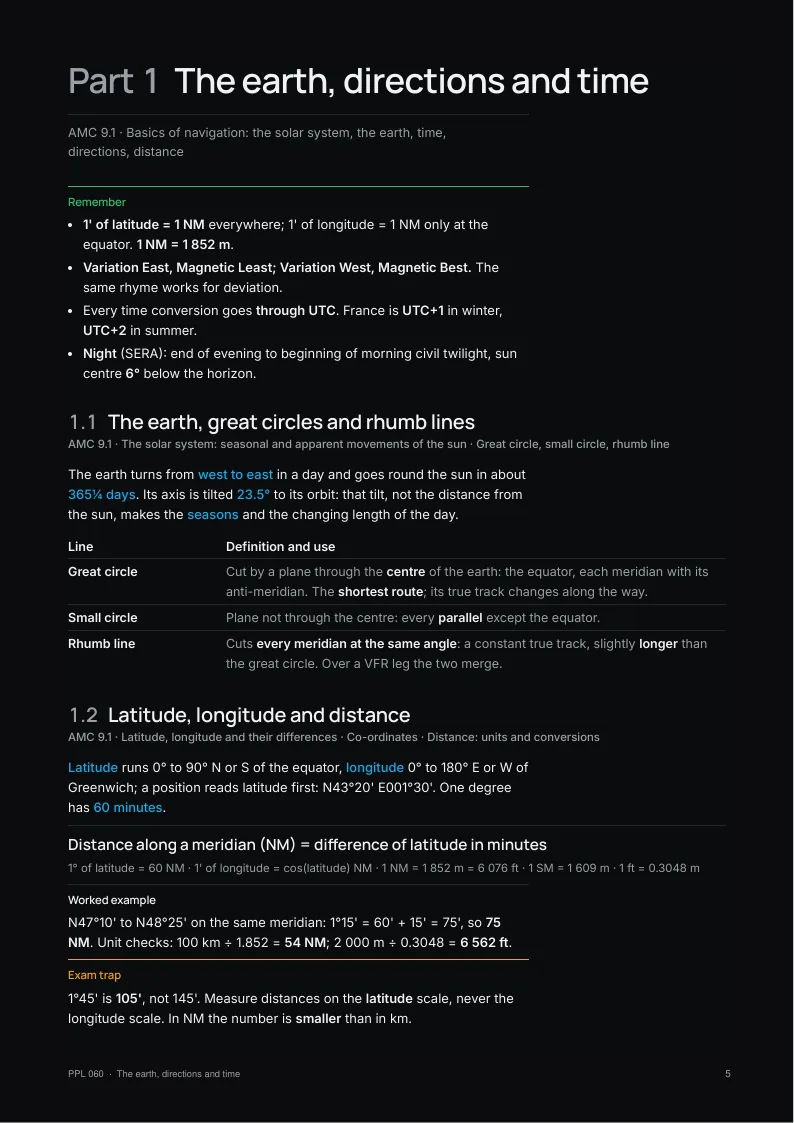
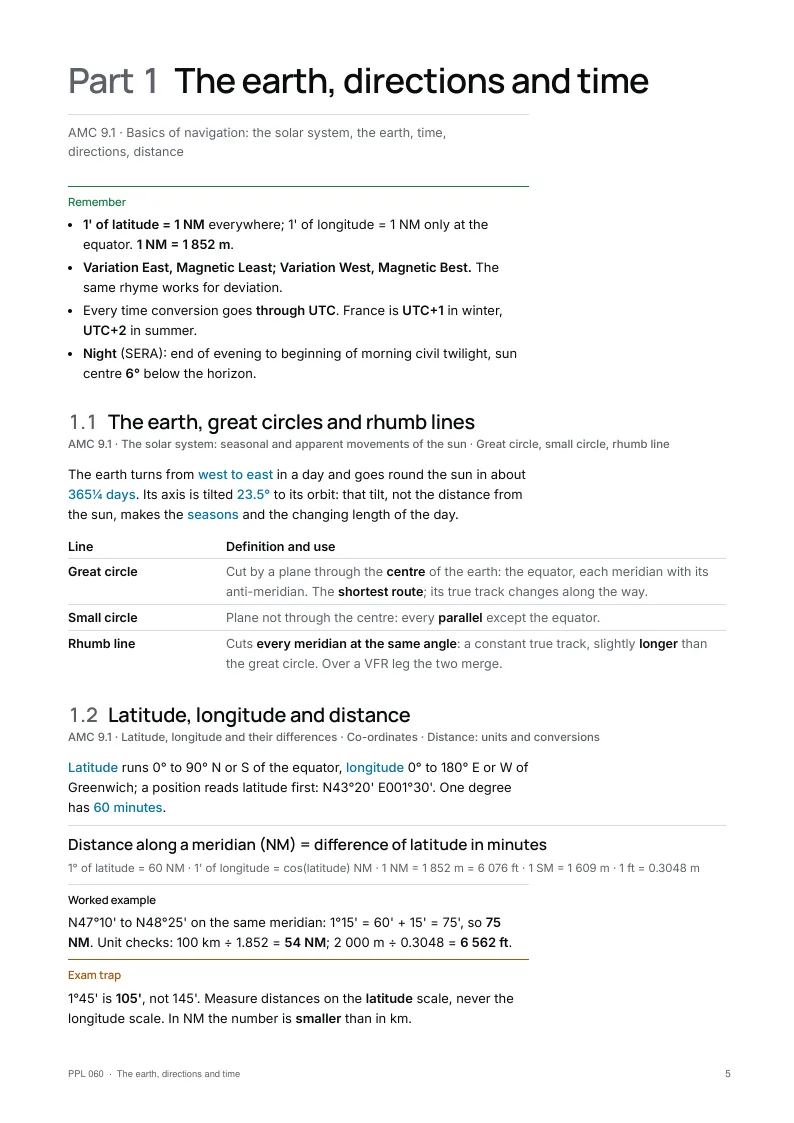
What the PPL 060 notes cover
Written on the EASA PPL(A) syllabus.
Checked against the primary texts.
An A4 PDF and a screen edition.
- Part 1
The earth, directions and time
Great circles, latitude and longitude, units, true and magnetic, UTC and night.
- Part 2
Magnetism and compasses
Earth magnetism, deviation, the acceleration and turning errors.
- Part 3
The chart
Mercator and Lambert, the ICAO 1:500 000 chart, scale, relief and symbols.
- Part 4
Dead reckoning and the computer
Triangle of velocities, drift, wind components, TAS, fuel and conversions.
- Part 5
In-flight navigation
Flight log, fixes, revised ETA, the 1 in 60 rule, fuel checks and diversions.
- Part 6
Radio navigation aids
Propagation and range, VDF, NDB and ADF, VOR, DME.
- Part 7
Radar, transponder and GNSS
Primary and secondary radar, modes and codes, GPS and its limits in VFR.
Exam traps in PPL 060 Navigation
A sample from Appendix B.
The full list is in the notes.
Exam trap
- Convert degrees to minutes before subtracting: 1°45' = 105'. Divide km by 1.852 to get NM.
- Variation or deviation West: magnetic or compass is the larger. Take the reciprocal for "the bearing of A from B".
- Tower and ATIS winds are magnetic; METAR, TAF and forecasts are true.
- Civil twilight: 6°, centre of the sun. Sunrise and sunset: upper edge.
- Lambert: measure at the mid-meridian. Obstacle: elevation first, height in brackets.
- ANDS on east and west only; turning onto north, roll out early. Southern hemisphere: the reverse.
Ten free PPL 060 Navigation questions
No account needed.
Pick an answer and the explanation opens.
The notes come with 1 month of all 80 questions and the mock exams.
1Which statement about great circles and rhumb lines is correct?
Show the answer
Answer C. A great circle is the intersection of the earth's surface with a plane through the centre of the earth: the equator and every meridian joined to its anti-meridian are great circles, and the shorter arc of a great circle is the shortest distance between two points. Parallels other than the equator are small circles. The line that cuts every meridian at the same angle is the rhumb line, which is longer than the great circle except along a meridian or the equator.
2The true heading is 087°, the variation is 2°E and the deviation card gives a deviation of 3°W on this heading. Which compass heading should the pilot fly?
Show the answer
Answer B. Work from true to compass, with east positive and west negative. Magnetic heading = true heading minus variation: 087 − 2 = 085°. Compass heading = magnetic heading minus deviation: 085 − (−3) = 088° (deviation west, compass best). 082° applies the deviation with the wrong sign and 092° applies the variation with the wrong sign.
3Which statement about the Lambert conformal conic projection, used for most ICAO 1:500 000 charts in Europe, is correct?
Show the answer
Answer A. The Lambert conformal conic projection is conformal, so angles measured on it are correct. Its meridians are straight lines converging towards the pole, a straight line drawn on it is very close to a great circle, and between its two standard parallels the scale is practically constant. Straight rhumb lines, parallel meridians and a scale increasing with latitude describe the Mercator projection.
4You plan a leg on a true track of 090°. TAS is 105 kt and the forecast wind is 040°/24 kt. What true heading must you fly and what will the groundspeed be?
Show the answer
Answer B. The wind blows from 50° left of the track, so the aeroplane must point into wind, to the left. Wind correction angle = arcsin(24 × sin 50° ÷ 105) = 10.1°, so the heading is 090 − 10 = 080°. Groundspeed = 105 × cos 10.1° − 24 × cos 50° = 88.0, that is 88 kt, because the wind has a headwind component. Turning to 100° applies the correction on the wrong side, and 119 kt treats the headwind component as a tailwind.
5On a 75 NM leg, after 45 NM you fix your position 3 NM right of the planned track. Using the 1 in 60 rule, what is the track error?
Show the answer
Answer A. Track error = distance off track × 60 ÷ distance flown = 3 × 60 ÷ 45 = 4°. The track error is computed on the distance already flown, not on the 30 NM still to go, which would give 6°. The distance off track in NM only equals the angle in degrees after 60 NM.
6Which of the following statements about the frequency bands used in light aircraft are correct?
1. VOR stations transmit between 108 and 118 MHz, in the VHF band.
2. NDBs transmit between 190 and 1,750 kHz, in the LF and MF bands.
3. DME operates in the VHF band, on the same frequency as the paired VOR.
4. VHF voice communications use the band from 118 to 137 MHz.Show the answer
Answer C. VOR uses 108.00 to 117.975 MHz and VHF communications 118.000 to 136.975 MHz, both in the VHF band (ICAO Annex 10). NDBs use 190 to 1,750 kHz, in the LF and MF bands. Statement 3 is false: DME works in the UHF band, between 962 and 1,213 MHz. Only its channel is paired with the VOR frequency, so selecting the VOR tunes the DME automatically.
7You call a VHF direction finding (VDF) station and receive "QDM 075". Which statement is correct?
Show the answer
Answer B. QDM is the magnetic bearing to the station, the magnetic heading to steer in nil wind to reach it; with wind, it is the magnetic track to follow. The reciprocal, 255°, is the QDR, the magnetic bearing from the station. QTE is the true bearing from the station and QUJ the true bearing to the station. Confusing QDM and QDR sends you directly away from the station.
8Which of the following statements about ground radar are correct?
1. A primary radar can detect an aircraft that has no transponder.
2. Mode A transmits the pressure altitude of the aircraft.
3. Code 7600 indicates a radio communication failure.
4. The secondary radar interrogates the transponder on 1,090 MHz.Show the answer
Answer B. A primary radar receives the energy reflected by the aircraft itself, so it needs no equipment on board. Code 7600 is the radio failure code, 7500 unlawful interference and 7700 emergency. Mode A only sends the 4-digit identity code; the altitude is added by mode C. The ground station interrogates on 1,030 MHz and the transponder replies on 1,090 MHz, so statement 4 reverses the two frequencies.
9What is the minimum number of satellites a GPS receiver needs for a three-dimensional position, and why?
Show the answer
Answer B. Each satellite gives a distance, measured from the time the signal takes to arrive. The receiver clock is not as accurate as the atomic clocks on board, so the measured distances are pseudo-ranges with a common clock error. Solving latitude, longitude, altitude and that clock error needs 4 satellites. A fifth is needed only for RAIM fault detection, not for the position itself.
10Aerodrome A is at N43°20' E001°30' and aerodrome B is at N45°05' E001°30'. What is the distance between A and B?
Show the answer
Answer A. Both aerodromes are on the same meridian, so the distance is the difference of latitude. From 43°20' to 45°05' is 1°45', that is 60' + 45' = 105', and one minute of latitude is 1 NM, so 105 NM. Reading 1°45' as 145' or as 1.75 × 100 gives the wrong values, and 194 is 105 × 1.852, the distance in km.
Keep practising.
The PPL 060 notes come with 1 month of its 80 questions.
The PPL pack: the notes of all nine subjects, with 2 months of all 698 questions.
Get PPL 060 Navigation
Pay once, no subscription.
Practise longer with its question bank.
The notes
€6.90 once
+ 1 month of its questions
PDF and screen edition, yours for life.
Updates included for 1 year.3 months of PPL 060 questions
€19 once
€6.33 / month
All 80 questions with explanations and the mock exams, for this subject only. Questions only: the notes are not included.
The other PPL subjects
- 010Air Law24 pages80 questions€6.90
- 020Aircraft General Knowledge24 pages80 questions€6.90
- 030Flight Performance and Planning22 pages80 questions€6.90
- 040Human Performance20 pages80 questions€6.90
- 050Meteorology24 pages80 questions€6.90
- 070Operational Procedures19 pages79 questions€6.90
- 080Principles of Flight21 pages80 questions€6.90
- 090Communications22 pages59 questions€6.90