ATPL(A) 010 Air LawRevision notes and practice questions
Air law stacks up in three layers: the Chicago Convention and its Annexes at the top, the European regulations next, national law last.
Knowing which layer a rule belongs to often settles a question on its own.
- 28 pages
- 547 questions
- €7.90 once
What the 010 notes cover
Written on the EASA Learning Objectives.
Checked against the primary texts.
An A4 PDF and a screen edition.
- Part 1010 01
International law
The Chicago Convention, the nineteen Annexes, the freedoms of the air, the other conventions and the European framework.
- Part 2010 02, 03 and 04
Airworthiness and licensing
Certificates, maintenance, registration marks, Part-FCL licences, ratings and medical fitness.
- Part 3010 05 and 06
Rules of the air
SERA, right of way, visual and instrument flight rules, altimetry and PANS-OPS procedures.
- Part 4010 07
Air traffic services
Airspace classes, separation, ATS units, clearances and flow management.
- Part 5010 08, 09 and 10
Information and aerodromes
AIP, AIRAC cycle, NOTAM, runway markings and lighting, rescue and fire fighting, facilitation.
- Part 6010 11, 12 and 13
SAR, security, investigation
Search and rescue, aviation security, accident investigation and occurrence reporting.
Exam traps in 010 Air Law
A sample from Appendix B.
The full list is in the notes.
Exam trap
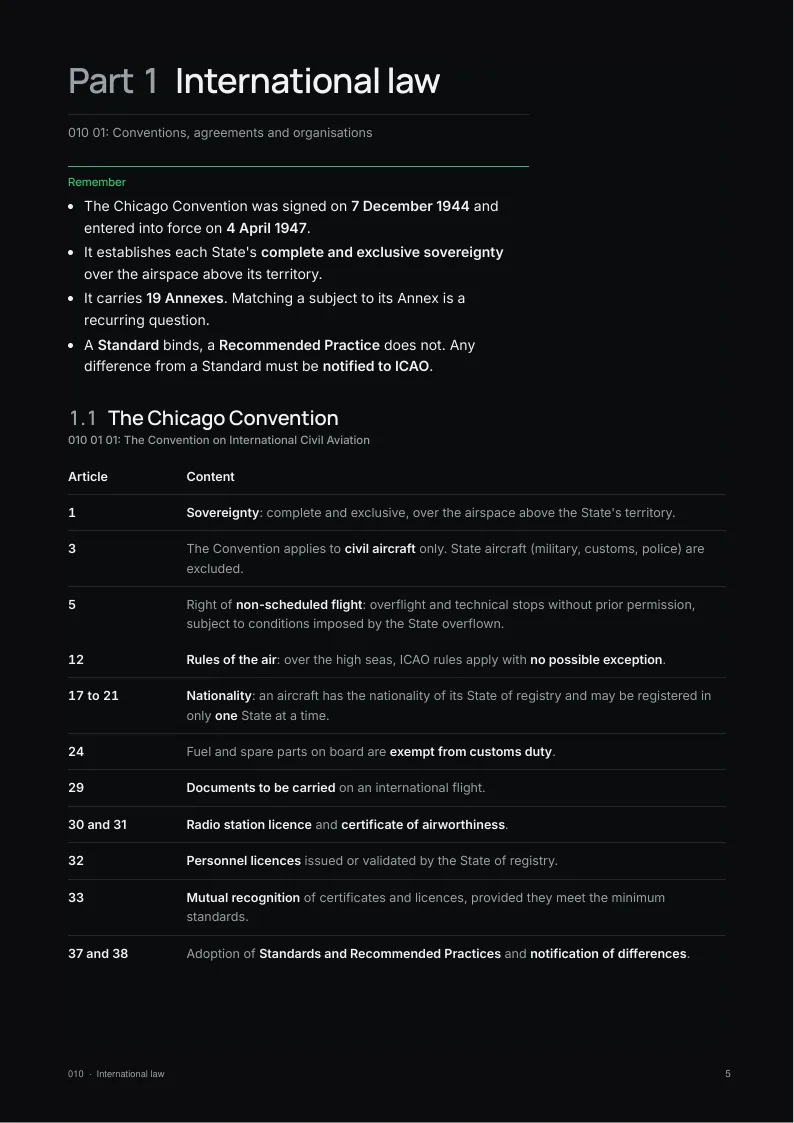
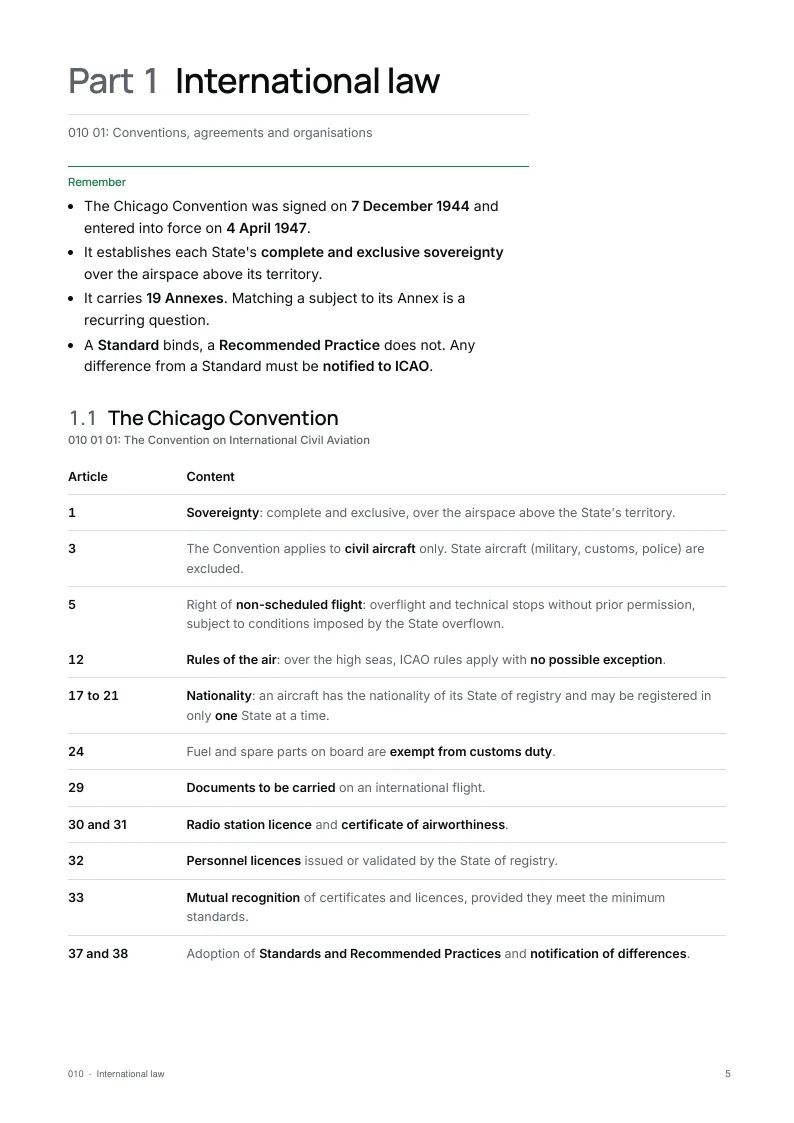
- The Chicago Convention does not apply to State aircraft.
- Over the high seas, ICAO rules apply with no possible derogation.
- A Standard binds, a Recommended Practice does not. Any difference from a Standard must be notified.
- The Transit Agreement grants two freedoms, the Transport Agreement five.
- The certificate of airworthiness has no expiry; it is the ARC that lasts one year.
- The licence does not expire; only the ratings and the medical certificate do.
The EASA 010 paper: 44 questions in 1 h. The exam rules →
Ten free 010 Air Law questions
No account needed.
Pick an answer and the explanation opens.
The notes come with 1 month of all 547 questions and the mock exams.
1Which statement about a Crew Member Certificate (CMC) is correct?
Show the answer
Answer C. Under ICAO Annex 9, a crew member holding a valid Crew Member Certificate and on duty is admitted for temporary entry without a visa, so the CMC takes the place of the visa. It is an identity document in its own right. The options that require it to be backed by a passport or visa plus a licence or logbook describe a condition that does not exist.
2An aircraft registered to a Canadian charter operator is to be used by an American travel agency for a flight between San Francisco and Miami. Can this flight be made without permission from the American authority?
Show the answer
Answer D. A flight between two points inside the United States is domestic traffic, in other words cabotage, and Article 7 of the Chicago Convention lets each State refuse that privilege to foreign aircraft. Both the aircraft and the operator are Canadian, so the flight needs specific permission from the American authority. The nationality of the customer, here an American travel agency, changes nothing.
3What is the subject of ICAO Annex 2?
Show the answer
Answer D. Annex 2 contains the Rules of the Air. Annex 1 covers personnel licensing, Annex 7 aircraft nationality and registration marks and Annex 11 air traffic services.
4For a single-pilot multi-engine class rating, how many flight hours are required and how long is the rating valid?
Show the answer
Answer B. Before a first single-pilot multi-engine class or type rating, the applicant needs 70 hours of experience as pilot-in-command of aeroplanes. Class and type ratings are valid for 1 year; the single exception with 2 years is the single-pilot single-engine class rating. The 200-hour figure has nothing to do with the multi-engine class rating.
5Radio contact with the intercepting aircraft has been established, but no common language is possible. Which phrase should the intercepted aircraft use to say that its position is unknown?
Show the answer
Answer C. When intercepting and intercepted aircraft share no common language, Annex 2 provides a short table of standard phrases, each transmitted twice. For the intercepted aircraft, AM LOST (pronounced AM LOSST) means position unknown. The other expressions sound plausible but are not in the table, so they would not be understood as standard phraseology.
6An aircraft is flying VFR in Class B airspace. The controller...
Show the answer
Answer C. Class B is the only class in which all flights, IFR and VFR, are separated from each other, so a VFR flight is separated from other VFR flights as well as from IFR traffic. Separation can be vertical or horizontal, whichever the controller uses. In class C VFR flights are only separated from IFR flights, and from class D downwards VFR flights receive no separation.
7Which of the following elements shall be included in an ATIS message containing both arrival and departure information?
Show the answer
Answer A. A combined arrival and departure ATIS includes the runway in use, the surface wind in degrees magnetic, visibility or RVR, weather and cloud, temperature and dew point, the altimeter setting and the transition level, plus any essential operational information. The wind is given in magnetic degrees, not true, and it is the transition level, not the published transition altitude, that is broadcast.
8For a flight to a destination in another country, which part of the AIP should you consult to find the transition altitude used in that country?
Show the answer
Answer A. Each State's AIP is divided into GEN, ENR and AD parts. The transition altitude is a national altimeter setting rule, so it is published in the ENR part with the altimeter setting procedures (ENR 1.7). GEN holds general regulations, units and charges, AD describes the individual aerodromes, and SUP is not a part of the AIP but a supplement for temporary changes.
9What is the correct definition of "PCN"?
Show the answer
Answer B. The pavement classification number (PCN) expresses the bearing strength of a pavement for unrestricted operations. An aircraft whose classification number (ACN) is equal to or less than the PCN may use the pavement without restriction. The first option describes the ACN, the aircraft's effect on the pavement.
10According to the air-to-ground signals of ICAO Annex 12, if survivors see an aircraft rocking its wings during the hours of...
Show the answer
Answer C. Rocking the wings is the daylight signal by which an aircraft tells survivors that their ground signals have been understood. At night the equivalent is flashing the landing lights, or the navigation lights if there are none, on and off twice. The absence of either signal means the message has not been understood, so there is no specific 'not understood' manoeuvre.
Keep practising.
The 010 notes come with 1 month of its 547 questions.
The pack: the notes of all thirteen subjects, with 2 months of all 6,295 questions.
Get 010 Air Law
Pay once, no subscription.
Practise longer with its question bank.
The notes
€7.90 once
+ 1 month of its questions
PDF and screen edition, yours for life.
Updates included for 1 year.3 months of 010 questions
€39 once
€13.00 / month
All 547 questions with explanations and the mock exams, for this subject only. Questions only: the notes are not included.
The other subjects
- 021Airframe, Systems, Powerplant50 pages551 questions€19.90
- 022Instrumentation29 pages568 questions€11.90
- 031Mass & Balance30 pages328 questions€11.90
- 032Performance25 pages461 questions€7.90
- 033Flight Planning & Monitoring31 pages311 questions€11.90
- 040Human Performance46 pages578 questions€19.90
- 050Meteorology43 pages447 questions€19.90
- 061General Navigation49 pages417 questions€19.90
- 062Radio Navigation29 pages512 questions€11.90
- 070Operational Procedures40 pages531 questions€15.90
- 081Principles of Flight39 pages516 questions€15.90
- 090Communications27 pages528 questions€7.90