PPL(A) 090 CommunicationsRevision notes and practice questions
Communications is the paper on the words a VFR pilot says on the radio, in what order, and what must be read back.
The French DGAC paper has 8 questions; 75 %, that is 6 correct answers, is a pass.
Learn the lists in Appendix A by heart, say the phrases aloud, then reread the traps in Appendix B the night before.
- 22 pages
- 59 questions
- €6.90 once
French DGAC exam: 8 questions, 75 % to pass (6 correct).
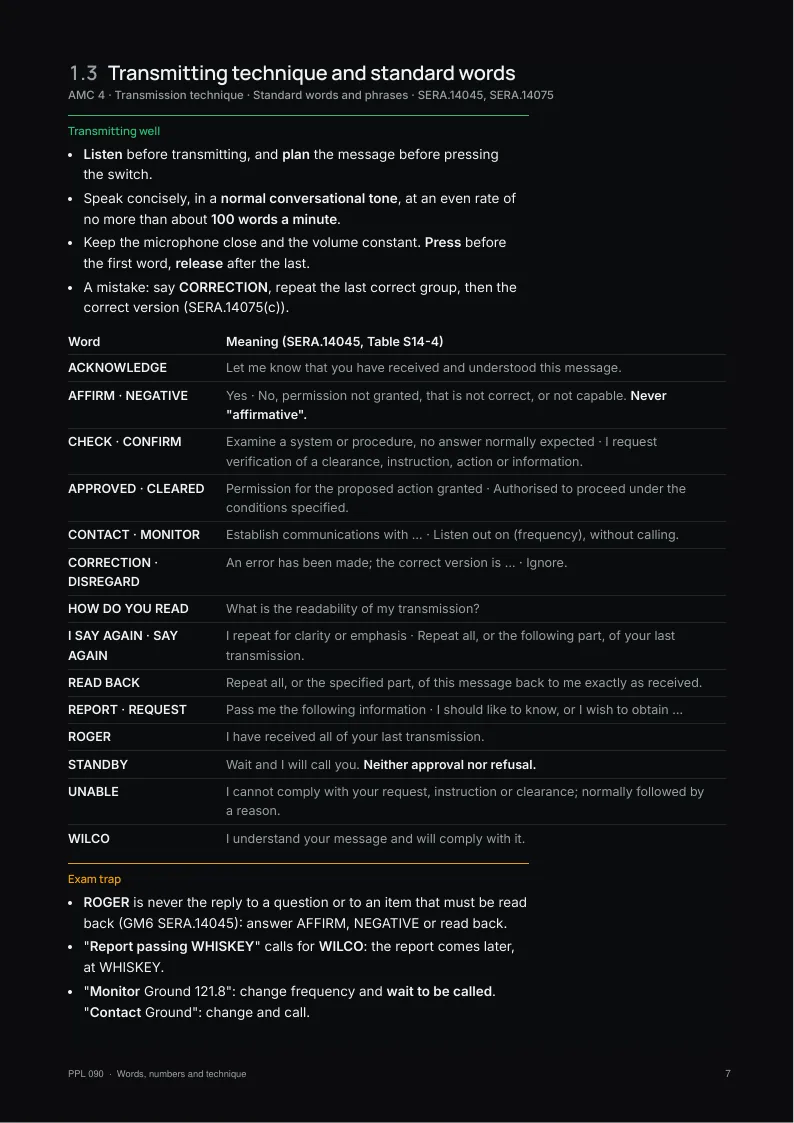
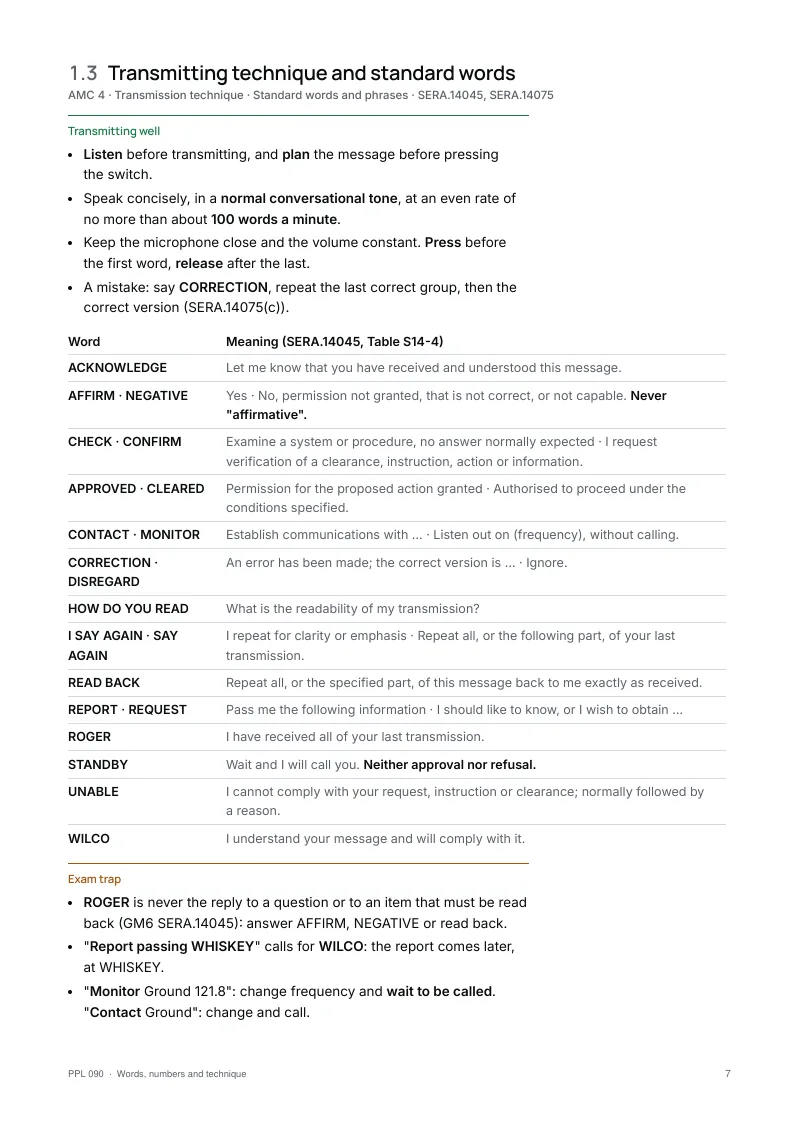
What the PPL 090 notes cover
Written on the EASA PPL(A) syllabus.
Checked against the primary texts.
An A4 PDF and a screen edition.
- Part 1
Words, numbers and technique
Terms, Q-codes, categories of message, alphabet, numbers, time and the standard words.
- Part 2
Call signs, read-back and general procedures
AMC 4 · R/T call signs for stations and aircraft · Transfer of communication · Test procedures · Read-back · SERA.14050 to SERA.14070, SERA.8015(e)
- Part 3
At the aerodrome and in the circuit
Taxi, line-up, conditional clearance, take-off, circuit calls, landing, AFIS and A/A.
- Part 4
En route: FIS, transit, weather information
AMC 4 · Standard words and phrases · Relevant weather information terms (VFR): aerodrome weather, weather broadcast · SERA.8025, SERA.9005, SERA.9010
- Part 5
Failure, urgency and distress
Radio failure, light signals, MAYDAY and PAN PAN, 121.5 MHz, VHF range.
Exam traps in PPL 090 Communications
A sample from Appendix B.
The full list is in the notes.
Exam trap
- ROGER never answers a question and never replaces a read-back. Yes is AFFIRM, not "affirmative".
- STANDBY authorises nothing and refuses nothing. MONITOR: listen, do not call.
- Headings, runways, wind and call signs go digit by digit: "HEADING ONE ZERO ZERO", never "one hundred".
- 2 500 ft is "TWO THOUSAND FIVE HUNDRED"; FL 100 is "ONE HUNDRED"; QNH 1000 is "ONE THOUSAND".
- First call: station called first, full call sign. Abbreviate only after the ground station has done so.
- Read back the runway, QNH, squawk and frequency; the wind and traffic information are not read back.
Ten free PPL 090 Communications questions
No account needed.
Pick an answer and the explanation opens.
The notes come with 1 month of all 59 questions and the mock exams.
1Which of the following is the ICAO definition of a blind transmission?
Show the answer
Answer A. ICAO Annex 10 Volume II defines a blind transmission as one made where two-way communication cannot be established but where it is believed that the called station can receive it. A pilot with a receiver failure uses it, prefixing the message with "transmitting blind" and giving position and intentions. A transmission not addressed to a specific station is a broadcast, such as ATIS or VOLMET. With a failed transmitter nothing can be sent at all, so a blind transmission would be pointless.
2The pilot of D-EFGH makes the first call to Bremen Tower to establish communication. Which call is correct?
Show the answer
Answer B. SERA.14055(b)(1) requires full call signs when establishing communication, with the call starting with the designation of the station called, followed by the call sign of the calling aircraft. The tower replies with the aircraft call sign followed by its own, which invites the pilot to pass the message. Reversing the order is the reply format, not the call, and "Delta Golf Hotel" is an abbreviated call sign, which is not allowed on first contact.
3Before a VFR departure, the tower instructs: "F-GTPO, taxi to holding point runway 27 via Alpha, QNH 1015." Which read-back is correct?
Show the answer
Answer D. The altimeter setting and the runway in use must be read back under SERA.8015(e)(1)(iii), and taxi instructions must be read back or acknowledged so that it is clear they are understood (SERA.8015(e)(2)). The full read-back with route, holding point, runway and QNH, ended by the call sign, leaves no doubt. Leaving out the QNH or the runway is the typical incomplete read-back, and "roger" does not confirm the taxi route.
4Which of the following statements about a flight information service (FIS) are correct?
1. Once contact is established, the pilot passes call sign, aircraft type, departure and destination, position, level and intentions.
2. The FIS unit may clear a VFR flight to enter a control zone.
3. Traffic information passed by the FIS does not relieve the pilot of the responsibility to avoid collisions.
4. All traffic information received from the FIS must be read back in full.Show the answer
Answer B. A flight information service gives information useful for the safe conduct of the flight, such as traffic, weather and aerodrome status, but it issues no clearances: only an ATC unit can clear you into a control zone. Receiving FIS does not relieve the pilot-in-command of any responsibility (SERA.9001(b)), so the pilot remains responsible for avoiding other traffic. The content of the initial call is prescribed by the service provider (SERA.14060(b)): in practice call sign, type, departure and destination, position, level and intentions. Traffic information is acknowledged, for example with 'traffic in sight' or 'looking out', and is not part of the items that SERA.8015(e) requires to be read back.
5Which statement about the automatic terminal information service (ATIS) is correct?
Show the answer
Answer D. The ATIS of an aerodrome is updated whenever a significant change occurs, and each new version is identified by the next letter of the ICAO spelling alphabet. On first contact the pilot states, for example, 'information Bravo', which tells the controller that the current information has been received; if it is out of date, the controller passes the changes. ATIS has its own frequency, never 121.5 MHz, and the regional broadcast of reports and forecasts for several aerodromes is VOLMET.
6En route, the FIS operator instructs you to contact Lyon Approach on 120.705 MHz. Your calls on that frequency remain unanswered, although you have checked the frequency selected, the volume, the squelch and the headset. What should you do next?
Show the answer
Answer A. When contact cannot be established on the designated frequency, the first step after checking the equipment is to try the previous frequency, then another frequency suitable for the route (ICAO Annex 10 Volume II, SERA.14085). Blind transmission comes only once these attempts have failed. Code 7700 and MAYDAY are for distress, not for a radio problem, and a radio failure never authorises entry into a control zone without a clearance.
7For which of the following situations is the distress signal MAYDAY the appropriate prefix?
1. The engine has failed over wooded terrain and a forced landing is inevitable.
2. You are uncertain of your position but have fuel for more than 1 hour and good visibility.
3. A passenger feels unwell and you request priority to land, with no immediate danger to the aircraft.
4. Smoke and a smell of burning fill the cockpit.Show the answer
Answer C. Distress is a condition of grave and imminent danger requiring immediate assistance: an engine failure leading to a forced landing and a fire or smoke in the cockpit are distress situations, announced by MAYDAY. Urgency concerns the safety of the aircraft or of a person on board without requiring immediate assistance, announced by PAN PAN: an unwell passenger or a pilot unsure of position with fuel and visibility in hand. Using PAN PAN for an engine failure in a single-engine aeroplane understates the danger and delays help (SERA.14095).
8Which of the following statements about aeronautical VHF communications are correct?
1. Voice communications use the band 118.000 to 136.975 MHz.
2. VHF waves are reflected by the ionosphere, which gives long ranges at low altitude.
3. In remote areas out of range of ground stations, 123.45 MHz is designated for air-to-air communications between pilots.
4. With 8.33 kHz channel spacing, channel 118.005 is spoken 'ONE ONE EIGHT DECIMAL ZERO'.Show the answer
Answer C. Aeronautical voice communications use 118.000 to 136.975 MHz, and 123.45 MHz is the air-to-air channel for areas out of range of VHF ground stations. VHF travels in a straight line and is not reflected by the ionosphere, so the range depends on height and is cut by terrain. With 8.33 kHz spacing, all 6 digits are spoken, 'ONE ONE EIGHT DECIMAL ZERO ZERO FIVE'; only when the fifth and sixth digits are both zero are the first 4 digits enough. 'ONE ONE EIGHT DECIMAL ZERO' designates channel 118.000, a different channel.
9Which of the following statements about standard words and phrases are correct?
1. WILCO means: I understand your message and will comply with it.
2. ROGER is an acceptable reply to an instruction that must be read back.
3. STANDBY means: wait and I will call you.
4. AFFIRMATIVE is the standard word for yes.Show the answer
Answer C. WILCO means "I understand your message and will comply with it", and STANDBY means "wait and I will call you": it is neither an approval nor a refusal. ROGER only means "I have received all of your last transmission" and must never be used in reply to an instruction requiring read-back or to a question requiring AFFIRM or NEGATIVE (ICAO Doc 9432). The standard word for yes is AFFIRM, not "affirmative", which is easily confused with "negative" on a poor frequency.
10Your aeroplane is F-GTPO. Two-way communication with the tower is now satisfactory, but the controller keeps addressing you as "Foxtrot Golf Tango Papa Oscar". Which call sign do you use in your next transmission?
Show the answer
Answer A. SERA.14055(c)(1) allows abbreviated call signs only once satisfactory communication is established and no confusion is likely, and an aircraft uses its abbreviated call sign only after the aeronautical station has addressed it in that manner. The abbreviated form of a registration call sign is the first character and at least the last two (SERA.14050(b)), so F-GTPO would become "Foxtrot Papa Oscar". Abbreviating on your own initiative, even after good contact, is the classic error.
Keep practising.
The PPL 090 notes come with 1 month of its 59 questions.
The PPL pack: the notes of all nine subjects, with 2 months of all 698 questions.
Get PPL 090 Communications
Pay once, no subscription.
Practise longer with its question bank.
The notes
€6.90 once
+ 1 month of its questions
PDF and screen edition, yours for life.
Updates included for 1 year.3 months of PPL 090 questions
€19 once
€6.33 / month
All 59 questions with explanations and the mock exams, for this subject only. Questions only: the notes are not included.
The other PPL subjects
- 010Air Law24 pages80 questions€6.90
- 020Aircraft General Knowledge24 pages80 questions€6.90
- 030Flight Performance and Planning22 pages80 questions€6.90
- 040Human Performance20 pages80 questions€6.90
- 050Meteorology24 pages80 questions€6.90
- 060Navigation24 pages80 questions€6.90
- 070Operational Procedures19 pages79 questions€6.90
- 080Principles of Flight21 pages80 questions€6.90