PPL(A) 080 Principles of FlightRevision notes and practice questions
Principles of flight explains why the aeroplane flies, stalls, turns and stays stable.
The French DGAC paper has 12 questions; 75 %, that is 9 correct answers, is a pass.
Learn the reasoning, run the worked examples again, then reread the traps in Appendix B the night before.
- 21 pages
- 80 questions
- €6.90 once
French DGAC exam: 12 questions, 75 % to pass (9 correct).
What the PPL 080 notes cover
Written on the EASA PPL(A) syllabus.
Checked against the primary texts.
An A4 PDF and a screen edition.
- Part 1
Lift and the aerofoil
Bernoulli, dynamic pressure, the aerofoil, the lift formula and CL.
- Part 2
Drag and the lift-to-drag ratio
Induced and parasite drag, best L/D, wake turbulence, ground effect.
- Part 4
Stability and control
The three axes, centre of gravity, dihedral, adverse yaw, tabs and trim.
- Part 5
Limitations and the propeller
Speed limits, flutter, the V-n diagram, VA, gusts, propeller effects.
- Part 6
Flight mechanics
Forces in level flight, climb, descent, glide and the level turn.
Exam traps in PPL 080 Principles of Flight
A sample from Appendix B.
The full list is in the notes.
Exam trap
- A narrowing lowers the static pressure of a subsonic flow. Double the speed: lift (same angle of attack) and parasite drag × 4, induced drag (level flight) ÷ 4.
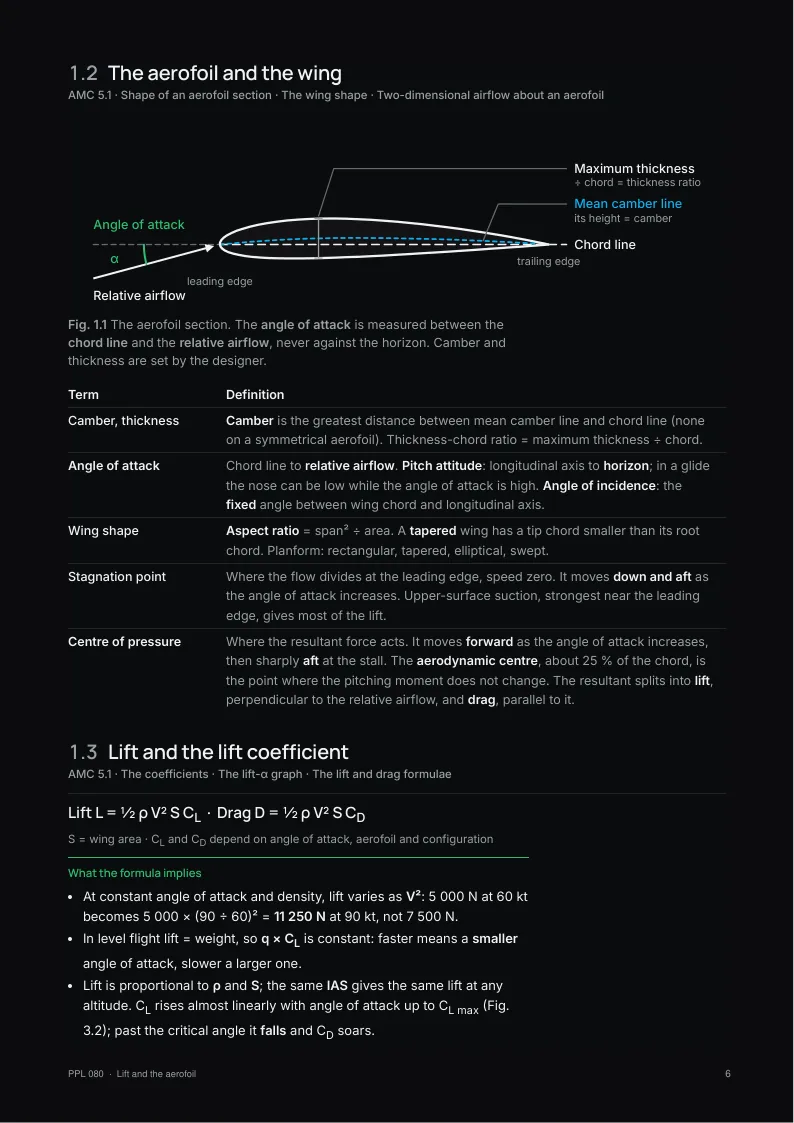
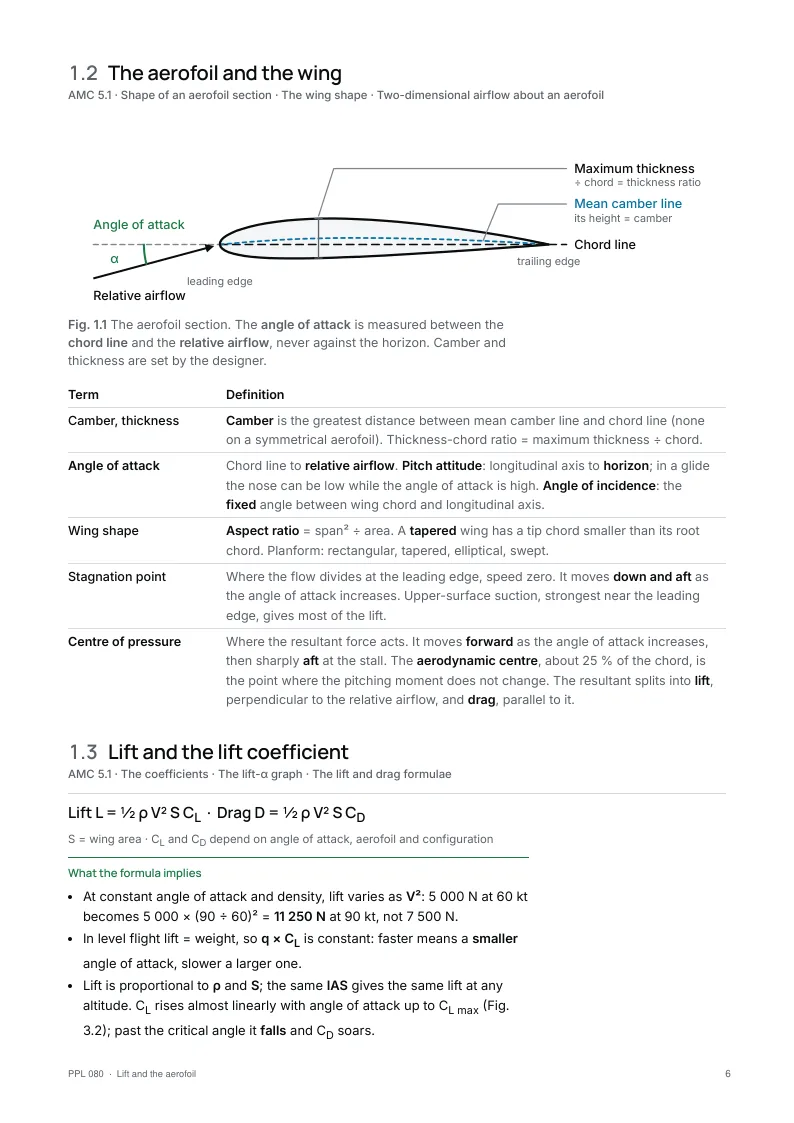
- Angle of attack is against the relative airflow; attitude against the horizon; incidence is fixed.
- The centre of pressure moves; the aerodynamic centre stays near 25 %. Best L/D does not change with mass.
- The critical angle is constant, not the stalling speed; speeds go through a square root. A forward CG raises VS.
- Flaps lower the stalling angle, slats raise it. With ice the stall can come before the warning.
- Skidding onto final: the inner wing stalls. Spin: speed low and steady; spiral dive: speed rising.
Ten free PPL 080 Principles of Flight questions
No account needed.
Pick an answer and the explanation opens.
The notes come with 1 month of all 80 questions and the mock exams.
1Air flows steadily through a venturi tube at low subsonic speed. Compared with the wide entry section, what happens in the narrow throat?
Show the answer
Answer C. The continuity equation says that the mass flow is the same through every section, so the air must speed up where the section narrows. Bernoulli's equation then says that the sum of static and dynamic pressure stays constant along a streamline: as dynamic pressure rises, static pressure falls. The same mechanism produces the low pressure over the curved upper surface of a wing. Thinking that a squeezed flow means a higher pressure is the classic trap.
2At a constant angle of attack and air density, a wing produces 6,000 N of lift at 50 kt TAS. What lift does it produce at 100 kt TAS?
Show the answer
Answer C. Lift is L = ½ρV²SCL. With density, wing area and CL (fixed by the angle of attack) unchanged, lift varies with the square of the TAS. The speed ratio is 100 ÷ 50 = 2, so lift is multiplied by 2² = 4: 6,000 × 4 = 24,000 N. Assuming that lift doubles with the speed gives the tempting 12,000 N. In level flight lift must equal weight, which is why the pilot lowers the angle of attack as the speed increases.
3Which statement about the induced drag of a light aeroplane in level flight is correct?
Show the answer
Answer A. Induced drag is the by-product of lift: the wingtip vortices create downwash, which tilts the lift vector rearwards. At low speed the wing needs a high angle of attack, so the vortices are strong and induced drag is high; it falls roughly as 1 ÷ V² as the speed increases. A high aspect ratio or winglets weaken the tip vortices and reduce it. The drag that rises with the square of the speed is parasite drag (form, skin friction and interference).
4With a clean wing, an aeroplane stalls at an angle of attack of 16° in wings-level flight at maximum mass. At a lower mass in a steep turn, same configuration, at what angle of attack will it stall?
Show the answer
Answer D. For a given configuration at low Mach number, a wing always stalls at the same critical angle of attack, whatever the speed, mass, attitude or load factor. Mass and load factor change only the speed at which that angle is reached: a lower mass lowers the stalling speed, a higher load factor raises it. That is why an aeroplane can stall at any speed and in any attitude. Flaps, ice or contamination do change the critical angle, but they are excluded here because the wing is clean and the configuration unchanged.
5Compared with the clean configuration, what is the effect of extending trailing-edge flaps on the wing?
Show the answer
Answer D. Trailing-edge flaps increase the camber of the wing (and its area for a Fowler flap), which shifts the lift curve upwards and to the left: CL max increases, but the critical angle of attack is reached earlier. They also add drag, which allows a steeper approach, and because the required CL is obtained at a smaller angle of attack the aeroplane flies a given speed at a lower nose attitude. A higher stalling angle is the effect of a leading-edge slat or slot, not of a flap.
6After a gust, an aeroplane pitches back towards its trimmed attitude, overshoots it and then oscillates with increasing amplitude. How is its longitudinal stability described?
Show the answer
Answer B. Static stability is the initial tendency after a disturbance: here the aeroplane starts back towards its trimmed attitude, so it is statically stable. Dynamic stability describes the motion over time, and oscillations that grow are dynamically unstable. A statically unstable aeroplane can never be dynamically stable, because it diverges from the start.
7A pilot rolls into a left turn using ailerons only, and the nose briefly yaws to the right. What causes this, and which design feature reduces it?
Show the answer
Answer B. This is adverse yaw: the down-going aileron on the rising right wing increases its lift and therefore its induced drag, which pulls that wing back and yaws the nose away from the turn. Differential ailerons move further up than down, and Frise ailerons push the nose of the up-going aileron into the airflow, both adding drag on the descending wing to balance it. The pilot corrects the rest with rudder in the direction of the turn, keeping the balance ball centred.
8A light aeroplane is certified in the normal category under the traditional CS-23 / FAR 23 rules (the rules in force before the 2017 rewrite of CS-23). What are its limit manoeuvring load factors, flaps up?
Show the answer
Answer D. The traditional CS 23.337 and FAR 23.337 set a positive limit manoeuvring load factor of 3.8 for the normal category and a negative one of 0.4 times that value, that is -1.52. The utility category goes to +4.4 and -1.76, and the aerobatic category to +6.0 and -3.0. The values +2.5 and -1.0 belong to large transport aeroplanes under CS-25. The limit load factor is the largest load expected in service; the structure must carry 1.5 times that value, the ultimate load, without failing. Since 2017 CS-23 amendment 5 has moved these figures out of the rule into industry standards, but the limits of the light aeroplanes in service remain those of their flight manual, built on these traditional values.
9Why does the blade angle of a propeller decrease from the root to the tip?
Show the answer
Answer D. The blade angle is measured between the chord and the plane of rotation, and the local relative airflow combines the forward speed with the rotational speed, which grows with the distance from the hub. Twist reduces the blade angle towards the tip so that every section works at a similar, efficient angle of attack. A fixed-pitch propeller is efficient at one speed only, whereas a constant-speed propeller changes its blade angle to hold the selected rpm: fine pitch for take-off, coarser pitch in cruise.
10Which statements about the forces on an aeroplane in steady, unaccelerated flight are correct?
1. In straight and level flight, lift equals weight and thrust equals drag.
2. In a steady straight climb, lift is slightly less than the weight.
3. In a steady straight climb, thrust is greater than drag.
4. In a steady straight climb, lift is greater than weight, which is what makes the aeroplane climb.Show the answer
Answer B. In level flight the four forces balance in pairs: lift against weight and thrust against drag. In a steady climb, part of the weight acts backwards along the flight path, so thrust must equal drag plus that component, and lift only has to balance the rest of the weight, which makes it slightly smaller than the weight. Excess thrust, not excess lift, makes an aeroplane climb.
Keep practising.
The PPL 080 notes come with 1 month of its 80 questions.
The PPL pack: the notes of all nine subjects, with 2 months of all 698 questions.
Get PPL 080 Principles of Flight
Pay once, no subscription.
Practise longer with its question bank.
The notes
€6.90 once
+ 1 month of its questions
PDF and screen edition, yours for life.
Updates included for 1 year.3 months of PPL 080 questions
€19 once
€6.33 / month
All 80 questions with explanations and the mock exams, for this subject only. Questions only: the notes are not included.
The other PPL subjects
- 010Air Law24 pages80 questions€6.90
- 020Aircraft General Knowledge24 pages80 questions€6.90
- 030Flight Performance and Planning22 pages80 questions€6.90
- 040Human Performance20 pages80 questions€6.90
- 050Meteorology24 pages80 questions€6.90
- 060Navigation24 pages80 questions€6.90
- 070Operational Procedures19 pages79 questions€6.90
- 090Communications22 pages59 questions€6.90