ATPL(A) 031 Mass & BalanceRevision notes and practice questions
Two questions (and only two): is the aeroplane too heavy; and is the load in the right place.
Everything else follows from those.
- 30 pages
- 328 questions
- €11.90 once
What the 031 notes cover
Written on the EASA Learning Objectives.
Checked against the primary texts.
An A4 PDF and a screen edition.
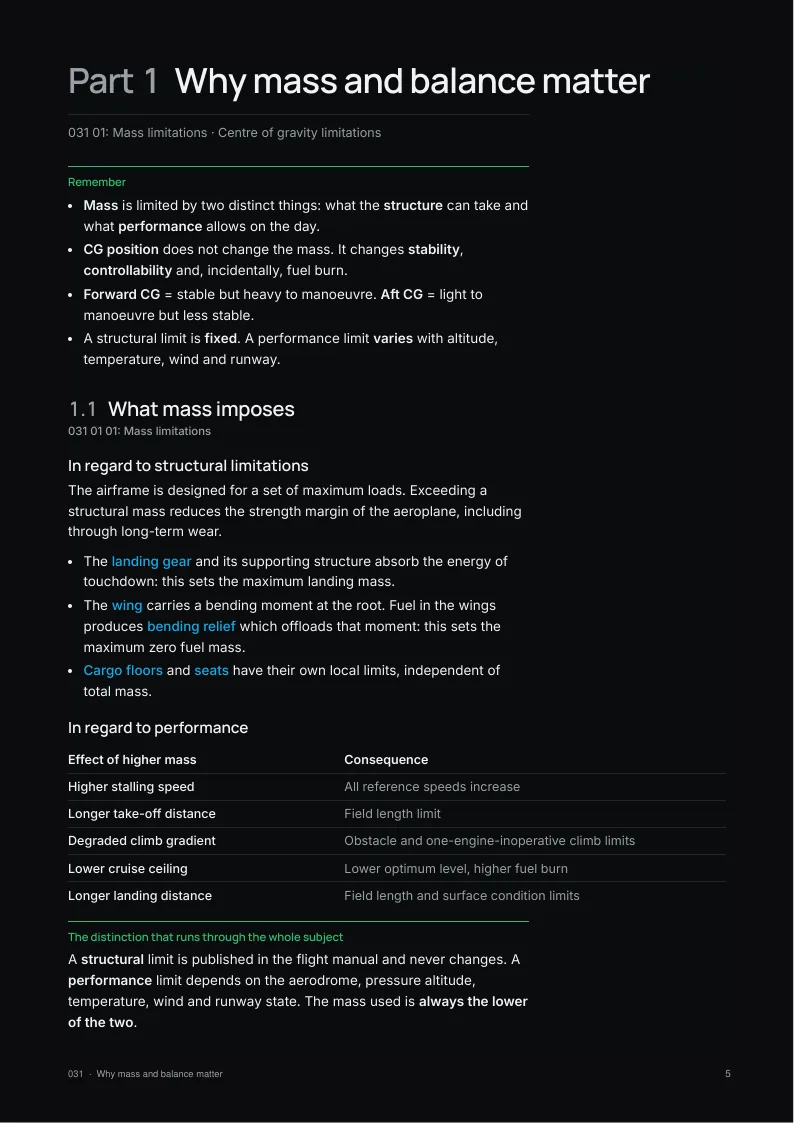
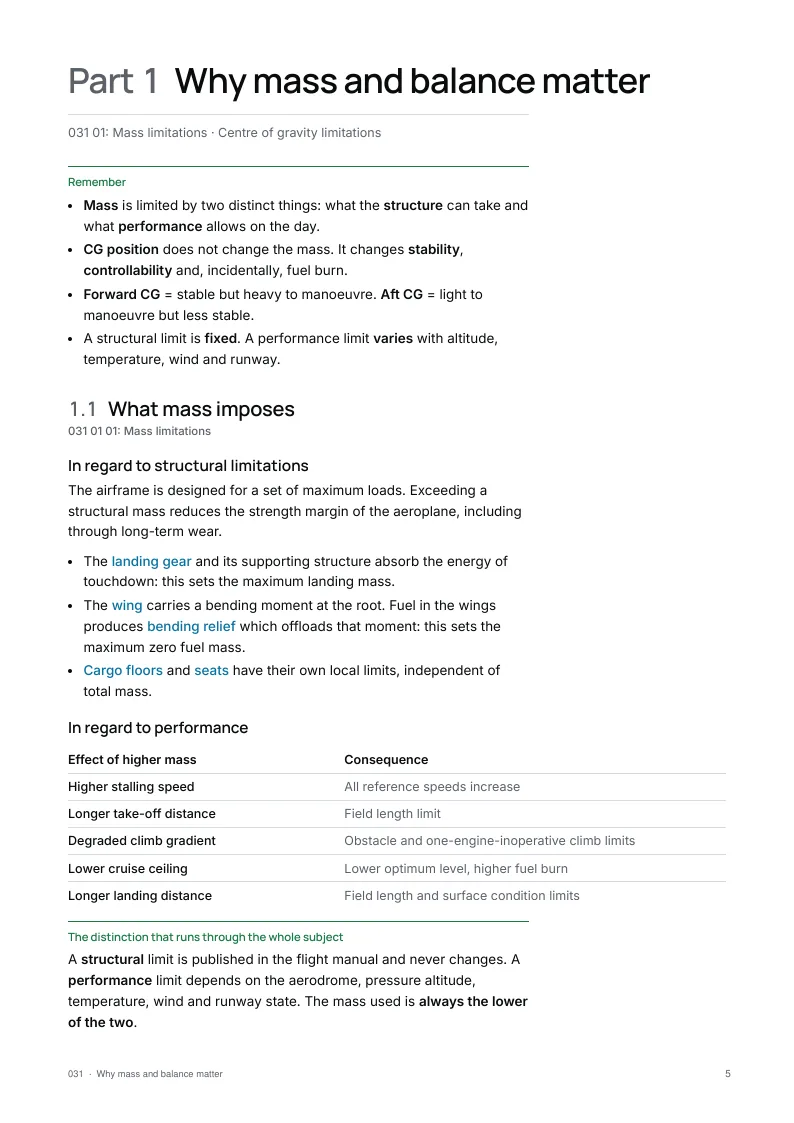
- Part 1031 01
Why mass and balance matter
What mass imposes on structure and performance and what centre of gravity position imposes on stability and controllability.
- Part 2031 02
Loading and limits
Mass terminology, the BEM → DOM → ZFM → TOM chain, structural and performance limits and the regulatory standard masses.
- Part 3031 03
CG fundamentals
Datum, arm and moment. The centre of gravity calculation is one division, provided you do not get the signs wrong.
- Part 4031 04
Documentation and weighing
What the mass and balance documentation contains, how weighing is carried out and the fleet mass rules.
- Part 5031 05
Determining and moving the CG
Arithmetic, graphic and index methods. Load and trim sheets. Shifting, adding and removing load and ballast.
- Part 6031 06
Cargo and holds
Cargo types, floor area load and running load. Followed by the appendices: formulae, traps, key terms, corrections and sources.
Exam traps in 031 Mass & Balance
A sample from Appendix B.
The full list is in the notes.
Exam trap
- Using block fuel instead of take-off fuel in the TOM. Taxi fuel is subtracted.
- Forgetting to bring the landing limit back to take-off by adding trip fuel.
- Confusing MZFM (wing bending) with MSLM (landing gear energy).
- Counting the crew in the traffic load. They are already in the DOM.
- Applying the all adult column below 30 seats.
- Counting hand baggage or an infant on the lap separately: both are already included.
The EASA 031 paper: 25 questions in 1 h 15. The exam rules →
Ten free 031 Mass & Balance questions
No account needed.
Pick an answer and the explanation opens.
The notes come with 1 month of all 328 questions and the mock exams.
1An aircraft is loaded according to the data below. If 250 kg of the cargo is moved to a station at an arm of 8.21 m, which statement about the new take-off CG position is correct?
Take-off mass: 17 800 kg
Cargo mass: 420 kg (moment arm: 18.57 m)
Take-off CG position: 13.41 m
Forward CG limit: 13.28 m
Aft CG limit: 15.65 mShow the answer
Answer C. The 250 kg moves forward by 18.57 − 8.21 = 10.36 m, so the CG shifts forward by 250 × 10.36 / 17 800 = 0.1455 m. New CG = 13.41 − 0.1455 = 13.2645 m. The forward limit is 13.28 m, so the CG is now 13.28 − 13.2645 = 0.0155 m, about 16 mm, ahead of it. The total mass is unchanged because the cargo is only repositioned; applying the shift in the wrong direction is what leads to the 'aft of the forward limit' options.
2What can happen if an aircraft is loaded incorrectly so that its Centre of Gravity lies ahead of the forward limit?
Show the answer
Answer B. With the CG ahead of the forward limit the aeroplane is nose-heavy and very stable in pitch. The tailplane needs a large download, so the pilot must use large elevator deflections and high stick forces to rotate or flare, and the forces may become too great to control the aircraft properly. The aircraft is sluggish rather than over-manoeuvrable, and over-pitching in the flare or a lack of forward control are symptoms of an aft CG.
3Using the information below, what is the underload or overload?
Allowed take-off mass: 4300 kg
Operating mass: 3253 kg
Total fuel mass: 650 kg
Mass of the crew and their baggage: 185 kg
Traffic load: 1015 kgShow the answer
Answer A. The Operating Mass already includes the DOM (with the crew and their baggage) and the fuel. The actual take-off mass is therefore 3253 + 1015 = 4268 kg, which is 4300 − 4268 = 32 kg below the allowed take-off mass: an underload of 32 kg. Adding the crew again (4453 kg, an overload of 153 kg) or the fuel again (4918 kg, an overload of 618 kg) counts those items twice.
4The mean aerodynamic chord given in the flight manual of an aeroplane starts at 520 mm and ends at 1700 mm from the datum line. The centre of gravity of the loaded aeroplane is at 30% MAC. What is the corresponding distance of the CG from the datum?
Show the answer
Answer C. MAC length = 1700 − 520 = 1180 mm. 30% of it is 0.30 × 1180 = 354 mm aft of the LEMAC. CG = 520 + 354 = 874 mm from the datum. The percentage always applies to the MAC length, measured from its leading edge, never to the distance from the datum.
5You are departing on a flight with a planned landing fuel of 3000 kg. The aircraft limitations require the centre tank fuel to be used before the wing tank fuel. Using the following information, how many metres aft of the datum will the landing CG be?
Maximum Take-Off mass: 99 800 kg
Actual Take-Off Mass: 59 500 kg
Take-off CG location: 16.26 m aft of the datum
Fuel in centre tank at take-off: 16 000 kg
Fuel in wing tanks at take-off: 18 000 kg
Centre fuel tank centroid: 15.38 m aft of the datum
Wing fuel tank centroid: 17.79 m aft of the datumShow the answer
Answer C. Fuel burnt: 16 000 kg from the centre tank and 18 000 − 3000 = 15 000 kg from the wings, so the landing mass = 59 500 − 31 000 = 28 500 kg. Take-off moment = 59 500 × 16.26 = 967 470 kg.m; remove 16 000 × 15.38 = 246 080 and 15 000 × 17.79 = 266 850, leaving 454 540 kg.m. Landing CG = 454 540 / 28 500 = 15.95 m. The maximum take-off mass plays no part in the calculation.
6Regarding the securing of traffic load, which of the following statements is correct?
Show the answer
Answer D. In the holds, containers and pallets move on roller tracks and ball mats, and in flight they may stay on those rollers as long as the floor locks (latches) are engaged to stop any movement. ULDs are held by these locks rather than strapped to tie-down points. An unsecured load slides aft, not forward, when the nose rises at rotation, moving the CG towards the aft limit.
7The crew of a turbojet aeroplane prepares a Commercial Air Transport flight with the data below, and the flight is operated as planned. Which statement about the Landing Mass (LM) is correct?
Maximum Certificated Landing Mass: 53 900 kg
Performance Limited Landing Mass: 51 950 kg
Dry Operating Mass: 35 500 kg
Block Fuel: 9720 kg
Taxi Fuel: 120 kg
Trip Fuel: 5080 kg
Estimated Traffic Load: 11 800 kg
Ignore any change in trip fuel caused by mass changes.Show the answer
Answer B. ZFM = DOM + traffic load = 35 500 + 11 800 = 47 300 kg. Fuel at landing = block − taxi − trip = 9720 − 120 − 5080 = 4520 kg, so LM = 47 300 + 4520 = 51 820 kg. The regulated landing mass is the lower of the certificated and performance limits, 51 950 kg, so the LM stays 130 kg below it. Adding the trip fuel to the ZFM (52 380 kg) or forgetting to remove the taxi fuel (51 940 kg) are the classic slips.
8What is the correct way to determine the underload?
Show the answer
Answer C. The underload is the mass still available before the limiting take-off mass is reached. Start from the allowable TOM (the lowest of the RTOM, MZFM + take-off fuel and RLM + trip fuel) and subtract the DOM and the useful load, i.e. the take-off fuel plus the traffic load already booked. Using the actual TOM always gives zero, and adding the useful load makes no sense.
9An aircraft with tricycle landing gear is weighed on jacks. Determine the BEM and the CG position aft of the datum from the following data:
Nose jack, located 161 in aft of datum, reads: 6488 kg
Each main wheel jack, located 775 in aft of datum, reads: 17 783 kgShow the answer
Answer D. There are two main jacks, so BEM = 6488 + 2 × 17 783 = 42 054 kg. Moments: 6488 × 161 = 1 044 568 kg·in and 35 566 × 775 = 27 563 650 kg·in, a total of 28 608 218 kg·in. CG = 28 608 218 ÷ 42 054 ≈ 680.3 in aft of datum. Counting only one main jack gives 24 271 kg, the classic mistake.
10Using the information below, what minimum additional load, in whole kilograms, must be placed in compartment 1 or compartment 2 to bring the CG within limits for take-off?
Aircraft take-off mass: 1785 kg
Initial CG position: +2.08 m
Forward CG limit: +2.14 m
Aft CG limit: +2.41 m
Compartment 1: +1.23 m
Compartment 2: +4.76 mShow the answer
Answer B. At +2.08 m the CG is forward of the forward limit, so it must move aft by 2.14 − 2.08 = 0.06 m, which means loading compartment 2. Distance from compartment 2 to the target CG = 4.76 − 2.14 = 2.62 m, so m = 1785 × 0.06 / 2.62 = 40.9 kg, rounded up to 41 kg; 40 kg would leave the CG just forward of the limit. Loading compartment 1 would move the CG further forward.
Keep practising.
The 031 notes come with 1 month of its 328 questions.
The pack: the notes of all thirteen subjects, with 2 months of all 6,295 questions.
Get 031 Mass & Balance
Pay once, no subscription.
Practise longer with its question bank.
The notes
€11.90 once
+ 1 month of its questions
PDF and screen edition, yours for life.
Updates included for 1 year.3 months of 031 questions
€39 once
€13.00 / month
All 328 questions with explanations and the mock exams, for this subject only. Questions only: the notes are not included.
The other subjects
- 010Air Law28 pages547 questions€7.90
- 021Airframe, Systems, Powerplant50 pages551 questions€19.90
- 022Instrumentation29 pages568 questions€11.90
- 032Performance25 pages461 questions€7.90
- 033Flight Planning & Monitoring31 pages311 questions€11.90
- 040Human Performance46 pages578 questions€19.90
- 050Meteorology43 pages447 questions€19.90
- 061General Navigation49 pages417 questions€19.90
- 062Radio Navigation29 pages512 questions€11.90
- 070Operational Procedures40 pages531 questions€15.90
- 081Principles of Flight39 pages516 questions€15.90
- 090Communications27 pages528 questions€7.90