ATPL(A) 032 PerformanceRevision notes and practice questions
All of performance answers one question: what is the greatest mass that still satisfies the most restrictive limitation of the day? Everything else is the list of those limitations.
- 25 pages
- 461 questions
- €7.90 once
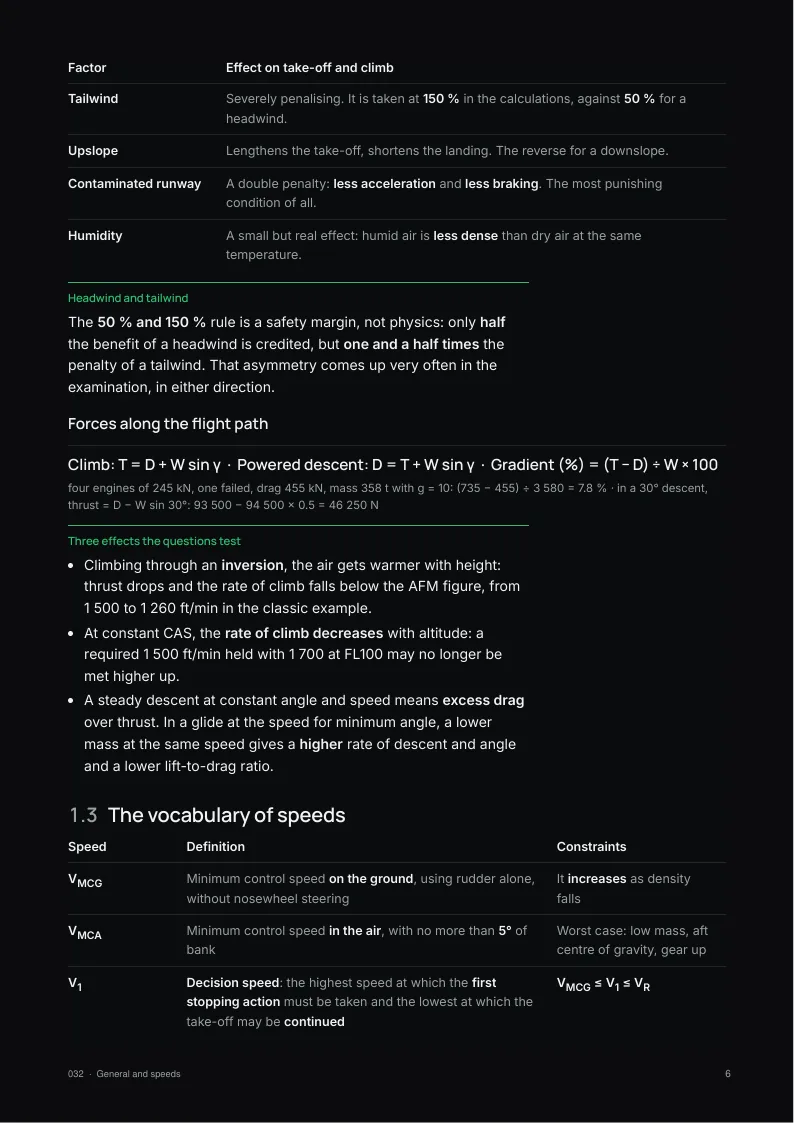
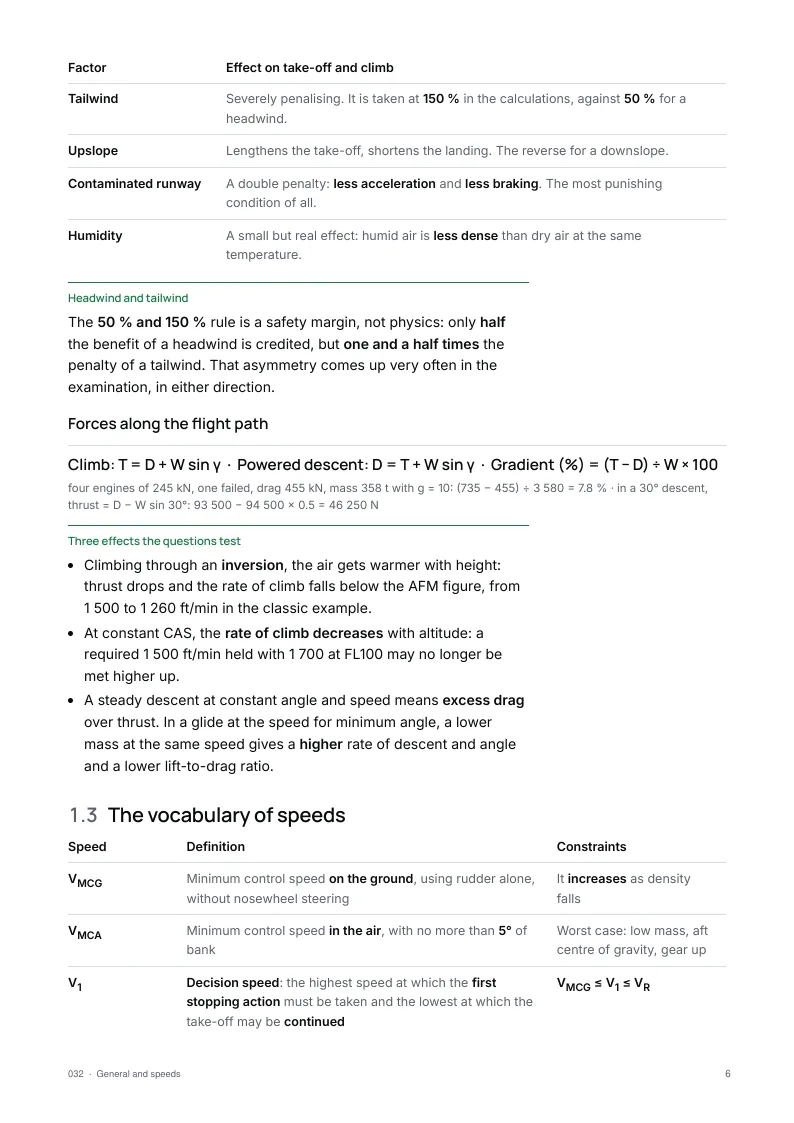
What the 032 notes cover
Written on the EASA Learning Objectives.
Checked against the primary texts.
An A4 PDF and a screen edition.
- Part 1032 01
General and speeds
Performance classes, the standard atmosphere, the factors that degrade performance and the vocabulary of speeds.
- Part 2032 02 and 032 03
Class B
Light propeller aeroplanes, single and multi-engine: distances, factors and climb requirements.
- Part 3032 04
Class A, take-off
V1, VR, V2, balanced field, clearway and stopway, climb segments and obstacle clearance.
- Part 4032 04
Cruise and descent
Ceilings, drift down, en-route one-engine-inoperative requirements and extended range operations.
- Part 5032 04
Landing and limitations
Required distances, wet and contaminated runways, wind, slope, altitude, temperature and missing items.
Exam traps in 032 Performance
A sample from Appendix B.
The full list is in the notes.
Exam trap
- The class depends on the powerplant and the thresholds. One threshold crossed makes it class A.
- For a single-engine class B aeroplane there is no performance requirement after engine failure.
- V1 can never exceed VR, fall below VMCG, or exceed VMBE.
- VMCA is worst at low mass and an aft centre of gravity, which often surprises candidates.
- The clearway extends the TODA, the stopway extends the ASDA. Neither extends the TORA.
- The TODA can never exceed 1.5 times the TORA.
The EASA 032 paper: 45 questions in 2 h. The exam rules →
Ten free 032 Performance questions
No account needed.
Pick an answer and the explanation opens.
The notes come with 1 month of all 461 questions and the mock exams.
1For a multi-engined piston aeroplane, the climb gradient from 50 ft above the take-off reference point up to the cloud base is assumed to be the (1) ______ multiplied by a factor of 0.77. Once the aeroplane has entered cloud and is no longer in VMC, the climb gradient is assumed to be the (2) ______.
Show the answer
Answer C. For multi-engined class B take-off obstacle clearance, the gradient from 50 ft up to the point where visual reference is lost is taken as the all-engine climb gradient factored by 0.77. Once the aeroplane enters cloud and is no longer in VMC, an engine failure is assumed at that point, so from there the one-engine-inoperative climb gradient must be used.
2Two aircraft with the same weight and configuration, at the same altitude, are climbing at the same pitch angle. Assume a standard atmosphere and no compressibility effects. Aircraft A is at Mach 0.75 and aircraft B at Mach 0.73. Which one has the higher rate of climb?
Show the answer
Answer A. At the same altitude both aircraft have the same local speed of sound, so the one flying at Mach 0.75 has the higher TAS. With the same pitch angle, taken here as the same climb angle, the rate of climb equals TAS multiplied by the sine of the climb angle, so aircraft A climbs faster. The TAS is not needed separately: at a common altitude the Mach numbers already rank the true airspeeds.
3Which statement about the climb gradient is correct? The climb gradient is...
Show the answer
Answer D. The climb gradient is the height gained per 100 units of horizontal distance, in other words the tangent of the climb angle expressed as a percentage. Because tan θ × 100 is always greater than θ in degrees, the gradient figure is larger than the angle: a 3° climb is a 5.2 % gradient. Treating the two as equal confuses a ratio with an angle.
4How does a full-flap approach and landing compare with a zero-flap one? The full-flap approach and landing will have a...
Show the answer
Answer B. Full flap lowers the stalling speed, so the approach and touchdown are flown at a lower speed, and the extra drag helps the deceleration. With less kinetic energy to dissipate, the ground roll is shorter than with zero flap. A zero-flap landing means a faster approach and a longer ground roll.
5For performance class A aeroplanes, V2MIN may not be less than which of the following?
Show the answer
Answer C. CS-25 requires V2MIN to be at least 1.1 VMC, and also at least 1.13 VSR for two- and three-engine turboprops and for turbojets without a significant reduction in the one-engine-inoperative power-on stall speed. The 1.08 VSR factor applies only to turboprops with more than three engines and to turbojets that do have such a reduction. Each wrong option swaps the 1.08 and 1.13 factors between these groups.
6During pre-flight planning for a Commercial Air Transport flight, the pilot has worked out several performance-limited landing masses. From the limits below, determine the maximum performance-limited landing mass that meets the operational requirements.
Approach climb limit mass: 32 250 lb
Landing climb limit mass: 38 300 lb
Field length limit mass: 34 500 lb
Structural limit landing mass: 39 300 lbShow the answer
Answer C. The performance-limited landing mass is the lowest of all the limits that apply: approach climb, landing climb, field length and structural. Here the approach climb limit of 32 250 lb is the lowest, so it is the maximum landing mass that complies with every requirement. Choosing the structural or field length limit ignores the fact that all the limits must be met at the same time.
7What can be done to reduce the problems caused by asymmetric thrust on a twin-engined propeller aeroplane?
Show the answer
Answer A. With both propellers turning the same way, asymmetric blade effect (P-factor) makes one engine critical because its thrust line sits closer to the centreline. Counter-rotating propellers make the thrust lines symmetrical, so there is no critical engine and the yawing moment after a failure is the same whichever engine fails. Moving the engines further outboard would lengthen the moment arm and make asymmetry worse, and blade count or fore-aft position does not solve it.
8All other factors remaining constant, how does retracting the gear, flaps and slats affect the Vx and Vy of an aeroplane?
Show the answer
Answer C. Gear, flaps and slats mainly add parasite drag, which raises the drag and power-required curves and moves their minima to a lower speed. VX is where the excess thrust is greatest and VY where the excess power is greatest, so both are lower with the aeroplane dirty. Retracting them does the reverse: VX and VY both increase, and so do the climb angle and rate. The options where one speed rises and the other falls ignore that both curves shift the same way.
9While flying at the speed for the minimum glide angle, which factor will increase the distance covered over the ground during a glide?
Show the answer
Answer C. At the best glide speed the still-air glide distance depends only on the lift/drag ratio, so mass changes the speed at which the aeroplane glides but not how far it goes through the air. A tailwind adds to the ground speed throughout the descent, so the same air distance becomes a longer ground distance. A headwind has the opposite effect.
10What is the VREF of a class B single-engine piston aeroplane with a maximum take-off mass of 1633 kg, given these stall speeds?
VS0: 60 kt
VS1: 63 kt
VS: 68 ktShow the answer
Answer D. VREF for a class B aeroplane must be at least 1.3 VS0, the stall speed in the landing configuration. Here 1.3 × 60 = 78 kt. Applying the factor to VS1 (82 kt) or to VS (88 kt) uses the wrong configuration.
Keep practising.
The 032 notes come with 1 month of its 461 questions.
The pack: the notes of all thirteen subjects, with 2 months of all 6,295 questions.
Get 032 Performance
Pay once, no subscription.
Practise longer with its question bank.
The notes
€7.90 once
+ 1 month of its questions
PDF and screen edition, yours for life.
Updates included for 1 year.3 months of 032 questions
€39 once
€13.00 / month
All 461 questions with explanations and the mock exams, for this subject only. Questions only: the notes are not included.
The other subjects
- 010Air Law28 pages547 questions€7.90
- 021Airframe, Systems, Powerplant50 pages551 questions€19.90
- 022Instrumentation29 pages568 questions€11.90
- 031Mass & Balance30 pages328 questions€11.90
- 033Flight Planning & Monitoring31 pages311 questions€11.90
- 040Human Performance46 pages578 questions€19.90
- 050Meteorology43 pages447 questions€19.90
- 061General Navigation49 pages417 questions€19.90
- 062Radio Navigation29 pages512 questions€11.90
- 070Operational Procedures40 pages531 questions€15.90
- 081Principles of Flight39 pages516 questions€15.90
- 090Communications27 pages528 questions€7.90