PPL(A) 070 Operational ProceduresRevision notes and practice questions
Operational procedures is the paper on what the pilot-in-command actually does: before flight, on the ground and when something goes wrong.
The French DGAC paper has 12 questions; 75 %, that is 9 correct answers, is a pass.
Learn the actions in the order they are given, then the figures in Appendix A and the traps in Appendix B.
- 19 pages
- 79 questions
- €6.90 once
French DGAC exam: 12 questions, 75 % to pass (9 correct).
What the PPL 070 notes cover
Written on the EASA PPL(A) syllabus.
Checked against the primary texts.
An A4 PDF and a screen edition.
- Part 1
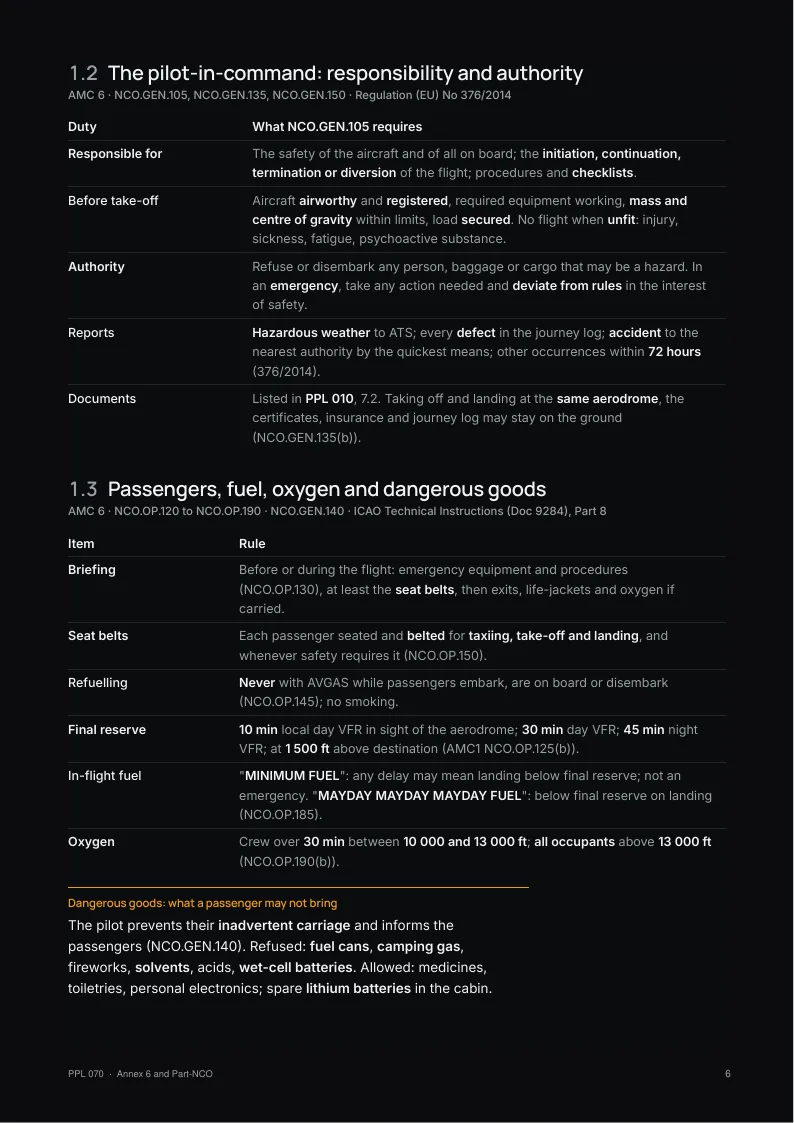
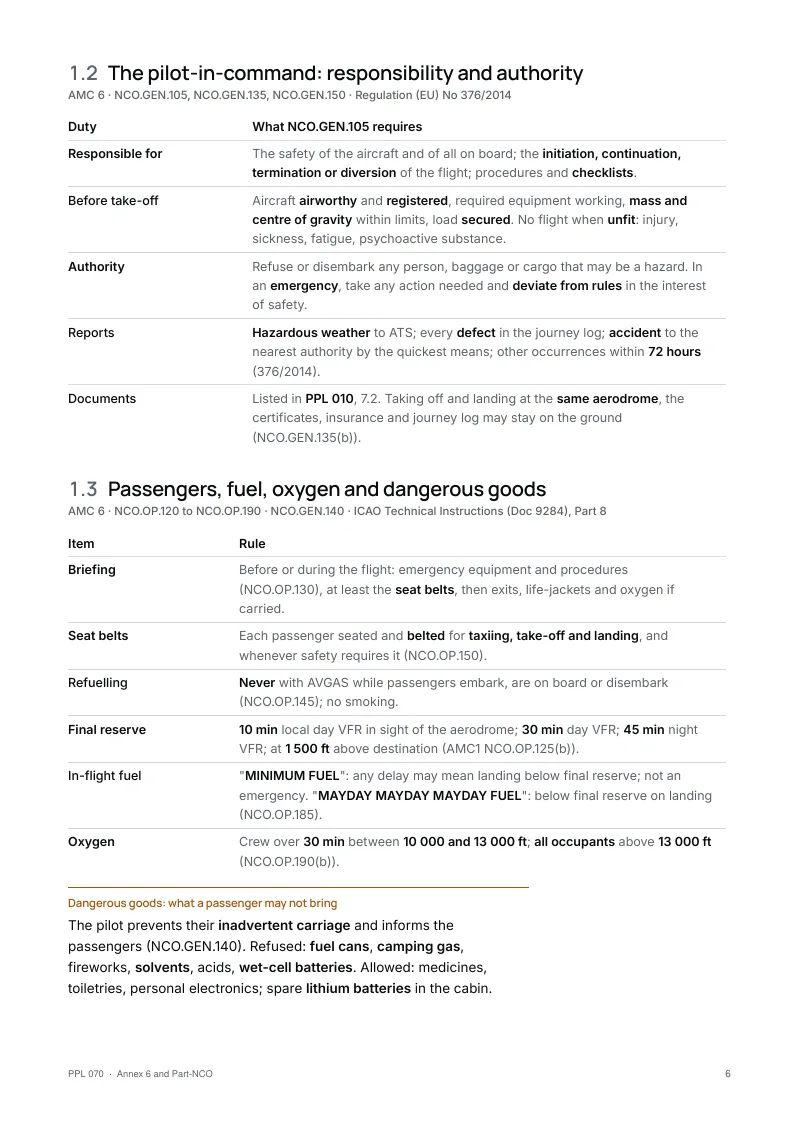
Annex 6 and Part-NCO
Who flies under which rules, the pilot-in-command's duties, passengers, fuel, oxygen, dangerous goods.
- Part 2
Noise abatement and runway incursion
AMC 6 · Noise abatement procedures · Influence of the flight procedure · Runway incursion awareness
- Part 3
Fire, smoke and technical failures
AMC 6 · Carburettor fire · Engine fire · Cabin and cockpit fire, extinguishing agents · Smoke · Emergency procedures · Influence of technical problems
- Part 4
Windshear, microburst and wake turbulence
AMC 6 · Windshear and microburst: effects, recognition, avoidance and actions · Wake turbulence: cause, parameters, actions
- Part 5
Emergency landings and contaminated runways
AMC 6 · Emergency and precautionary landings: definition, cause, passenger information, evacuation, action after landing · Contaminated runways
Exam traps in PPL 070 Operational Procedures
A sample from Appendix B.
The full list is in the notes.
Exam trap
- Aerial work is not general aviation in ICAO terms; a private flight is.
- "MINIMUM FUEL" is not an emergency; "MAYDAY MAYDAY MAYDAY FUEL" is.
- AVGAS: no refuelling with passengers on board, even with the pilot standing by.
- "HOLDING SHORT", not ROGER or WILCO. "RUNWAY VACATED" when the whole aircraft is past the holding position.
- Pattern A: the solid lines are on the taxiway side, where the aircraft stops.
- Fire at start: keep cranking, do not stop the starter.
Ten free PPL 070 Operational Procedures questions
No account needed.
Pick an answer and the explanation opens.
The notes come with 1 month of all 79 questions and the mock exams.
1According to the ICAO definition used in Annex 6, what is the flight time of an aeroplane?
Show the answer
Answer C. ICAO Annex 6 defines flight time for aeroplanes as the total time from the moment an aeroplane first moves for the purpose of taking off until the moment it finally comes to rest at the end of the flight. It is often called block time, and the same definition is used for logging flight time under Part-FCL. Engine start to shutdown is the tempting answer, but an aeroplane can run its engine for minutes before it moves, and that time is not flight time.
2Which of the following statements about noise abatement on departure in a light aeroplane are correct?
1. Gaining height quickly, for example by climbing at the best rate of climb speed, reduces the noise heard on the ground.
2. On an aeroplane with a constant-speed propeller, reducing the RPM once a safe height is reached reduces propeller noise.
3. A published noise abatement procedure must be flown even if the aeroplane cannot then achieve a safe climb performance.
4. The published departure track should be followed and noise-sensitive areas avoided.Show the answer
Answer A. Noise on the ground falls with height, so a prompt climb at the best rate of climb speed and a published track that avoids noise-sensitive areas are the main tools. Reducing propeller RPM once at a safe height lowers the tip speed, which is the main source of noise of a light aeroplane. NCO.OP.120 requires the pilot-in-command to take published noise abatement procedures into account while ensuring that safety has priority over noise abatement, so statement 3 is false.
3During engine start of a carburettor piston engine, the engine backfires and flames appear at the air intake. According to most light aeroplane flight manuals, what is the first action?
Show the answer
Answer B. An induction fire on start is usually caused by over-priming, and fuel has pooled in the intake. Flight manuals of light piston aeroplanes call for continued cranking, so that the flames and the accumulated fuel are sucked through the carburettor into the engine. If the engine does not start, the usual sequence is throttle fully open, mixture idle cut-off and continued cranking, then fuel off and the extinguisher. Stopping the cranking leaves the fire burning in the intake, and pumping the throttle or priming adds more fuel to it. The aircraft flight manual of the type always governs.
4On a clear night with a calm surface wind, you take off from an inland aerodrome. Passing 300 ft above the ground, the wind suddenly increases to 30 kt and the airspeed fluctuates. What is the most likely cause of this wind shear?
Show the answer
Answer C. On clear nights, radiation cooling builds a surface temperature inversion that decouples the calm air near the ground from a stronger wind above, sometimes a low-level jet. Crossing the top of the inversion produces a sudden change in wind speed and direction, a classic cause of low-level wind shear described in the ICAO Manual on Low-level Wind Shear (Doc 9817). A sea breeze is a daytime coastal effect, a microburst needs a convective cloud, and buildings only disturb the wind when it is already blowing at the surface.
5In which condition does an aircraft generate the most dangerous wake turbulence?
Show the answer
Answer C. Wingtip vortices are a by-product of lift, and their strength grows with the lift the wing must produce at a given speed. A heavy aircraft needs more lift, a slow one needs a higher angle of attack, and a clean wing concentrates the vortex at the tip, so heavy, slow and clean is the worst case. That is typically a large aircraft just after take-off or on approach before full flap. Flaps and high speed both tend to weaken or spread the vortices, which is why the other options are less dangerous.
6What is the difference between a forced landing and a precautionary landing?
Show the answer
Answer A. A forced landing is imposed by the situation, typically an engine failure, a fire or structural damage, and the pilot has no choice but to land now. A precautionary landing is a deliberate decision taken while the aeroplane is still flying normally, to stop a situation from getting worse: deteriorating weather, low fuel, approaching darkness, a doubt about the aeroplane or a sick passenger. Either can take place on an aerodrome or off-field, and the decision always rests with the pilot in command.
7According to the usual definition, when is a runway considered contaminated?
Show the answer
Answer C. A runway is contaminated when more than 25 % of the surface area being used is covered by standing water or slush more than 3 mm deep, or by snow or ice. Up to and including 3 mm of water, the runway is only wet. A change of colour due to moisture without standing water describes a damp runway, which the Global Reporting Format treats as wet, not as contaminated.
8In ICAO Annex 6, which definition corresponds to an alternate aerodrome?
Show the answer
Answer A. ICAO Annex 6 defines an alternate aerodrome as one to which an aircraft may proceed when it becomes either impossible or inadvisable to proceed to or to land at the aerodrome of intended landing. It must have the necessary services and facilities, allow the aircraft performance requirements to be met and be operational at the expected time of use. It is chosen by the pilot during flight preparation, not designated by ATC, and there is no fixed distance in the definition.
9Which arrival technique best reduces the noise heard on the ground when approaching an aerodrome in a light aeroplane?
Show the answer
Answer B. Noise abatement on arrival relies on keeping the aeroplane as high and at as low a power setting as possible for as long as possible, which is the principle of the continuous descent approach described in ICAO PANS-OPS (Doc 8168). Level segments at low height need power and spread noise over the houses below the approach path. A low, dragged-in final at high power is the noisiest arrival possible and is also less safe.
10In cruise, flames and smoke appear from the engine cowling of your single-engine piston aeroplane. Which sequence of actions is correct?
Show the answer
Answer C. The fire is fed by fuel, so the fuel supply is shut off at the selector and the mixture set to idle cut-off; the engine then stops as the lines empty. Cabin heat comes from a muff around the exhaust, behind the firewall, so it is closed to keep flames and smoke out of the cabin. An engine that has been on fire is never restarted, because the fire would almost certainly start again: the flight ends in a forced landing. The detailed sequence, including any speed to use, is in the aircraft flight manual.
Keep practising.
The PPL 070 notes come with 1 month of its 79 questions.
The PPL pack: the notes of all nine subjects, with 2 months of all 698 questions.
Get PPL 070 Operational Procedures
Pay once, no subscription.
Practise longer with its question bank.
The notes
€6.90 once
+ 1 month of its questions
PDF and screen edition, yours for life.
Updates included for 1 year.3 months of PPL 070 questions
€19 once
€6.33 / month
All 79 questions with explanations and the mock exams, for this subject only. Questions only: the notes are not included.
The other PPL subjects
- 010Air Law24 pages80 questions€6.90
- 020Aircraft General Knowledge24 pages80 questions€6.90
- 030Flight Performance and Planning22 pages80 questions€6.90
- 040Human Performance20 pages80 questions€6.90
- 050Meteorology24 pages80 questions€6.90
- 060Navigation24 pages80 questions€6.90
- 080Principles of Flight21 pages80 questions€6.90
- 090Communications22 pages59 questions€6.90