PPL(A) 030 Flight Performance and PlanningRevision notes and practice questions
This paper checks that a private pilot can load the aeroplane, predict what it will do and plan a VFR flight with enough fuel.
The French DGAC paper has 12 questions; 75 %, that is 9 correct answers, is a pass.
About half of the questions are calculations: redo each worked example with a calculator, then reread Appendices A and B.
- 22 pages
- 80 questions
- €6.90 once
French DGAC exam: 12 questions, 75 % to pass (9 correct).
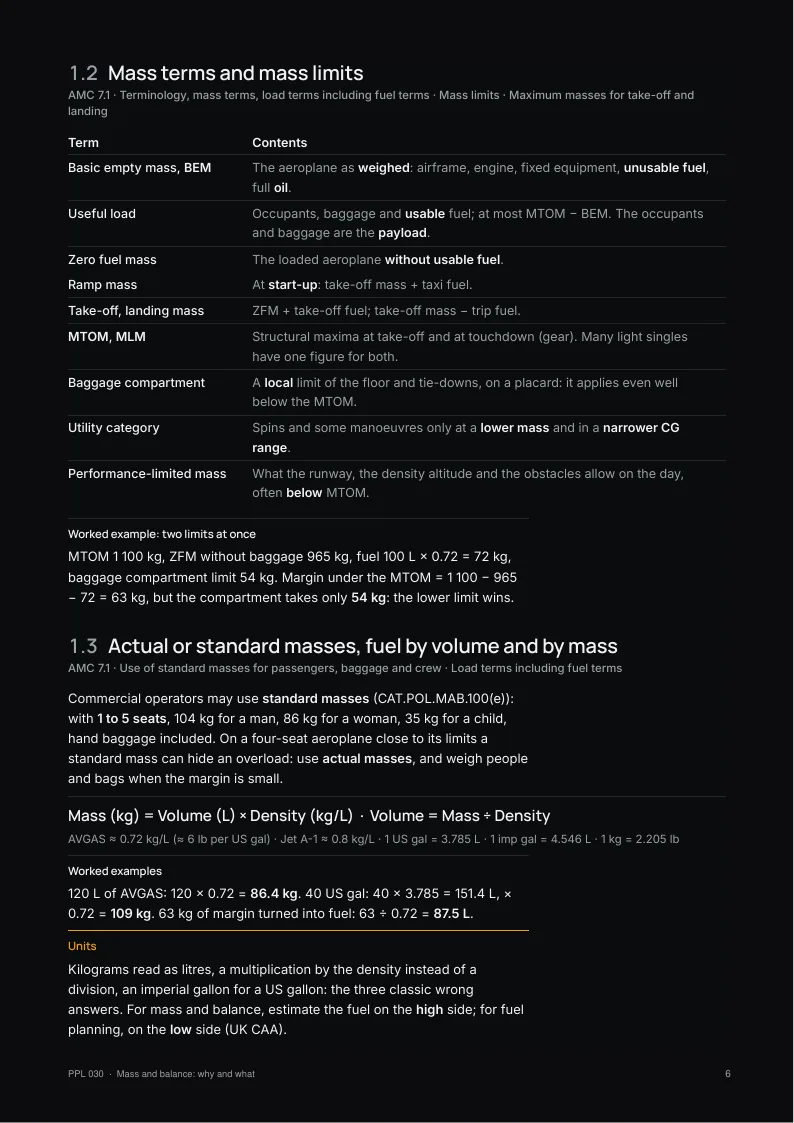
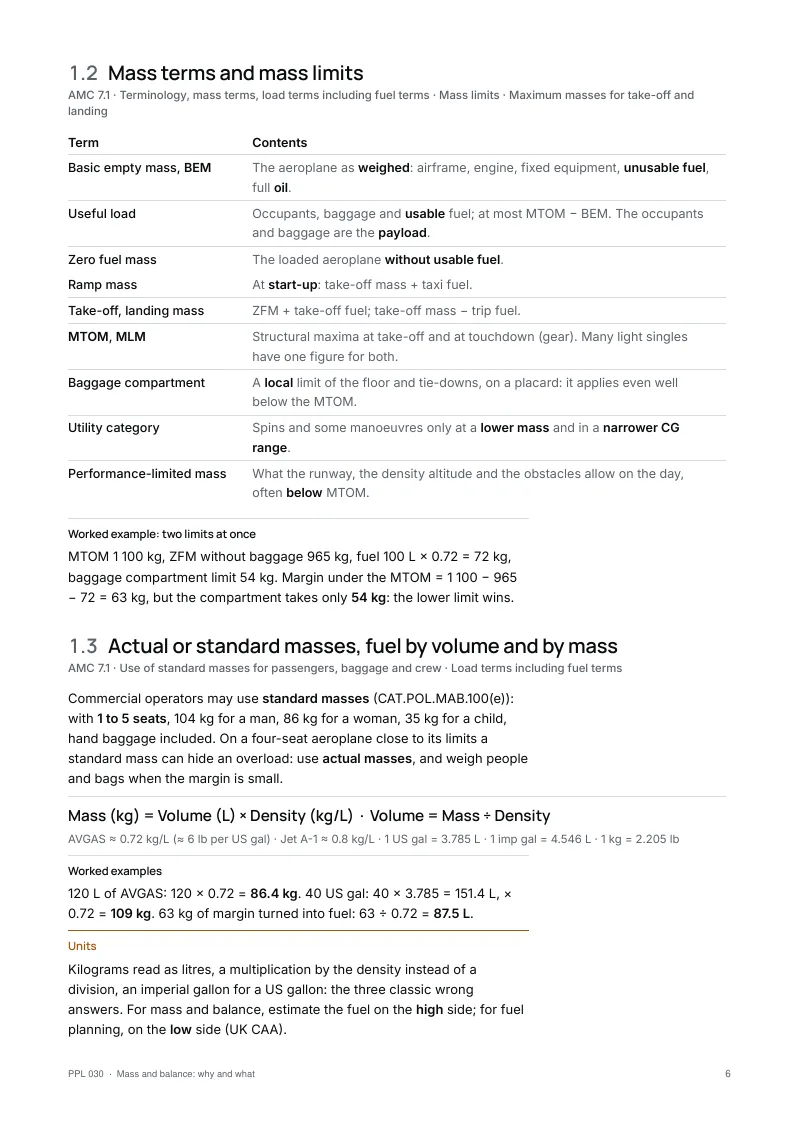
What the PPL 030 notes cover
Written on the EASA PPL(A) syllabus.
Checked against the primary texts.
An A4 PDF and a screen edition.
- Part 1
Mass and balance: why and what
Why mass and CG are limited, the mass terms, fuel by volume and by mass.
- Part 2
Mass and balance: the calculations
Datum, arm, moment, the loading table, the envelope, moving and burning.
- Part 3
Take-off and landing performance
Density altitude, distances to 50 ft, AFM charts, correction and safety factors.
- Part 4
Climb, cruise and the aircraft's limits
VX and VY, gradients, ceilings, endurance and range, power settings and wind.
- Part 5
Planning the VFR flight
Route, safety altitude, cruising level, navigation log, fuel plan.
- Part 6
Briefing, flight plan and monitoring
AIP, NOTAM and weather, the ICAO flight plan, in-flight checks and diversion.
Exam traps in PPL 030 Flight Performance and Planning
A sample from Appendix B.
The full list is in the notes.
Exam trap
- A CG inside the envelope does not make an overload acceptable.
- Forward CG: higher stalling speed, heavy pitch. Aft CG: lower stalling speed, unstable, poor spin recovery.
- Never average the arms. Divide the total moment by the total mass, fuel included.
- Transfer: distance travelled, total mass unchanged. Addition: new total mass in the denominator.
- Baggage compartment and seat limits apply even below the MTOM.
- Litres are not kilograms: × 0.72 for AVGAS; US gallon 3.785 L, imperial 4.546 L.
Ten free PPL 030 Flight Performance and Planning questions
No account needed.
Pick an answer and the explanation opens.
The notes come with 1 month of all 80 questions and the mock exams.
1A light aeroplane is loaded so that its centre of gravity lies forward of the forward limit. What is a likely consequence?
Show the answer
Answer A. With a forward CG the tailplane must produce more download to balance the aeroplane, so the wing carries more load and the stalling speed rises. Beyond the forward limit the elevator may no longer be powerful enough to raise the nose for rotation or to hold the flare at low speed. Reduced stability, light stick forces and poor spin recovery are the consequences of an aft CG, not a forward one.
2Which of the following statements about mass terms for a light aeroplane are correct?
1. The basic empty mass includes the unusable fuel and the full engine oil.
2. The zero fuel mass is the mass of the loaded aeroplane without usable fuel.
3. The ramp mass is the take-off mass minus the fuel used for start-up and taxi.
4. Using the actual masses of the occupants is more accurate than standard masses, because one heavy passenger is a large share of the useful load.Show the answer
Answer D. The basic empty mass comes from weighing and includes fixed equipment, unusable fuel and full operating fluids such as engine oil. The zero fuel mass is everything loaded except usable fuel. The ramp mass is the mass at start-up, so it is the take-off mass plus the start-up and taxi fuel, which makes statement 3 false. On a four-seat aeroplane, standard masses can hide an overload, so actual masses give the safer figure.
3Using the data below, where is the take-off centre of gravity? Arms are measured aft of the datum.
Basic empty mass: 745 kg, arm 39.5 in
Pilot and front passenger: 165 kg, arm 37.0 in
Rear passenger: 80 kg, arm 73.0 in
Fuel: 115 kg, arm 48.0 in
Baggage: 25 kg, arm 95.0 inShow the answer
Answer B. Moments (mass × arm): 29,427.5 + 6,105 + 5,840 + 5,520 + 2,375 = 49,267.5 kg in. Total mass = 745 + 165 + 80 + 115 + 25 = 1,130 kg. CG = 49,267.5 ÷ 1,130 = 43.6 in. 58.5 in is the average of the arms, which means nothing, 66.1 in divides the total moment by the empty mass, and 48.5 in leaves the fuel out of the total mass.
4Which of the following increase the take-off distance of a light aeroplane?
1. A higher aerodrome elevation
2. A downslope
3. Long wet grass
4. A tailwindShow the answer
Answer A. A higher elevation reduces air density, so the engine and propeller produce less thrust and the aeroplane must reach a higher true airspeed to lift off. Long wet grass adds rolling resistance, and a tailwind increases the groundspeed needed to reach lift-off airspeed, both lengthening the run. A downslope helps the aeroplane accelerate, so it shortens the take-off distance.
5Which of the following statements about climb performance are correct?
1. VX gives the greatest height gain over a given horizontal distance.
2. As altitude increases, VX and VY move further apart.
3. A higher mass or a higher temperature reduces the rate of climb at VY.
4. The service ceiling is the altitude where the maximum rate of climb has fallen to 100 ft/min.Show the answer
Answer D. VX gives the best angle of climb, used to clear obstacles, while VY gives the best rate of climb. With altitude the indicated VY decreases and VX increases slightly, so they come closer together and meet at the absolute ceiling, which makes statement 2 false. A heavier aeroplane or warmer air leaves less excess power, so the rate of climb falls, and the service ceiling is reached when it is down to 100 ft/min.
6On your VFR navigation log, a leg measures 42 NM. The planned TAS is 105 kt and the forecast wind gives a groundspeed of 92 kt on this leg. What leg time do you enter?
Show the answer
Answer C. Leg time = distance ÷ groundspeed = 42 ÷ 92 = 0.457 h, and 0.457 × 60 = 27.4, so 27 min. Using the TAS of 105 kt ignores the headwind and gives 24 min. Reading 0.46 h as 46 minutes forgets to multiply by 60, and 21 min comes from adding the wind component to the TAS (118 kt) instead of subtracting it.
7Plan the minimum fuel at engine start for a VFR flight by day. Fuel flow 32 L/h for every airborne phase, trip time 1 h 40 min, taxi fuel 3 L. The club fuel policy adds contingency fuel of 10 % of the trip fuel and 20 min of flight to a diversion aerodrome, then the 30 min final reserve. What is the minimum fuel?
Show the answer
Answer C. Trip fuel = 32 × 1.667 h = 53.3 L, contingency = 10 % of 53.3 = 5.3 L, diversion = 32 × 20 ÷ 60 = 10.7 L and final reserve = 32 × 0.5 = 16 L. Total = 3 + 53.3 + 5.3 + 10.7 + 16 = 88.3, so 88 L. Under Part-NCO only the final reserve is a set figure (AMC1 NCO.OP.125(b): 30 minutes by day): NCO.OP.125(a) asks the pilot to allow for expected delays and contingencies without fixing any percentage, which is why the club policy supplies the 10 % and the 20 min. 72 L forgets the final reserve, 83 L forgets the contingency fuel, and 96 L uses the 45 min reserve of VFR at night.
8Under SERA.2010(b), what must the pre-flight action include for a VFR flight away from the vicinity of the departure aerodrome?
Show the answer
Answer C. SERA.2010(b) requires the pilot-in-command to become familiar with all available information appropriate to the intended operation. For flights away from the vicinity of an aerodrome, this includes a careful study of current weather reports and forecasts, taking into account fuel requirements and an alternative course of action if the flight cannot be completed as planned. NCO.OP.135 sets the same requirement under Part-NCO. A flight plan is not required by this rule, and the destination must be checked before departure, not in flight.
9Under SERA.4001(b), which of these VFR flights by day requires a flight plan to be submitted?
Show the answer
Answer A. SERA.4001(b)(5) requires a flight plan for any flight across international borders, unless otherwise prescribed by the States concerned. A flight plan is also required for a flight provided with air traffic control service, in areas designated by the competent authority, and for a flight at night leaving the vicinity of an aerodrome. Neither the duration of the flight, a cross-country flight by day in uncontrolled airspace nor the carriage of passengers makes it mandatory, although it is recommended for search and rescue.
10You set heading overhead the departure aerodrome at 09:40 and pass a checkpoint 27 NM along track at 09:58. The destination is 63 NM beyond the checkpoint and the planned TAS is 100 kt. What is your revised ETA?
Show the answer
Answer A. The actual groundspeed is 27 NM in 18 min: 27 × 60 ÷ 18 = 90 kt. Time to go = 63 ÷ 90 × 60 = 42 min, added to the time at the checkpoint: 09:58 + 42 = 10:40. 10:36 uses the TAS and ignores the headwind, 10:58 computes the time to go on the whole 90 NM, and 10:22 adds the time to go to the departure time.
Keep practising.
The PPL 030 notes come with 1 month of its 80 questions.
The PPL pack: the notes of all nine subjects, with 2 months of all 698 questions.
Get PPL 030 Flight Performance and Planning
Pay once, no subscription.
Practise longer with its question bank.
The notes
€6.90 once
+ 1 month of its questions
PDF and screen edition, yours for life.
Updates included for 1 year.3 months of PPL 030 questions
€19 once
€6.33 / month
All 80 questions with explanations and the mock exams, for this subject only. Questions only: the notes are not included.
The other PPL subjects
- 010Air Law24 pages80 questions€6.90
- 020Aircraft General Knowledge24 pages80 questions€6.90
- 040Human Performance20 pages80 questions€6.90
- 050Meteorology24 pages80 questions€6.90
- 060Navigation24 pages80 questions€6.90
- 070Operational Procedures19 pages79 questions€6.90
- 080Principles of Flight21 pages80 questions€6.90
- 090Communications22 pages59 questions€6.90