ATPL(A) 081 Principles of FlightRevision notes and practice questions
The most physical subject in the syllabus.
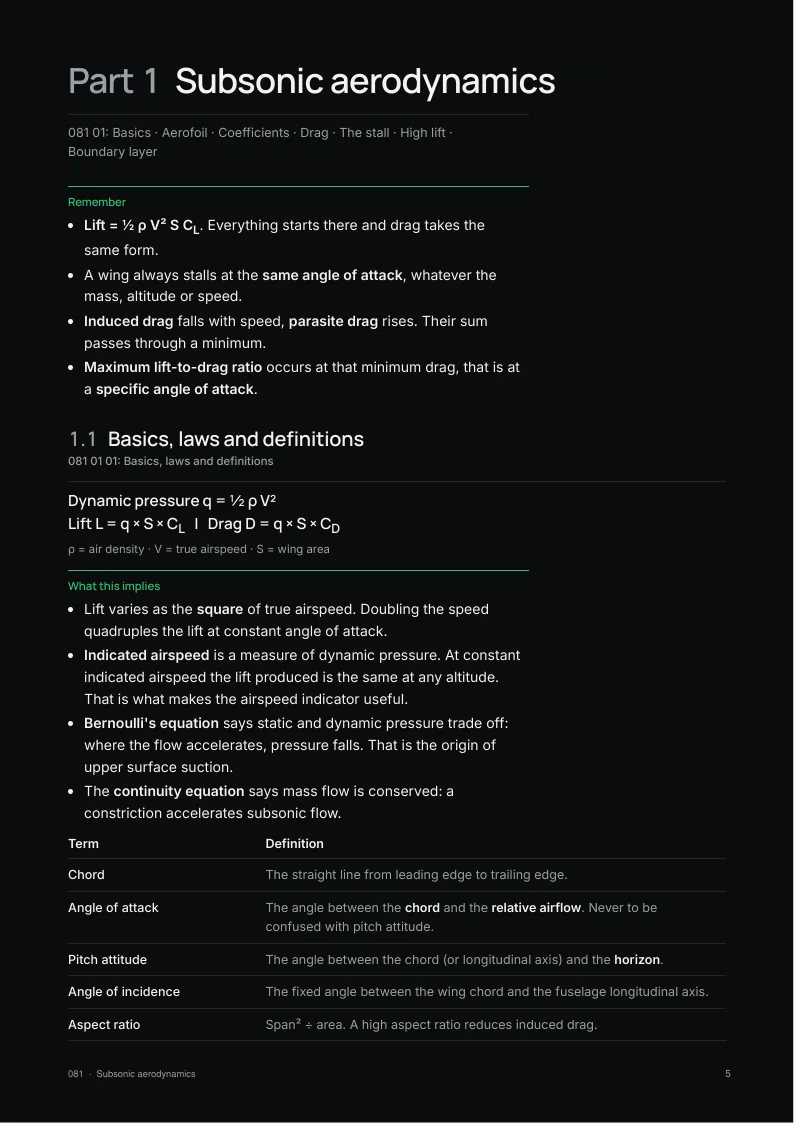
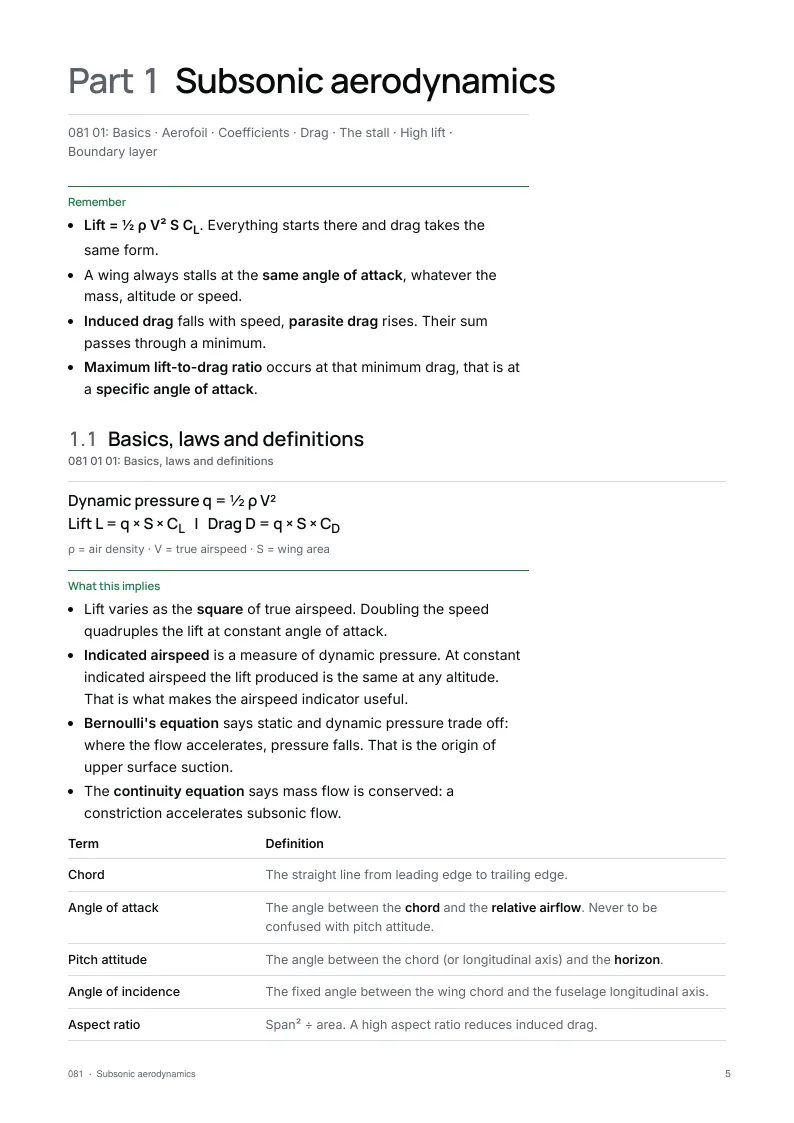
Everything follows from one equation, the lift equation and one idea: the flow separates when too much is asked of it.
- 39 pages
- 516 questions
- €15.90 once
What the 081 notes cover
Written on the EASA Learning Objectives.
Checked against the primary texts.
An A4 PDF and a screen edition.
- Part 1081 01
Subsonic aerodynamics
Aerofoil, coefficients, drag, ground effect, the stall, high-lift devices and the boundary layer. The core of the subject.
- Part 2081 02
High speed aerodynamics
Mach number, shock waves, critical Mach, buffet and the means of pushing back the effects of compressibility.
- Part 3081 04
Stability
Static and dynamic stability in all three axes and the role of centre of gravity position in longitudinal stability.
- Part 4081 05
Control
The control surfaces, roll-yaw interaction, reduction of control forces, mass balance and trimming.
- Part 5081 06 · 07 · 08
Limitations and flight mechanics
Manoeuvring and gust envelopes, propellers, forces in flight and asymmetric thrust.
Exam traps in 081 Principles of Flight
A sample from Appendix B.
The full list is in the notes.
Exam trap
- Believing stalling speed is a constant: it is the angle of attack that is.
- Forgetting that stalling speed varies as the square root of mass and load factor, not proportionally.
- Forgetting that a forward CG raises the stalling speed.
- Believing the maximum lift-to-drag ratio changes with mass: it does not; only the speed at which it occurs changes.
- Confusing VMD, minimum drag, with VMP, minimum power. VMP is the slower.
- Forgetting the region of reverse command below VMD.
The EASA 081 paper: 46 questions in 1 h 30. The exam rules →
Ten free 081 Principles of Flight questions
No account needed.
Pick an answer and the explanation opens.
The notes come with 1 month of all 516 questions and the mock exams.
1As an aircraft climbs out of ground effect after lift-off, the wing tip vortices (1) ______ and the induced angle of attack (2) ______.
Show the answer
Answer B. Close to the runway, the ground blocks the full development of the tip vortices and of the downwash behind the wing. Once the aircraft climbs away, that restriction disappears: the vortices grow, the downwash increases and the induced angle of attack increases with it. Induced drag rises, and a higher angle of attack is needed to keep the same lift. The two quantities always change in the same direction.
2A large turbojet aeroplane is flying at its optimum altitude and the crew aim for the most efficient flight performance. If the speed were increased slightly above the critical Mach number, the lift coefficient would (1) ____, requiring a/an (2) ____ in the angle of attack.
Show the answer
Answer A. Just above the critical Mach number the lift curve becomes steeper: compressibility increases the lift coefficient obtained at a given angle of attack, as the flow over the upper surface accelerates to supersonic speed ahead of the shock. The lift required is unchanged, so the angle of attack must be reduced to keep the lift coefficient at the value the flight needs.
3An aeroplane has a stall speed of 100 kt. At what speed will it stall in a level, co-ordinated turn with a load factor of 1.5?
Show the answer
Answer C. The stall speed increases with the square root of the load factor. In a co-ordinated turn at a load factor of 1.5, the aeroplane stalls at 100 × √1.5 = 100 × 1.225 = 122 kt. Multiplying by the load factor itself (150 kt) or by √2 (141 kt) are the classic mistakes.
4Flying a multi-engine aeroplane with the flaps down, you suffer a failure of the right engine. Which way will the aeroplane roll, and how do the flaps affect it?
Show the answer
Answer C. When the right engine fails the aircraft yaws right, the left wing moves faster and gains lift, and the right wing loses the lift from its propeller slipstream, so the aircraft rolls right. With flaps down, a larger share of the lift comes from the slipstream over the flapped sections, so the lift difference between the wings, and the roll, is greater. The roll is always towards the dead engine, never away from it.
5During a go-around, the crew forget to retract the trailing-edge flaps. What could be the consequence?
Show the answer
Answer A. Flaps left at the landing setting keep their high drag, so both the climb gradient and the rate of climb are poorer than planned. As the aircraft accelerates in the climb, the speed can also reach the flap limit speed VFE for that setting, with a risk of structural damage. Flaps at go-around never improve climb performance, which rules out every other option.
6Which flight control loses the most effectiveness once MCRIT is exceeded?
Show the answer
Answer D. Above MCRIT, shock waves form on the upper surface of the wing. The ailerons sit at the wing trailing edge, behind the shock, where the flow can separate; deflecting them also moves the shock, so their effectiveness drops sharply and aileron buzz can occur. The tail surfaces are thinner and have a higher critical Mach number, so the elevator and rudder are less affected, and flaps are not used at high speed.
7A jet aeroplane cruising close to its maximum altitude suffers an engine failure. While the pilots concentrate on the checklist, they do not notice that the speed is decreasing. Buffet develops and eventually becomes strong enough to act as a deterrent. This means that the aircraft is...
Show the answer
Answer A. As the speed decreases the angle of attack rises and, at high altitude, the low-speed buffet appears early because of compressibility effects. Under the certification definition, buffet strong enough to deter the pilot from slowing further is treated as the stall, even if the classic critical angle of attack has not been reached. VMC concerns directional control at low speed near the ground, not buffet at cruise altitude.
8An aircraft is flying a 3° approach path with the engines at idle. Using the data below, calculate the drag.
Weight: 650 000 N
Thrust: 30 000 NShow the answer
Answer D. On a 3° descent a component of the weight acts forward along the flight path: 650 000 × sin 3° = 650 000 × 0.0523 = 34 000 N. In a steady descent the drag balances that component plus the thrust: D = 30 000 + 34 000 = 64 000 N. Taking only the weight component (34 000 N) forgets the thrust, and subtracting the thrust gives 4 000 N.
9Skin friction drag is caused by the...
Show the answer
Answer A. Skin friction drag comes from the viscosity of the air: the layer touching the surface is brought to rest, and shear between adjacent layers moving at different speeds inside the boundary layer produces a force on the surface along the flow. The tempting answer is wrong because the air in contact with the skin does not slide over it at all. A turbulent boundary layer produces more skin friction than a laminar one.
10(1) ____ the mass of an aircraft will lead to a/an (2) ____ in MCRIT.
Show the answer
Answer D. A heavier aircraft needs a higher lift coefficient at a given speed and altitude, which means a higher angle of attack and a faster flow over the upper surface. The local flow reaches the speed of sound at a lower flight Mach number, so the critical Mach number decreases with increasing mass.
Keep practising.
The 081 notes come with 1 month of its 516 questions.
The pack: the notes of all thirteen subjects, with 2 months of all 6,295 questions.
Get 081 Principles of Flight
Pay once, no subscription.
Practise longer with its question bank.
The notes
€15.90 once
+ 1 month of its questions
PDF and screen edition, yours for life.
Updates included for 1 year.3 months of 081 questions
€39 once
€13.00 / month
All 516 questions with explanations and the mock exams, for this subject only. Questions only: the notes are not included.
The other subjects
- 010Air Law28 pages547 questions€7.90
- 021Airframe, Systems, Powerplant50 pages551 questions€19.90
- 022Instrumentation29 pages568 questions€11.90
- 031Mass & Balance30 pages328 questions€11.90
- 032Performance25 pages461 questions€7.90
- 033Flight Planning & Monitoring31 pages311 questions€11.90
- 040Human Performance46 pages578 questions€19.90
- 050Meteorology43 pages447 questions€19.90
- 061General Navigation49 pages417 questions€19.90
- 062Radio Navigation29 pages512 questions€11.90
- 070Operational Procedures40 pages531 questions€15.90
- 090Communications27 pages528 questions€7.90