ATPL(A) 090 CommunicationsRevision notes and practice questions
The shortest subject on the syllabus and the one where marks are lost most carelessly: almost everything turns on exact lists (an order of priority, a message sequence, a readability scale).
- 27 pages
- 528 questions
- €7.90 once
What the 090 notes cover
Written on the EASA Learning Objectives.
Checked against the primary texts.
An A4 PDF and a screen edition.
- Part 1091 01 and 092 01
Definitions and messages
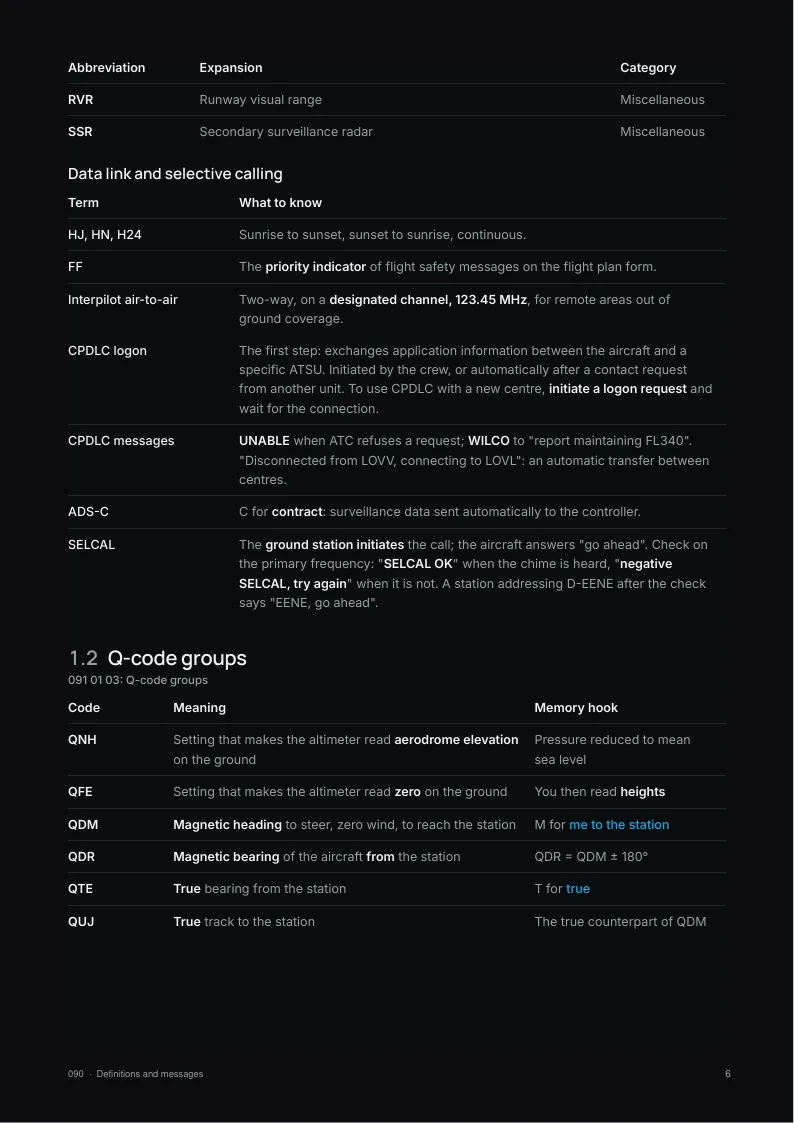
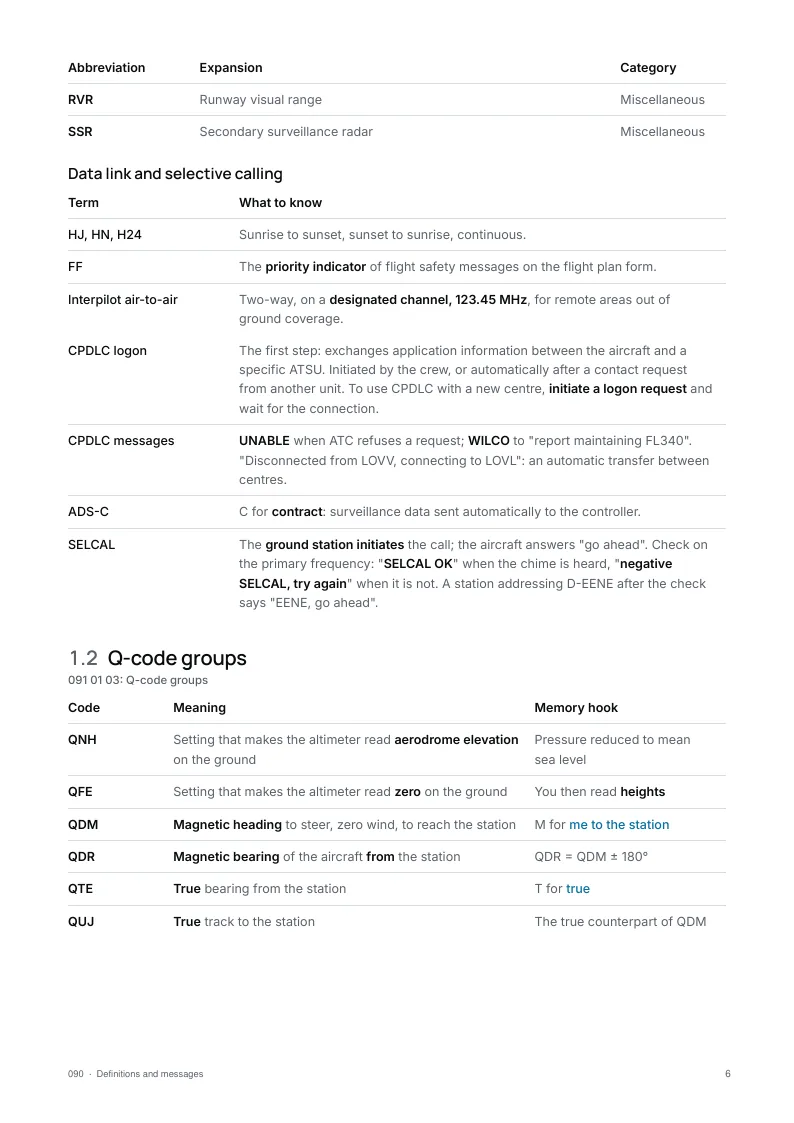
Terms, air traffic services abbreviations, Q-code groups and above all the priority order of the six categories of message.
- Part 2092 02 01 to 05
Transmission
Phonetic alphabet, pronunciation of numbers, expression of time, transmitting technique and standard words.
- Part 3091 02 and 092 02 06 to 12
Call signs and read-back
Station and aircraft call signs, abbreviation, transfer, radio check, mandatory read-back and radar phraseology.
- Part 4091 03 and 092 05
Weather on the radio
Contents of an aerodrome report, CAVOK, ATIS and VOLMET, runway visual range, runway state and air reports.
- Part 5091 04, 092 03 and 092 04
Failure, distress, urgency
Action on communication failure, MAYDAY and PAN PAN, message content and sequence, transponder codes.
- Part 6092 06
VHF propagation
Spectrum, aeronautical band, channel spacing and the line-of-sight range calculation.
Exam traps in 090 Communications
A sample from Appendix B.
The full list is in the notes.
Exam trap
- ROGER never answers a question: use AFFIRM or NEGATIVE.
- STANDBY authorises nothing and refuses nothing.
- Numbers go digit by digit, except whole hundreds and thousands.
- FL 100 is "WUN HUNDRED", but FL 180 is "WUN AIT ZERO".
- A heading is always digit by digit: 270 → "TOO SEVEN ZERO".
- A type c call sign (operator plus flight number) is never abbreviated.
The EASA 090 paper: 34 questions in 1 h. The exam rules →
A student asked: What do I squawk and do after a radio failure (7600)?
Ten free 090 Communications questions
No account needed.
Pick an answer and the explanation opens.
The notes come with 1 month of all 528 questions and the mock exams.
1The abbreviation "TA" can stand for...
Show the answer
Answer A. TA has two standard meanings. In ACAS/TCAS it is a traffic advisory, the caution-level alert that another aircraft is getting close, and in altimetry it is the transition altitude, at or below which vertical position is given as an altitude on QNH. The context tells which one is meant; "terminal altitude" and "traffic altitude" are not ICAO abbreviations.
2A TCAS Resolution Advisory (RA) manoeuvre has been completed and the return to the ATC clearance or instruction has begun. Which phraseology should the pilots use?
Show the answer
Answer A. Once the RA ends and the return to the clearance begins, the report is "clear of conflict, returning to (assigned clearance)". When the aircraft is back on it, the crew say "clear of conflict, (assigned clearance) resumed". "RA terminated" and "clear of RA" are not standard phrases.
3Which statement about the following D-ATIS is correct?
WSSS ATIS F 0230 METAR EXP ILS APCH SEGREGATED PARL OPS IN USE ARR RWY 02L DEP 02C JUNCTION OF TWY EP AND A3 INCLUDING RAPID EXIT TWY E3 SOUTHBOUND CLSD DUE WIP WIND 010 04 KT GUST 23 WIND DIR 320 V 040 10 KM FEW 1600 FT T 27/DP 26 QNH 1012 NOSIG ARR TO ACK INFO F WITH APP ON 120.3 AND DEP WITH DELIVERY ON 121.65Show the answer
Answer A. The header 'ATIS F 0230 METAR' shows that the message is built on the 0230Z METAR, and the junction of taxiways EP and A3, including rapid exit E3 southbound, is closed due to work in progress (WIP). Runway 02C is used for departures, but information F is acknowledged on 120.3 by arrivals and on 121.65 by departures, not by all traffic on one frequency. No wind shear warning is given.
4An aircraft in the traffic circuit of a controlled aerodrome suffers a radio communication failure. What is the correct course of action?
Show the answer
Answer C. In the circuit with communications lost, the pilot transmits each message blind, twice, in case the transmitter still works, and watches the tower for light signals, which are how instructions reach an aircraft that cannot hear. Rocking the wings and flashing lights are interception signals, 7700 is not the radio failure code, and repeated radio checks to all stations only clutter the frequency.
5In flight, a pilot faces technical problems and decides to declare an urgency condition by radio. Which phraseology is correct?
Show the answer
Answer D. The radiotelephony urgency signal is PAN PAN, preferably spoken three times and pronounced like the French word 'panne'. MAYDAY is the distress signal, reserved for grave and imminent danger. 'URGENCY' and 'PAN PAN TECHNICAL' are not standard ICAO signals.
6For an aircraft in flight working a control tower on VHF, when are the effective range and quality of the transmissions at their best?
Show the answer
Answer C. VHF signals travel in straight lines, so the radio horizon grows with the aircraft's height, and signal strength falls off with distance. The best range and quality are therefore obtained high up and close to the tower. Low and far away is the worst case, because the aircraft may be below the radio horizon.
7Pilot A is flying 50 NM from the station and pilot B 100 NM from it. Compared with pilot A, pilot B receives a poorer quality transmission because of...
Show the answer
Answer D. Attenuation is the progressive loss of signal strength as a radio wave spreads out from the transmitter and is partly absorbed along its path. At twice the distance, pilot B receives a much weaker signal, so reception quality is poorer. Ionospheric refraction concerns HF sky waves rather than VHF line-of-sight reception, and the wavelength of a signal does not change with distance.
8What is "SELCAL"?
Show the answer
Answer C. SELCAL (selective calling) lets a ground station alert one specific aircraft over an HF or VHF radiotelephony channel by transmitting that aircraft's assigned tone code. The decoder on board triggers a chime or light, so the crew do not have to keep a continuous listening watch. Communication in both directions at once is the definition of duplex, and direct exchanges between ATS units use ground links, not SELCAL.
9Once a successful connection has been established, SELCAL is used...
Show the answer
Answer C. SELCAL works from the ground to the aircraft: the ATSU or radio operator transmits the aircraft's tone code to call it, and the cockpit decoder alerts the crew, who then reply by voice. The tones carry no clearance or instruction, and the pilot cannot use SELCAL to call anyone.
10Approaching the destination aerodrome, the pilot listens to the ATIS broadcast. Assuming no CB is present, which clouds will the ATIS report?
Show the answer
Answer A. An ATIS reports the cloud of operational significance: cloud below 1500 m (5000 ft) or below the highest minimum sector altitude, whichever is greater, plus any CB or towering cumulus at any height. Using only the 5000 ft limit would miss cloud where the MSA is higher. Cloud above that is not relevant to the approach, and the report is not a description of the whole TMA.
Keep practising.
The 090 notes come with 1 month of its 528 questions.
The pack: the notes of all thirteen subjects, with 2 months of all 6,295 questions.
Get 090 Communications
Pay once, no subscription.
Practise longer with its question bank.
The notes
€7.90 once
+ 1 month of its questions
PDF and screen edition, yours for life.
Updates included for 1 year.3 months of 090 questions
€39 once
€13.00 / month
All 528 questions with explanations and the mock exams, for this subject only. Questions only: the notes are not included.
The other subjects
- 010Air Law28 pages547 questions€7.90
- 021Airframe, Systems, Powerplant50 pages551 questions€19.90
- 022Instrumentation29 pages568 questions€11.90
- 031Mass & Balance30 pages328 questions€11.90
- 032Performance25 pages461 questions€7.90
- 033Flight Planning & Monitoring31 pages311 questions€11.90
- 040Human Performance46 pages578 questions€19.90
- 050Meteorology43 pages447 questions€19.90
- 061General Navigation49 pages417 questions€19.90
- 062Radio Navigation29 pages512 questions€11.90
- 070Operational Procedures40 pages531 questions€15.90
- 081Principles of Flight39 pages516 questions€15.90