
Part 1
Human factors: basic concepts
040 01: Human factors in aviation · Accident statistics · Flight safety concepts · Safety culture
1.1 Human factors and accident statistics
040 01 01 · 040 01 02: Human factors in aviation, accident statistics
Commercial air transport is the safest mode of transport per distance travelled. As technical progress has sharply reduced mechanical failures, the relative share of human causes has mechanically increased: it is not that humans make more errors, but that other causes have receded.
The phases of take-off, initial climb, approach and landing account for the majority of accidents, although they represent a tiny fraction of flight time.
1.2 Threats, errors and undesired aircraft states
040 01 03: Flight safety concepts, Threat and Error Management
The TEM model describes what a crew must manage in flight. Its three components are threats, errors and undesired aircraft states.
Threats
| Type | Examples |
|---|---|
| Environmental | Weather, terrain, traffic, ATC phraseology, runway state |
| Organisational | Commercial pressure, aircraft malfunction, poorly designed procedures, tight rostering, incomplete documentation, inadequate training |
| Latent | Threats already present in the system but not visible: design flaw, company culture, a decision taken months earlier |
Countermeasures
| Hard | Built into the system before flight: procedures, checklists, warnings, redundancy, flight deck design. |
| Soft | Provided by the human during flight: vigilance, communication, briefing, challenge, task sharing. |
1.3 Models of human error
040 03 02 03: Theory and model of human error
| Model | Central idea |
|---|---|
| Error chain | An accident results from a succession of small events, typically 4 to 7 links. Breaking any one is enough to prevent it. |
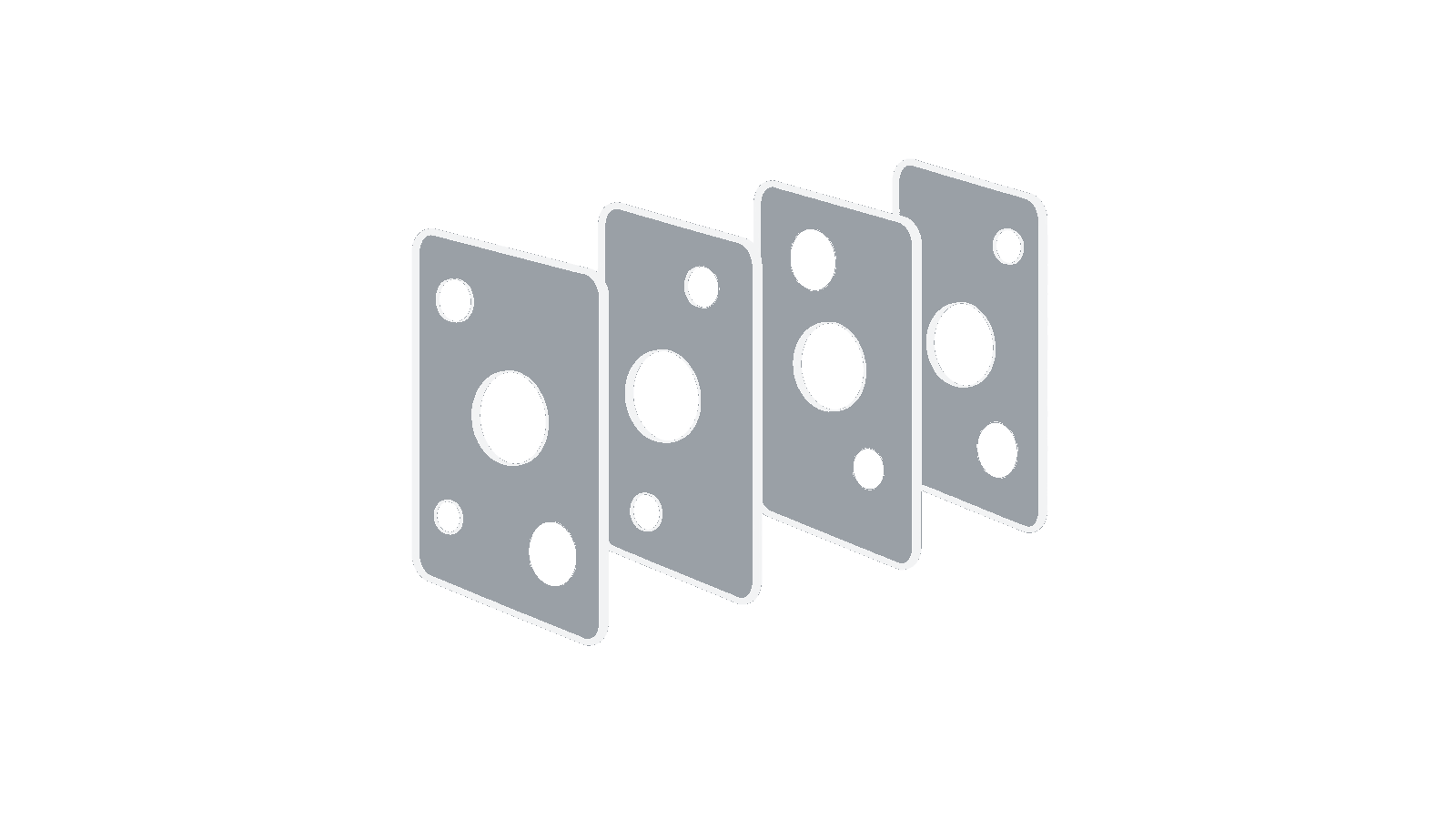
| Swiss cheese Reason | The system has successive layers of defence, each with holes. The accident occurs when the holes line up. The holes move continuously. |
| SHELL | The human at the centre, interacting with Software (procedures, documentation), Hardware, Environment and other Liveware. Errors arise at the interfaces (Fig. 1.2). |
| Rasmussen | Three levels of behaviour: skill-based, rule-based and knowledge-based. Each level has its own type of error. |
1.4 Types of error
040 03 02 04: Error generation
| Type | Definition | Example |
|---|---|---|
| Mistake | The intention is wrong, the action matches the intention | Shutting down a serviceable engine |
| Slip | The intention is right, the execution is wrong | Selecting the flap lever instead of the gear lever |
| Lapse, omission | A planned action is not carried out | Skipping a checklist item |
| Commission | An unplanned action is carried out | Taking off without clearance |
| Substitution | A correct action is replaced by another | Selecting the wrong frequency |
| Design-induced | Poor flight deck or system ergonomics | Two identical selectors side by side |
| Operator-induced | Inadequate human performance | Lack of system knowledge, misinterpretation |
| By regularity | Characteristic |
|---|---|
| Sporadic | Isolated, with no repeating pattern |
| Random | Unpredictable, with no identifiable cause |
| Systematic | Reproducible, linked to a defective procedure or design. The easiest to correct once identified. |
1.5 Safety culture
040 01 04: Safety culture
| Concept | Content |
|---|---|
| Open culture | Information flows, errors are reported and analysed, management can be questioned. |
| Closed culture | Information is withheld, errors are hidden for fear of sanction, hierarchy is not challenged. |
| Just culture | Honest errors are not punished, but wilful negligence and deliberate violation remain so. |
| Non-punitive culture | No sanction at all, whatever the fault. This is not just culture and it is not the model sought. |